
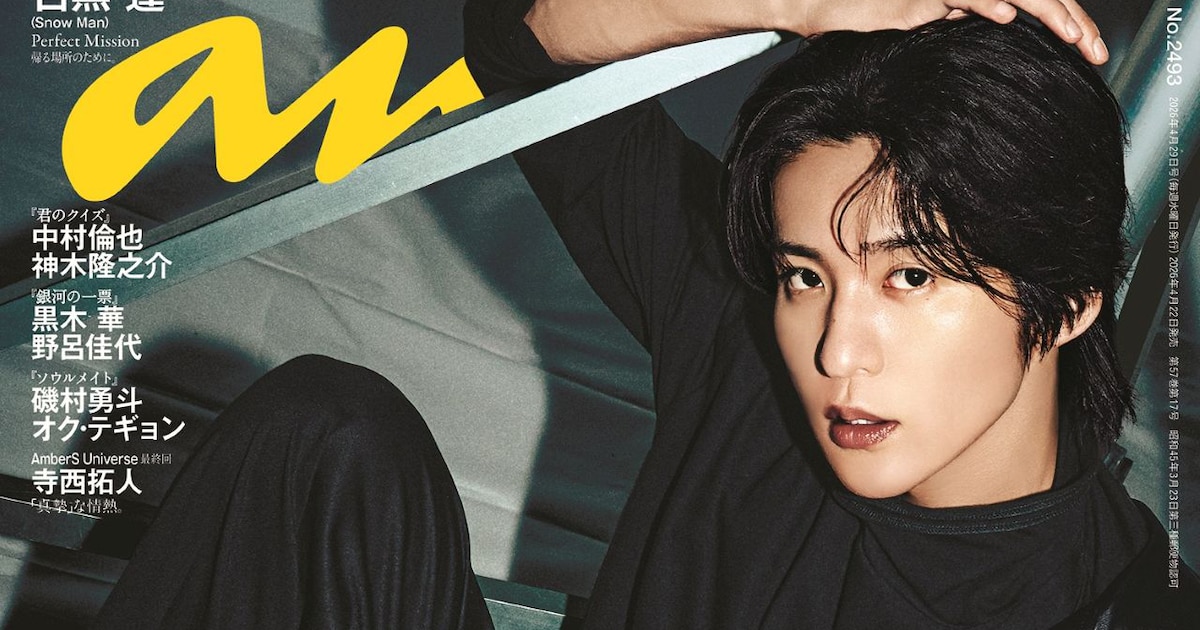
On April 22, 2026, Snow Man’s Meguro Ren will appear solo on the cover of anan magazine issue 2493—bringing to life the striking 二面性 (nimen-sei, duality) of Sakamoto Taro, the hero of the upcoming live-action film SAKAMOTO DAYS.
The issue, themed “ジャパンエンタメの現在地 2026” (“The Current State of Japan Entertainment 2026”), highlights the energy of Japan’s entertainment industry—and Meguro’s transformation into two very different versions of one man is at its center.
From Legendary Hitman to Gentle Family Man
SAKAMOTO DAYS is based on the manga of the same name by Suzuki Yuto. The story follows Sakamoto Taro, a once-feared hitman who 引退 (intai, retires) from the underworld after getting married. Marriage becomes the turning point—結婚をきっかけに (kekkon o kikkake ni, triggered by marriage)—that leads him to leave his life of crime behind and embrace peaceful family days.
This grammar pattern 〜をきっかけに means “taking the opportunity of” or “triggered by.” In this case:
- 結婚をきっかけに、殺し屋を引退した。 Kekkon o kikkake ni, koroshiya o intai shita. “He retired from being a hitman after getting married.”
The film is directed and written by Fukuda Yuichi, known for the Gintama series. Meguro plays Sakamoto, alongside a large ensemble cast including Takahashi Fumiya, Ueto Aya, Kitamura Takumi, and many others. The movie opens in Japan on April 29, 2026.
Expressing Duality on the anan Cover
The anan photoshoot visually captures Sakamoto’s dramatic contrast—his past and present selves.
The Former Sakamoto: Dangerous and Alluring
In scenes inspired by “the former Sakamoto,” Meguro embodies a man living in the criminal underworld. Wearing a heavy black leather long coat, gloves, and glasses, he stands under red lighting. He dramatically 翻す (hirugaesu, flings or flips) his coat and even removes his gloves with his mouth.
The poses are described as radiating an almost untouchable 色気 (iroke, sex appeal or allure). The styling and lighting emphasize a cold, dangerous aura—a man you wouldn’t dare approach.
Notice how visual storytelling plays a major role here. Without changing the actor, costume, color, and body language create an entirely different presence.
The Retired Sakamoto: Calm and Gentle
In contrast, the second set of images imagines Sakamoto after retirement. Now a devoted husband and father, he spends 穏やか (odayaka, calm and peaceful) moments with his loved ones.
Green and yellow serve as key colors. Meguro appears in layered styling—a shirt and tie combined with a brown jumpsuit. We see him 腕まくり (udemakuri, rolling up his sleeves), and watering houseplants with a gentle expression. In another shot, he holds a bouquet made of yellow flowers, revealing what the magazine calls his “pure and straightforward side.”
The transformation is striking. The same character, the same actor—but completely different energy. This is 二面性 in action.
Meguro’s Personal Reflections
In the interview, Meguro shares that in the past he often approached his work wanting to communicate something “for someone watching.” This time, however, he wanted to appear in the film “for himself.”
He also discusses moments from filming, the everyday scenes he wants to protect, and his own thoughts on what “strength” and “kindness” mean.
The issue aims to 迫る (semaru, draw near to or approach) the excitement of “Japan Entertainment 2026” through interviews with actors and creators. Other featured artists include Nakamura Tomoya and Kamiki Ryunosuke (Kimi no Quiz), Isomura Hayato and Ok Taec-yeon (Netflix’s Soulmate), and Kuroki Haru and Noro Kayo (Ginga no Ippyo). The magazine also includes spot guides to cultural attractions such as Uzumasa Eigamura and Sanrio Puroland.
Cultural Context: Why anan Covers Matter
anan is one of Japan’s most influential lifestyle and culture magazines, especially known for its stylish, often bold cover shoots. Appearing solo on the cover is a major milestone for idols and actors alike.
For a member of Snow Man—a hugely popular idol group—this kind of feature highlights not just star power, but acting credibility. By focusing on 二面性, the magazine positions Meguro not simply as an idol, but as a serious actor capable of emotional and visual range.
Learn Japanese from This Article
Let’s turn this entertainment news into a language lesson you can actually use.
Vocabulary
| Japanese | Romaji | Meaning |
|---|---|---|
| 二面性 | nimen-sei | duality; having two sides |
| 引退 | intai | retirement; stepping down |
| 穏やか | odayaka | calm; peaceful |
| 色気 | iroke | sex appeal; allure |
| 翻す | hirugaesu | to flip; to fling dramatically |
| 腕まくり | udemakuri | rolling up one’s sleeves |
| 迫る | semaru | to approach; to draw near |
Try making your own sentence:
- 彼は俳優としての二面性を見せた。 Kare wa haiyū to shite no nimen-sei o miseta. “He showed his duality as an actor.”
Grammar Spotlight ①: 〜をきっかけに
Structure: Noun + をきっかけに
Meaning: Triggered by; taking the opportunity of
Examples:
日本の映画をきっかけに、日本語を勉強し始めた。 Nihon no eiga o kikkake ni, nihongo o benkyō shi hajimeta. “I started studying Japanese after watching Japanese movies.”
留学をきっかけに、考え方が変わった。 Ryūgaku o kikkake ni, kangaekata ga kawatta. “Studying abroad changed my way of thinking.”
This pattern is extremely common in interviews when people talk about life-changing moments.
Grammar Spotlight ②: 〜ながら
Structure: Verb (stem form) + ながら
Meaning: While doing; during
Example inspired by the photoshoot:
- 赤いライトに照らされながら、ポーズを取った。 Akai raito ni terasare nagara, pōzu o totta. “He posed while being illuminated by red light.”
Another example:
- 音楽を聴きながら、雑誌を読んでいる。 Ongaku o kiki nagara, zasshi o yonde iru. “I’m reading a magazine while listening to music.”
Useful Expression
- 守りたい日常 (mamoritai nichijō) — “the everyday life I want to protect”
This phrase often appears in dramas and interviews, expressing emotional attachment to ordinary, peaceful moments.
Continue Learning
📚 Working on your reading skills? Our Katakana Essentials: Adapting Global Words to Japanese lesson is a great next step.
📚 Working on your reading skills? Our Introduction to Kanji: Pictorial Foundations of Japanese Script lesson is a great next step.
Introduction to Kanji: Pictorial Foundations of Japanese Script
📚 To understand more about entertainment, explore our Basic Vocabulary Building: Embracing Words Without Latin Ties lesson.
Basic Vocabulary Building: Embracing Words Without Latin Ties
これからもよろしくお願いします。 Kore kara mo yoroshiku onegaishimasu.