
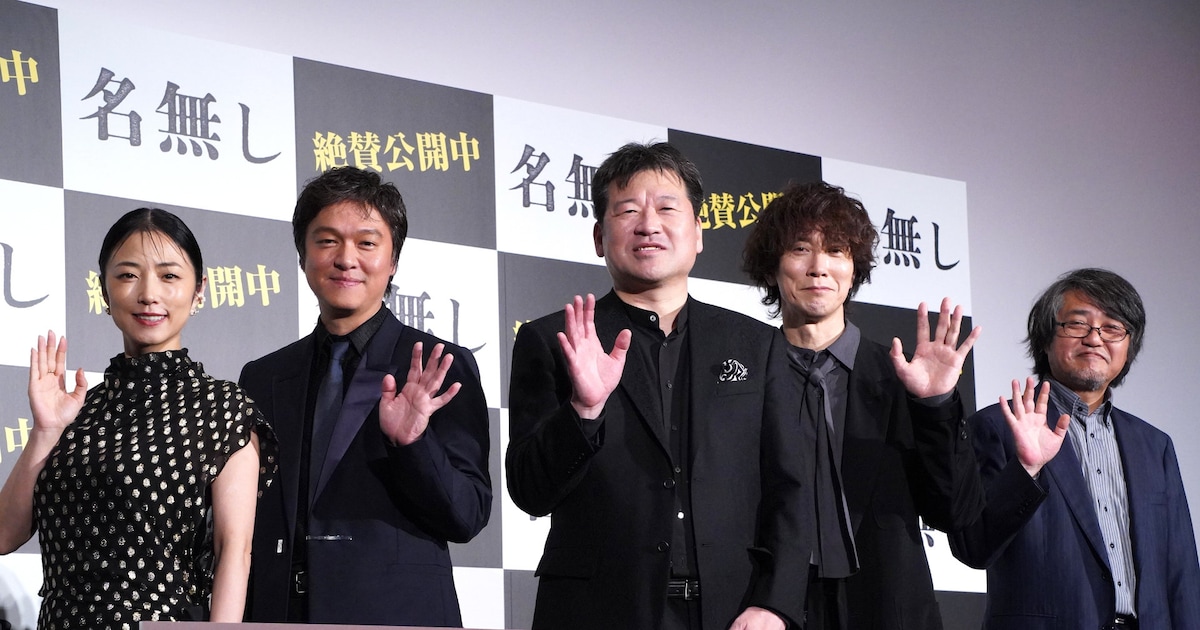
On May 23, 2026, the cast of the film 「名無し」 (Nanashi, “Nameless”) gathered at TOHO Cinemas Roppongi Hills in Tokyo for a public premiere event—and the mood shifted constantly between laughter and talk of madness, identity, and the power of names.
The event was a 公開記念舞台挨拶 (koukai kinen butai aisatsu)—a special stage greeting held to celebrate a film’s release. Appearing on stage, or 登壇する (toudan suru), were original author, screenwriter, and lead actor Sato Jiro, along with co-stars Maruyama Ryuhei (of SUPER EIGHT), MEGUMI, Sasaki Kuranosuke, and director Jōjō Hideo.
A “Nameless Monster” Comes to Life
「名無し」 centers on a random mass killing at a family restaurant in broad daylight. Security cameras capture a middle-aged man suspected of the crime. In the film, he is portrayed as a “nameless monster,” a man burdened with a strange fate—torn between hope, despair, and 狂気 (kyouki, madness).
Sato Jiro plays Yamada Taro, also known as “Nameless,” a man with hidden power in his right hand. Maruyama plays Teruo, the police officer who gives him his name. MEGUMI portrays Yamada Hanako, who grew up in the same children’s home as Taro. Sasaki plays Detective Kunieda, who races to stop Yamada’s rampage 〜べく (beku, “in order to”).
Sato revealed that he first conceived the story five years ago while watching families play in a park in Futako-Tamagawa. Reflecting on the film’s release, he said it was deeply moving to see the project reach audiences with the help of many professionals.
When asked about audience reactions, Sato jokingly admitted he still doesn’t know the difference between a hashtag and a sharp sign, playfully おどける (odokeru, joking around). He shared that one comment stood out to him: a viewer said they watched Taro’s violent act and the chaos that followed “as if it were a fire on the other side of the river”—in other words, from a detached perspective.
Sato responded that perhaps that’s fine. After finishing the film, he said, he hopes viewers will go home wanting to hug someone important—“a loved one, your dog or cat… even your plastic models or 推しグッズ (oshi guzzu, merchandise of your favorite idol or character).” Realizing this sounded like a closing speech, he laughed in an お茶目 (ochame, playfully cheeky) way: “Ah, I should’ve saved that for the final greeting!”
Comedy, Madness, and Sharp Comebacks
Though the film deals with dark themes, the stage event was full of humor.
Maruyama reflected that people grow up in different environments, and he thinks there may be viewers who find parts of the story overlapping with their own lives: 「重なる部分がある人もいるのではないかと思います」 (Kasanaru bubun ga aru hito mo iru no de wa nai ka to omoimasu.) — “I think there may be people who feel some parts overlap with their own experiences.”
MEGUMI recalled filming a love scene with Sato. They had joked about making it “the dirtiest love scene in Japanese film history,” and she laughed that audience members described it as “truly dirty,” meaning their intention came across.
When the MC asked the audience, “How was it?” both Sato and MEGUMI immediately responded with comedic ツッコミ (tsukkomi, sharp retorts pointing out something odd). “What do you mean, ‘How was it?’” Sato shot back, while MEGUMI added, “It’s not exactly something you applaud for!” The exchange reflects Japan’s manzai-style comedy tradition, where quick verbal reactions are key.
Sasaki addressed the public reaction to Sato taking on a frightening role. Some people were surprised, saying, “Sato-san is playing a scary character?” Sasaki, however, felt differently. He pointed out that Sato has portrayed characters with elements of 狂気 (kyouki) for 25 years, and that for him, comedy and seriousness exist on the same level.
Director Jōjō shared that his own son watched the film and compared it to “The Texas Chain Saw Massacre,” calling it interesting. Jōjō laughed and said he thought, “You really understand movies!” He also admitted that since the character’s name is Taro, filming felt complicated for him personally.
The Power of Naming
The conversation turned to the theme of naming—an especially meaningful topic given the film’s title, 「名無し」 (“Nameless”).
Maruyama shared that when his group changed its name to SUPER EIGHT, it became a major turning point in his life. Because the name is something shared with fans, the members gathered in front of a whiteboard for days to discuss it. As they’ve become active individually in different fields, opportunities to sit down together were rare—mostly limited to concert meetings. He felt the discussion strengthened their 絆 (kizuna, bonds) as a group.
Sato responded warmly: “That’s a great story! Naming is important.”
MEGUMI then revealed her own 고민: how long should she continue using her stage name written in Roman letters? Seeing “MEGUMI” in the end credits feels slightly uncomfortable to her. Maruyama joked that it sounds “worldwide,” but she said that as a Japanese person, she sometimes wishes for a surname. Maruyama even proposed a strikingly Japanese name: 「杜若めぐみ」 (Kakitsubata Megumi), suggesting it would leave a strong impression.
Acting Without Words
Maruyama also praised Sato’s performance, especially moments where Yamada’s true identity feels unknowable. “You can’t see the depths of his eyes—that’s what made him a monster,” he said.
MEGUMI noted that although the role has very few lines, Sato’s presence was powerful. Sato explained that in his 2025 film 「爆弾」 (Bakudan), he played a very talkative character. In discussions with director Jōjō, he wondered whether, this time, it might be better not to speak much. For one key line he absolutely had to deliver, he imagined that after years of not speaking, his vocal cords would sound dry and worn.
「名無し」 opened nationwide on May 22, 2026.
Cultural Context: What Is a 舞台挨拶?
In Japan, a 舞台挨拶 (butai aisatsu) is a special appearance by cast and staff at a theater, usually on opening day. Unlike Western red carpets, these events often happen inside the cinema auditorium itself. Actors greet the audience, share behind-the-scenes stories, and sometimes respond spontaneously—leading to playful ツッコミ moments like the ones seen here.
These events reflect a strong sense of connection between creators and viewers. Just as Maruyama described naming his group as something shared with fans, films in Japan often emphasize that same shared emotional space.
Learn Japanese from This Article
Key Vocabulary
| Japanese | Romaji | Meaning |
|---|---|---|
| 舞台挨拶 | butai aisatsu | stage greeting at a premiere |
| 登壇する | toudan suru | to take the stage |
| 狂気 | kyouki | madness, insanity |
| おどける | odokeru | to joke around |
| お茶目 | ochame | playfully cheeky |
| ツッコミ | tsukkomi | comedic retort |
| 絆 | kizuna | bond, connection |
| 推しグッズ | oshi guzzu | merchandise of your favorite idol/character |
Grammar Spotlight 1: 〜べく (In Order To)
Pattern: Verb (dictionary form) + べく
This is a formal, written-style expression meaning “in order to” or “for the purpose of.”
Example from the article:
- 暴走を止めるべく奔走する。 Bousou o tomeru beku honsou suru. He runs around frantically in order to stop the rampage.
More examples:
成功するべく努力する。 Seikou suru beku doryoku suru. I make efforts in order to succeed.
真実を明らかにするべく調査する。 Shinjitsu o akiraka ni suru beku chousa suru. They investigate in order to clarify the truth.
You’ll often see this in news articles, novels, and speeches.
Grammar Spotlight 2: 〜のではないかと思う (I Think Maybe…)
Pattern: Clause + のではないかと思う
Used to express a thoughtful, slightly softened opinion: “I think that maybe…”
Example:
- 重なる部分がある人もいるのではないかと思います。 Kasanaru bubun ga aru hito mo iru no de wa nai ka to omoimasu. I think there may be people who find overlapping parts.
This structure is very common in interviews and formal speech because it avoids sounding too direct.
Useful Expression
- 対岸の火事 (taigan no kaji) — “a fire on the opposite shore.” It means seeing a problem as someone else’s issue, not your own.
Understanding idioms like this helps you grasp emotional nuance in Japanese storytelling.
Continue Learning
Want to strengthen your reading skills even more?
- Working on your reading skills? Our Introduction to Kanji: Pictorial Foundations of Japanese Script lesson is a great next step.
- Ready to dive deeper? Our lesson on Basic Vocabulary Building: Embracing Words Without Latin Ties will help you master these concepts.
- Working on your reading skills? Our Katakana Essentials: Adapting Global Words to Japanese lesson is a great next step.
Names carry weight. Whether it’s a “nameless monster,” a rebranded idol group, or a stage name written in Roman letters, Japanese storytelling often asks: what does it mean to give something a name?
As you continue learning Japanese, pay attention to the words people choose—and the emotions behind them.
これからもよろしくお願いします。 Kore kara mo yoroshiku onegaishimasu.