
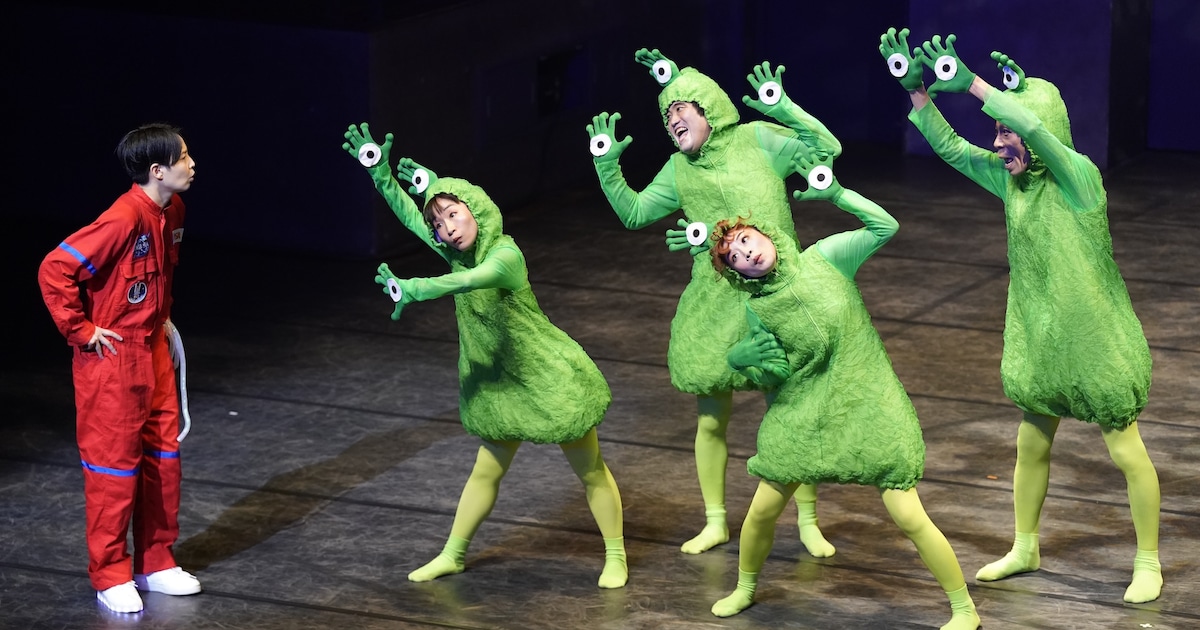
On April 4, 2026, it was announced that the “dancing picture book” version of Shinsuke Yoshitake’s 「みえるとか みえないとか」 (Mieru to ka Mienai to ka) will return to the stage for the first time in two years.
This special production—described as an “おどる絵本” (odoru ehon, a “dancing picture book”)—will be performed from July to September at venues across Japan, beginning at the Saitama Arts Theater.
A Picture Book That Dances
The original work, 「みえるとか みえないとか」 (Mieru to ka Mienai to ka), was written by popular author and illustrator Shinsuke Yoshitake and first adapted for the stage in 2024. Now, two years later, it is being restaged—what Japanese calls a 再演 (saien), meaning a revival performance.
The stage version is choreographed, structured, and directed by Takuro Suzuki of the dance company CHAiroiPLIN. In Japanese, we say he 作品を手がける (sakuhin o tegakeru)—he “handles” or is in charge of the production. Specifically, Suzuki is responsible for:
- 振付 (furitsuke) — choreography
- 構成 (kousei) — composition/structure
- 演出 (enshutsu) — direction
The story follows a narrator—an astronaut—who lands on a planet where the people have three eyes:
宇宙飛行士のぼくが降り立ったのは、目が3つある人の星で……。 Uchū hikōshi no boku ga oritatta no wa, me ga mittsu aru hito no hoshi de… “I, an astronaut, landed on a planet where the people have three eyes…”
From this imaginative premise, the performance explores perspectives, visibility, and difference—core themes of Yoshitake’s original picture book.
Cast and Performance Schedule
In addition to Suzuki, the cast includes Lala Kobayashi, So Aoi, Yukari Inaba, Yusaku Torigoe, Naoya Yamashita, and Satoshi Okuda. In Japanese, we can say:
出演者にはスズキのほか、…が名を連ねた。 Shutsuen-sha ni wa Suzuki no hoka, … ga na o tsuraneta. “In addition to Suzuki, … are listed among the performers.”
The expression 名を連ねる (na o tsuraneru) literally means “to line up names” and is often used in news articles to describe notable members of a cast or group.
Tour Dates (July–September 2026)
The production will be 上演される (jouen sareru), meaning “staged” or “performed,” at the following venues:
- July 18–19: Saitama Arts Theater (Small Hall), Saitama
- July 25: Kumagaya Cultural Creation Center Sakura Mate, Saitama
- August 1: Ota Civic Plaza (Large Hall), Tokyo
- August 5: iichiko Oto no Izumi Hall, Oita
- August 8: J:COM Kitakyushu Performing Arts Center (Middle Theater), Fukuoka
- August 12: Kumamoto Prefectural Theater (Drama Hall), Kumamoto
- August 16: Kobe Bunka Hall (Middle Hall), Hyogo
- August 20: Chigasaki Civic Cultural Center (Large Hall), Kanagawa
- September 5–6: Mito Arts Center ACM Theater, Ibaraki
Advance ticket sales (前売り, maeuri) for the Saitama performances begin at 10:00 a.m. on April 25.
There will also be a related dance workshop on July 15 at the Saitama Arts Theater, with Suzuki and others serving as instructors.
Cultural Context: From Picture Book to Performance
In Japan, picture books—絵本 (ehon)—are not just for small children. Many are deeply philosophical, exploring themes such as empathy, perspective, and social awareness. Shinsuke Yoshitake is known for works that gently question how we see the world.
Turning a picture book into a dance performance reflects Japan’s rich performing arts culture, where stories move fluidly between media: book, stage, and sometimes even animation. The phrase おどる絵本 (odoru ehon) captures this blend perfectly—keeping the heart of a picture book while expressing it through movement.
Learn Japanese from This Article
Key Vocabulary
| Japanese | Romaji | Meaning |
|---|---|---|
| 再演 | saien | revival performance; restaging |
| 上演 | jouen | to stage; to perform (a play) |
| 手がける | tegakeru | to handle; to be in charge of |
| 振付 | furitsuke | choreography |
| 名を連ねる | na o tsuraneru | to be listed among; to join a lineup |
| 前売り | maeuri | advance ticket sales |
| 〜ぶりに | ~buri ni | for the first time in (a period of time) |
Grammar Spotlight 1: 〜を手がける
Structure: Noun + を手がける
Meaning: to handle, to work on, or to be responsible for a project.
Example from this article:
スズキ拓朗が振付・構成・演出を手がける。 Suzuki Takurō ga furitsuke, kousei, enshutsu o tegakeru. “Takuro Suzuki handles the choreography, structure, and direction.”
You’ll often see this in news about films, plays, and creative projects.
Grammar Spotlight 2: 〜ぶりに
Structure: Time period + ぶりに
Meaning: for the first time in (that period).
Example:
2年ぶりに再演される。 Ni-nen buri ni saien sareru. “It will be restaged for the first time in two years.”
Other examples:
3年ぶりに日本に行きました。 San-nen buri ni Nihon ni ikimashita. “I went to Japan for the first time in three years.”
久しぶりに会いました。 Hisashiburi ni aimashita. “I met them for the first time in a while.”
Useful Expression: 〜が名を連ねる
Structure: Person/Group + が名を連ねる
Used in formal writing to describe people included in a list of notable participants.
有名な俳優がキャストに名を連ねた。 Yūmei na haiyū ga kyasuto ni na o tsuraneta. “Famous actors were listed among the cast.”
Working on reading these kinds of performance announcements? Recognizing kanji like 演, 振, and 再 becomes much easier once you understand their building blocks.
Continue Learning
- Working on your reading skills? Our Introduction to Kanji: Pictorial Foundations of Japanese Script lesson is a great next step.
- Ready to dive deeper? Our lesson on Basic Vocabulary Building: Embracing Words Without Latin Ties will help you master these concepts.
- Want help with loanwords like “ダンス” and “ワークショップ”? Check out Katakana Essentials: Adapting Global Words to Japanese.
Through stories like this, you’re not just learning vocabulary—you’re seeing how Japanese describes creativity, collaboration, and performance in the real world.
これからもよろしくお願いします。 Kore kara mo yoroshiku onegaishimasu.