
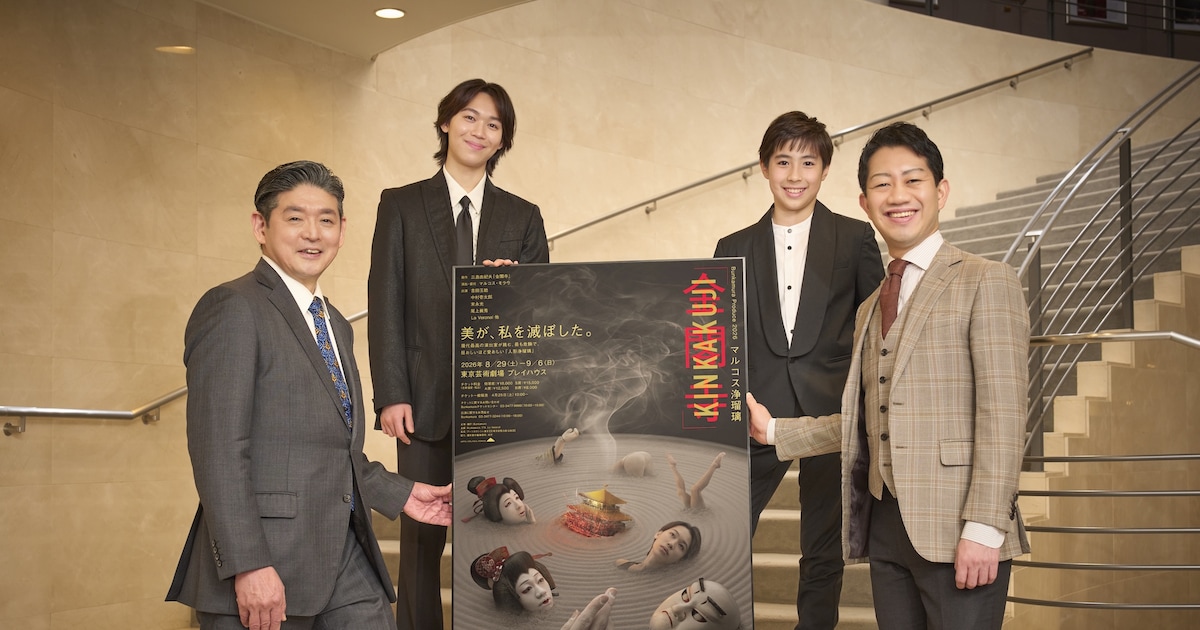
On May 13, 2026, cast members of Bunkamura Produce 2026 マルコス浄瑠璃「金閣寺」 gathered for a joint press interview—and their words made one thing clear: they’re ready for a bold, new challenge. The performers 意欲を見せる (iyoku o miseru, “showed enthusiasm”) as they prepare to bring a new kind of puppet theater to the stage.
This production reimagines Yukio Mishima’s novel The Temple of the Golden Pavilion through a collaboration between European director Marcos Morau and his company La Veronal, and Japan’s Bunkamura. The result? A performance that aims to create a “new puppet jōruri” by combining dancers and traditional Japanese puppets.
Let’s take a closer look—both at the production and the Japanese you can learn from it.
A European Director Meets Japanese Tradition
Marcos Morau is known for presenting works at the Paris Opera and the Avignon Festival. Now, he turns his attention to Mishima Yukio’s 「金閣寺」 (Kinkakuji, “The Temple of the Golden Pavilion”), bringing together contemporary dance and Japan’s classical puppet theater, 人形浄瑠璃 (ningyō jōruri).
At the press event were:
- 吉田玉助 (Yoshida Tamasuke)
- 中村壱太郎 (Nakamura Ichitarō)
- 末永光 (Suenaga Hikaru)
- 尾上眞秀 (Onoe Maho)
When asked about their impressions of Morau, Yoshida Tamasuke recalled their first meeting:
「すごく感性の強い感じの方だなと思いました、というのが第一印象です。」 Sugoku kansei no tsuyoi kanji no kata da na to omoimashita, to iu no ga daiichi inshō desu. “My first impression was that he’s someone with very strong sensitivity.”
That phrase 〜というのが第一印象 (~to iu no ga daiichi inshō) is a useful pattern meaning “My first impression was that…”
Suenaga Hikaru described Morau’s movement as something beyond genre:
「本当にマルコスというジャンルの動きだなと感じました。」 Hontō ni Marukosu to iu janru no ugoki da na to kanjimashita. “I felt it was truly movement that belongs to a genre called ‘Marcos.’”
Meanwhile, Ichitarō and Maho, who had yet to meet Morau at the time, listened with curiosity, wondering what kind of person he might be.
Workshops, Jealousy, and New Discoveries
Ahead of rehearsals—稽古に先がけて (keiko ni sakigakete, “prior to rehearsals”)—some of the cast participated in a ワークショップ (waakushoppu, workshop) led by Morau.
Tamasuke reflected on seeing contemporary dance up close:
「こんなの僕、できない!というのが第一印象(笑)。」 Konna no boku, dekinai! to iu no ga daiichi inshō (wara). “My first impression was, ‘There’s no way I can do this!’ (laughs)”
He noted that although Morau said, 「自分はダンサーではない」 (Jibun wa dansā de wa nai, “I’m not a dancer”), he moved with surprising intensity.
In a touching moment, Tamasuke revealed he felt 嫉妬 (shitto, jealousy) toward the 17-year-old Suenaga’s physical ability:
「末永さんに嫉妬を覚えて、絶対にがんばるぞ!と思いました。」 Suenaga-san ni shitto o oboete, zettai ni ganbaru zo! to omoimashita. “I felt jealous of Suenaga and thought, ‘I’m absolutely going to give it my all!’”
Suenaga himself admitted the movements were unfamiliar and demanding. He later 振り返る (furikaeru, reflect back on*) the experience, explaining that Morau reassured them:
「それぞれのいつもの役割から離れる必要はない、無理にいつもと違うことはしなくていい。」 Sorezore no itsumo no yakuwari kara hanareru hitsuyō wa nai, muri ni itsumo to chigau koto wa shinakute ii. “There’s no need to step away from your usual role; you don’t have to force yourself to do something completely different.”
That reassurance eased their anxiety.
Puppets, Humans, and a Beautiful “Strangeness”
Another fascinating discussion centered on the collaboration between puppets and human performers.
Ichitarō explained that Morau had been researching the concept of “the puppet,” focusing on both Bunraku puppets and kabuki-style puppet movements. During a session, he demonstrated movements close to Bunraku choreography.
He pointed out something important:
Because puppets and humans have completely different proportions, their co-performance may seem strange at first.
That sense of strangeness is expressed in Japanese as 違和感 (iwakan), a feeling of discomfort or incongruity. But Ichitarō suggested that this 違和感 can become something beautiful and artistically powerful.
This idea—transforming discomfort into beauty—connects directly to Mishima’s novel.
Mishima’s “Kinkakuji” and the Danger of Beauty
Mishima Yukio’s Kinkakuji is the foundation of this production. The novel’s protagonist, Mizoguchi, becomes obsessed with the beauty of the Golden Pavilion.
Tamasuke remarked:
「『金閣寺』には三島由紀夫の人生そのものが入っているような感じがします。」 “It feels as though Mishima’s entire life is contained within ‘Kinkakuji.’”
Ichitarō reflected on the novel’s theme of beauty crossing a line:
When beauty goes beyond a certain point, it can awaken the urge to destroy it.
Suenaga admitted the original novel was extremely difficult to read, but he connected with its core idea—that beauty can become overwhelming, even dangerous.
Maho simply said:
「美しさを強く感じました。」 Utsukushisa o tsuyoku kanjimashita. “I strongly felt its beauty.”
Their comments suggest that this production will not merely “show” Kinkakuji, but digest both the novel and Mishima’s life to create something new.
Cultural Context: What Is “Ningyō Jōruri”?
人形浄瑠璃 (ningyō jōruri) is traditional Japanese puppet theater, most famously represented by 文楽 (bunraku). Large puppets are operated by visible puppeteers, accompanied by chanting and shamisen music.
By blending this centuries-old art with contemporary European dance, Morau and the cast are attempting what they call a “new puppet jōruri.” It’s a meeting of:
- Classical Japanese aesthetics
- Modern physical expression
- Mishima’s philosophical exploration of beauty
For learners of Japanese, this kind of collaboration shows how tradition in Japan is not static—it evolves.
Learn Japanese from This Article
Vocabulary
| Japanese | Romaji | Meaning |
|---|---|---|
| 意欲を見せる | iyoku o miseru | to show enthusiasm |
| 稽古 | keiko | rehearsal, practice |
| ワークショップ | waakushoppu | workshop |
| 嫉妬 | shitto | jealousy |
| 違和感 | iwakan | sense of discomfort, strangeness |
| 振り返る | furikaeru | to look back on, reflect |
| 〜に先がけて | ~ni sakigakete | ahead of, prior to |
Grammar Spotlight
1️⃣ 〜というのが第一印象
“My first impression was that…”
Structure: Plain clause + というのが第一印象
Example:
- すごく感性の強い方だなというのが第一印象です。 Sugoku kansei no tsuyoi kata da na to iu no ga daiichi inshō desu. My first impression was that he’s very sensitive.
This pattern is very natural in interviews and conversations.
2️⃣ 〜わけですが
A soft explanatory phrase meaning “so…” or “the situation is that…”
It adds nuance and context, often before expanding on a point.
Example (adapted):
- 人形と人間では等身が違うわけですが、その違和感が面白い。 Ningyō to ningen de wa tōshin ga chigau wake desu ga, sono iwakan ga omoshiroi. Puppets and humans have different proportions, so that sense of strangeness becomes interesting.
You’ll hear わけですが frequently in interviews and formal speech.
Useful Expression
- 絶対にがんばるぞ! Zettai ni ganbaru zo! “I’m absolutely going to do my best!”
This kind of determined self-encouragement is common in Japanese media interviews.
Continue Learning
Working on your reading skills? These lessons will help you go deeper:
- Katakana Essentials: Adapting Global Words to Japanese
- Introduction to Kanji: Pictorial Foundations of Japanese Script
- Basic Vocabulary Building: Embracing Words Without Latin Ties
Traditional puppets, contemporary dance, jealousy, beauty, and artistic risk—all of it comes together in this ambitious reimagining of Kinkakuji. For Japanese learners, it’s also a reminder that language, like theater, is something you practice, reflect on, and constantly reinvent.
これからもよろしくお願いします。 Kore kara mo yoroshiku onegaishimasu.