
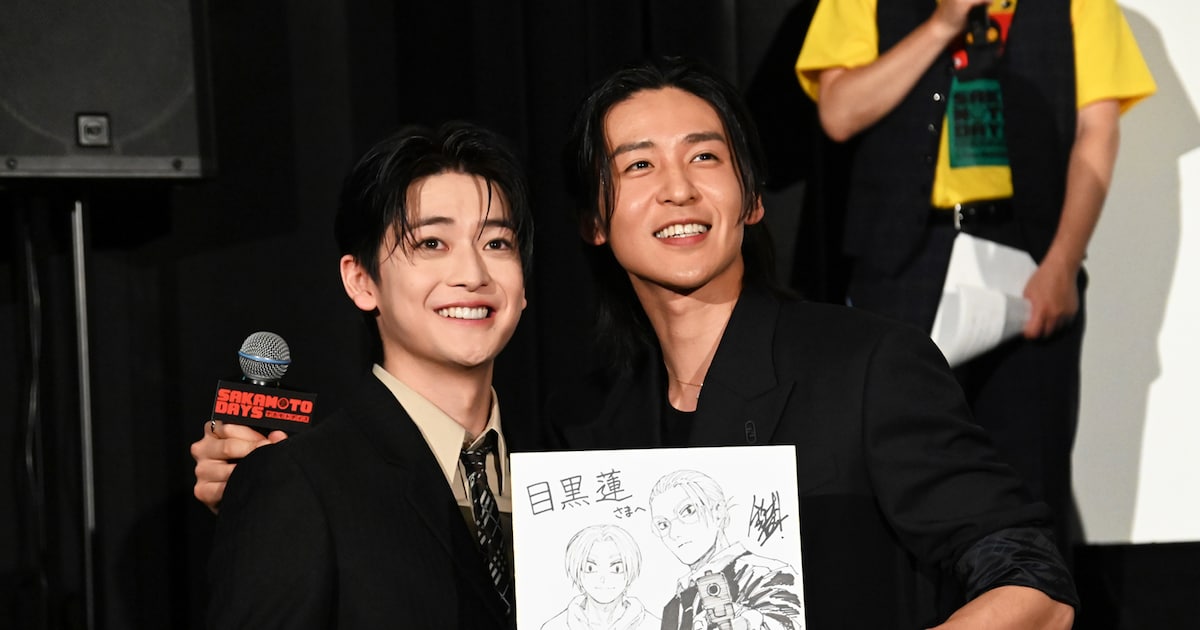
On April 29, 2026, the live-action film 「SAKAMOTO DAYS」 held its opening-day stage greeting at TOHO Cinemas Hibiya in Tokyo. Lead actor Ren Meguro of Snow Man appeared alongside co-stars Fumiya Takahashi, Aya Ueto, Mayu Yokota, Junki Tozuka, Miyu Yoshimoto, and director Yuichi Fukuda—marking the official launch of one of the year’s most talked-about 実写化 (jisshaka, live-action adaptations).
Early viewers were already calling it “the perfect live-action adaptation” and praising the バディ感 (badi-kan, buddy chemistry) between Meguro and Takahashi.
From Manga to Live-Action Action
Based on the manga by Yuto Suzuki, 「SAKAMOTO DAYS」 tells the story of legendary hitman Taro Sakamoto. He retires from assassination after getting married and begins living a peaceful family life.
But there’s a twist.
Sakamoto is now described as ふくよか (fukuyoka, pleasantly plump), almost unrecognizable from his former self. However, when a 1 billion yen bounty is placed on his head, that event becomes the trigger—賞金が懸けられたのを機に (shoukin ga kakerareta no o ki ni)—for enemies to start attacking him one after another.
Meguro plays Sakamoto, while Takahashi plays his partner Shin Asakura. Aya Ueto portrays Sakamoto’s beloved wife Aoi, and the rest of the cast fills out a colorful group of fighters and family members.
“Sakamoto, Isn’t It?!” — A Funny On-Set Memory
Meguro had just returned from Canada, where he was filming Season 2 of the drama “SHOGUN,” to attend the event. Smiling at the audience, he said he was happy to finally deliver the film directly to viewers.
When asked about memorable filming moments, he recalled a scene at Fuji-Q Highland amusement park where Aoi becomes furious—ブチギレる (buchigireru, to totally lose it).
Regular park guests were there at the time.
「通行人の方は坂本じゃん!ってなるんです。」 “People walking by would go, ‘That’s Sakamoto, isn’t it?!’”
The casual expression 〜じゃん (~jan) adds emphasis, like saying “See?” or “Right?” in English. It gives the sentence a natural, conversational feel.
Meguro also shared that someone in the crowd said, “I wish it were Ren Meguro instead!” Seeing that reaction while dressed as “plump Sakamoto” made him laugh.
A Serious Bond — and Lots of Laughter
Takahashi reflected warmly on working with Meguro, saying they both enjoy having serious conversations and talked often during filming. Their strong バディ感 (badi-kan) clearly translated to the screen.
Aya Ueto revealed she tried to make Meguro laugh on purpose—even though his special makeup might come off if he laughed too much. Meguro jokingly protested that she kept trying to break his composure.
Another charming behind-the-scenes story involved an onigiri (rice ball) scene. Yokota described how Ueto taught young Miyu Yoshimoto to wet her hands before shaping the rice—but during filming, Yoshimoto used so much water her hands became びしょびしょ (bishobisho, soaking wet).
Meguro laughed and said he noticed immediately—but since it was made with love, he ate all the rice balls anyway.
Meanwhile, Junki Tozuka humorously acted as if he felt 疎外感 (sogaikan, left out) while listening to the “Sakamoto family” bonding stories, stepping away from the group and making the audience laugh.
“Thank You” for Every Cut
Near the end of the event, the cast discussed their personal “important rules.”
Meguro shared:
「本気で思ったことは言葉にしています。」 “If I truly feel something, I put it into words.”
He also said that if he decides not to say something, he doesn’t dwell on it. Expressing “I like you” and “thank you” is something he values deeply.
Director Fukuda revealed that Meguro said “ありがとうございました!” (“Thank you very much!”) after every single cut during filming. He commented that no other actor does that.
As a surprise, an original illustration drawn by manga creator Yuto Suzuki was presented to Meguro. Clearly moved, he said he had loved 「SAKAMOTO DAYS」 even before receiving the role and couldn’t believe he was able to play Sakamoto.
「自分のために出たいと思った映画です。」 “It’s a film I wanted to be in for myself.”
The movie is now showing nationwide in Japan.
Cultural Context: Stage Greetings in Japan
In Japan, it’s common for films to hold a 初日舞台挨拶 (shonichi butai aisatsu, opening-day stage greeting). Cast and directors 登壇する (toudan suru, appear on stage) to greet audiences, share behind-the-scenes stories, and build excitement.
These events create a direct connection between performers and fans—something Meguro specifically mentioned appreciating.
The emphasis on gratitude—saying “thank you” after every cut—also reflects a broader Japanese workplace value: acknowledging the group effort behind a project.
Learn Japanese from This Article
Key Vocabulary
| Japanese | Romaji | Meaning |
|---|---|---|
| 実写化 | jisshaka | live-action adaptation |
| バディ感 | badi-kan | buddy chemistry |
| ブチギレる | buchigireru | to totally lose it |
| ふくよか | fukuyoka | plump (polite expression) |
| 疎外感 | sogaikan | feeling left out |
| びしょびしょ | bishobisho | soaking wet |
| 登壇する | toudan suru | to appear on stage |
Grammar Spotlight
1️⃣ 〜のを機に (~no o ki ni)
Meaning: Taking (an event) as an opportunity; triggered by
Structure: Verb (dictionary/past) + のを機に
Example from the story: 賞金が懸けられたのを機に、刺客が襲ってくる。 Shoukin ga kakerareta no o ki ni, shikaku ga osotte kuru. “Taking the bounty as a trigger, assassins start attacking.”
You’ll often see this in news reports when describing turning points.
2️⃣ 〜じゃん (~jan)
Casual emphasis meaning “Isn’t it?” or “See?”
Example: 坂本じゃん! Sakamoto jan! “That’s Sakamoto, isn’t it?!”
Very common in casual speech, especially in Tokyo dialect.
Useful Expressions
- ありがとうございました! (Arigatou gozaimashita!) – Thank you very much (past tense, polite)
- 本気で思ったことは言葉にする。 (Honki de omotta koto wa kotoba ni suru.) – Put into words what you truly feel.
Notice how Japanese often omits “I” (私は). The subject is understood from context.
Continue Learning
To understand more about how dates like 2026年4月29日 work in Japanese—and why verbs don’t change for future tense—explore our lesson:
Mastering time expressions will make reading entertainment news much easier.
The live-action 「SAKAMOTO DAYS」 combines explosive action with heartfelt family moments—and just as much warmth behind the scenes as on screen. Through stories like this, you’re not only following Japanese entertainment news, you’re learning the language the way it’s actually used.
これからもよろしくお願いします。 Kore kara mo yoroshiku onegaishimasu.