
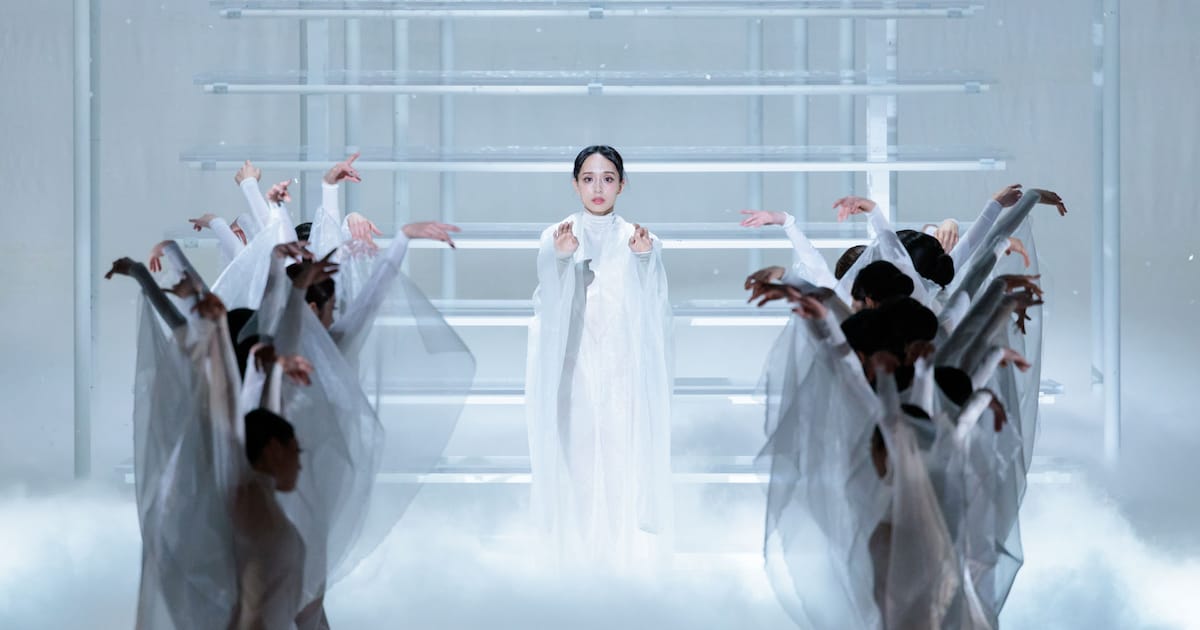
On May 5 and 6, 2026, the Tokyo Ballet’s production of 「かぐや姫」 (Kaguya-hime) was performed at Tokyo Bunka Kaikan—marking both the 閉幕 (heimaku, closing) of the production’s latest run and the venue’s final performances before its temporary 休館 (kyuukan, closure).
Directed, choreographed, and spatially designed by Kanamori Jo, this grand ballet reimagines one of Japan’s oldest tales, The Tale of the Bamboo Cutter (竹取物語, Taketori Monogatari), set to music by Claude Debussy.
A Japanese Classic, Elevated Through Ballet
This production did not appear all at once. Act I premiered in 2021, Act II followed in April 2023, and the full three-act version was completed in October 2023. Through this gradual process, the ballet reached its final form.
The story follows Princess Kaguya, a mysterious girl born from a glowing bamboo stalk. In the ballet, we see her experience love and loneliness, feel pain over human conflict, and ultimately return to the moon.
The production transforms what is traditionally a quiet, classical Japanese tale into a dazzling ballet work. The article describes how the modest atmosphere of a Japanese-style story was 昇華する (shouka suru, elevated or sublimated) into a brilliant stage production through Debussy’s music and Kanamori’s visual staging.
Scenes of nature created by green spirits and the otherworldly beings of light who descend to bring Kaguya back to the moon left a strong impression. With overseas performances already planned, anticipation is high for how international audiences will respond.
It has been announced that:
- Act I 〜ことが決まっている (koto ga kimatte iru, it has been decided that…) will be performed in Italy this December.
- The full three-act version will be staged at the Palais Garnier of the Paris Opera in May next year.
Rotating Cast and Passionate Performances
This run featured a 回替わり (mawarigawari, rotating cast depending on the performance date*) system for the main roles.
Kaguya-hime was performed by:
- Akiyama Akira (May 5, 1:00 PM and May 6)
- Adachi Maria (May 5, 6:30 PM and May 6)
Doji, an original character who falls in love with Kaguya-hime, was performed by:
- Otsuka Taku
- Tsukamoto Dan (depending on the performance)
On the opening day matinee, Akiyama gave a 熱演 (netsuen, passionate performance), portraying Kaguya with rich facial expression. In the Act I pas de deux set to Debussy’s “Clair de Lune” (月の光, Tsuki no Hikari), she and Otsuka delicately expressed the shared loneliness that draws their characters together.
Other cast members included:
- Oki Kanako and Kaneko Hitomi as Kage-hime (the Emperor’s principal consort)
- Ikemoto Shoma and Ubukata Ryunosuke as the Emperor
- Okazaki Shunya as Okina (the old bamboo cutter)
Each brought strong presence to their roles, contributing to the emotional depth of the production.
A Farewell to Tokyo Bunka Kaikan
During the May 6 カーテンコール (kaaten kooru, curtain call), the audience received special news: with this performance 〜をもって (o motte, marking the point of…), Tokyo Bunka Kaikan would enter a period of temporary closure.
A subtitle displayed on stage read:
「3年後にまた会いましょう!」 San-nen go ni mata aimashou! “Let’s meet again in three years!”
For many audience members, the performance was not only the closing of a ballet run, but also a heartfelt goodbye to an important cultural venue.
Cultural Context: From Bamboo Tale to Global Stage
竹取物語 (Taketori Monogatari) is often considered the oldest surviving Japanese narrative, dating back to the Heian period (10th century). Nearly every Japanese child encounters this story in school.
By turning it into a Western-style grand ballet—complete with Debussy’s impressionist music—this production bridges Japanese literary heritage and European classical art. That balance between tradition and reinterpretation is a hallmark of modern Japanese performing arts.
The fact that the ballet will travel to Italy and France highlights how Japanese stories are increasingly shared on global stages—not just as folklore, but as high art.
Learn Japanese from This Article
Key Vocabulary
| Japanese | Romaji | Meaning |
|---|---|---|
| 上演 | jouen | stage performance; to perform (a play/ballet) |
| 閉幕 | heimaku | closing; curtain down |
| 休館 | kyuukan | temporary closure (of a facility) |
| 回替わり | mawarigawari | rotating cast depending on performance date |
| 熱演 | netsuen | passionate performance |
| 昇華する | shouka suru | to elevate; to sublimate into something higher |
| カーテンコール | kaaten kooru | curtain call |
Notice how many of these are commonly used in theater and entertainment news. If you enjoy reading about stage productions in Japanese, these words will appear again and again.
Grammar Spotlight
1️⃣ 〜をもって
Meaning: “With this as the point of…” (marks a concluding point)
Structure: Noun + をもって
Example from the article context: 本公演をもって東京文化会館が休館に入る。 Hon kouen o motte Tokyo Bunka Kaikan ga kyuukan ni hairu. “With this performance, Tokyo Bunka Kaikan enters its temporary closure.”
This expression is often used in formal announcements, especially for endings, retirements, or final events.
2️⃣ 〜ことが決まっている
Meaning: “It has been decided that…”
Structure: Clause (plain form) + ことが決まっている
Example: イタリアで第1幕が上演されることが決まっている。 Italia de dai-ichi-maku ga jouen sareru koto ga kimatte iru. “It has been decided that Act I will be performed in Italy.”
This pattern is common in news reports when announcing confirmed plans.
Useful Expression
3年後にまた会いましょう! San-nen go ni mata aimashou! “Let’s meet again in three years!”
A warm, forward-looking phrase. The volitional form 会いましょう (aimashou) expresses invitation or shared intention—“let’s.”
Continue Learning
Working on your reading skills? Our Introduction to Kanji: Pictorial Foundations of Japanese Script lesson is a great next step.
Want to learn more about entertainment vocabulary? Check out: Basic Vocabulary Building: Embracing Words Without Latin Ties
Curious about words like カーテンコール written in katakana? Katakana Essentials: Adapting Global Words to Japanese
A Japanese folktale, French music, a rotating cast, and a historic venue’s farewell—all woven together in one production. Reading news like this is one of the best ways to see how traditional culture and modern Japanese language meet in real life.
これからもよろしくお願いします。 Kore kara mo yoroshiku onegaishimasu.