
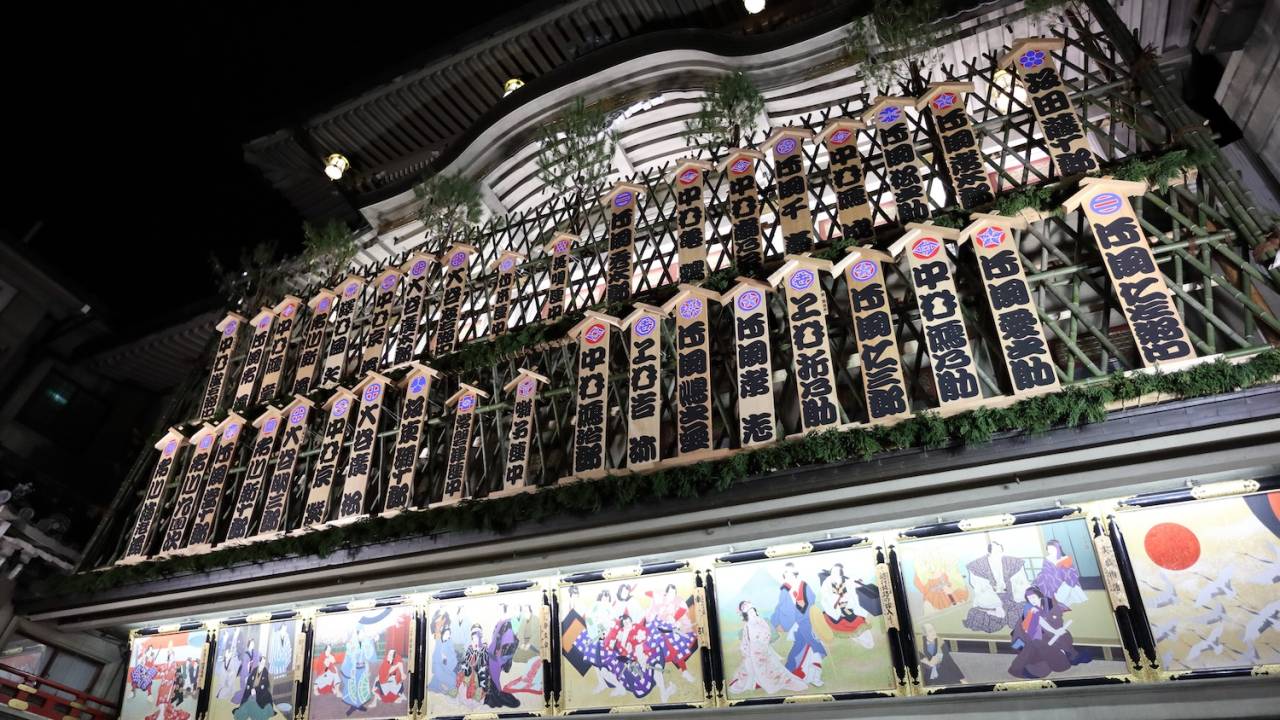
On November 27, 2026, Kyoto marked the coming of 師走 (shiwasu), the traditional name for December, with まねき上げ—the annual raising of theater signboards at Minamiza. As Christmas trees and winter illuminations begin to light up the city at the 年の瀬 (toshi no se), this event signals the 到来 (tourai), or arrival, of the year’s closing season in Kyoto.
The stage for the event is Minamiza, standing at the たもと (tamoto), or foot, of Shijō Bridge. According to Japaaan, this theater has watched over Kyoto from the same spot for more than 400 years.
Kyoto’s kabuki birthplace still stands
Kabuki’s roots are said to go back to かぶき踊り performed by Izumo no Okuni, and Kyoto is treated as its 発祥の地 (hasshou no chi), its place of origin. Even today, beside the front of Minamiza there is a monument marking the birthplace of kabuki, and a bronze statue of Izumo no Okuni stands by Shijō Bridge.
Minamiza is visible from that statue. Since it was founded in the Keichō era of the early Edo period, from 1596 to 1615, it has remained in the same place for about four centuries.
In the Keichō era, there were seven officially recognized playhouses under the shogunate. Over time, that number decreased after fires destroyed some theaters and as Kamigata kabuki’s center shifted to Osaka.
Why is it called Minamiza?
The name Minamiza naturally makes people wonder whether there was also a “Kitaza,” or North Theater. There was: Kitaza stood almost 真向かい (mamukai), directly opposite today’s Minamiza, and there was also a theater called Nishi, or West.
Of the original seven playhouses, Minami, Kita, and Nishi remained into the mid-Edo period. Later, Nishi burned down in 1794 and was not rebuilt. Kitaza closed in 1892 because Shijō Street was being widened. Only Minami still 現存する (genzon suru), meaning it remains in existence today.
Even so, the name Kitaza has not disappeared. In the area where the theater once stood, there is now a building bearing the Kitaza name, along with a stone marker for the former site.
That building now houses the Gion main store of Izutsu Yatsuhashi Honpo, known for one of Kyoto’s representative sweets, yatsuhashi. On the fifth floor, the Kitaza Gion Omoide Museum introduces the history and culture of Gion-chō. According to the Kyoto Prefecture tourism guide cited by the source, it displays belongings and works connected to figures such as the poet, novelist, and playwright Yoshii Isamu (1886–1960) and the novelist Tanizaki Jun’ichirō (1886–1965), as well as traditional hairstyles of Kyoto’s 舞妓 and 芸妓.
The old “North” still 息づく (ikizuku), still lives on, as a place where visitors can trace Kyoto’s performing arts history. Across the rainy Shijō Bridge, Minamiza remains the surviving theater that leads the way into Gion.
Learn Japanese from This Article
Vocabulary
| Japanese | Romaji | Meaning |
|---|---|---|
| 年の瀬 | toshi no se | year-end; the closing days of the year |
| 師走 | shiwasu | December (traditional name) |
| 到来 | tourai | arrival; advent |
| たもと | tamoto | foot/base of something; by the side of |
| 発祥の地 | hasshou no chi | birthplace; place of origin |
| 真向かい | mamukai | directly opposite; right across from |
| 現存する | genzon suru | to still exist; to remain in existence |
| 息づく | ikizuku | to live on; to breathe with life |
Grammar Spotlight
〜を期に
Meaning: taking ~ as an occasion; on the occasion of; after ~ as a turning point
From the article: しかし火事による消失、そして上方の歌舞伎の拠点が大阪に移っていったことを期に、だんだんとその数は少なくなっていきました。 Shikashi kaji ni yoru shōshitsu, soshite Kamigata no kabuki no kyoten ga Ōsaka ni utsutte itta koto o ki ni, dandan to sono kazu wa sukunaku natte ikimashita. However, after fires destroyed theaters and as the center of Kamigata kabuki moved to Osaka, their numbers gradually decreased.
Example: 留学を期に、日本の伝統芸能に興味を持ちました。 Ryūgaku o ki ni, Nihon no dentō geinō ni kyōmi o mochimashita. Studying abroad became the turning point that made me interested in Japan’s traditional performing arts.
Example: 京都旅行を期に、南座について調べ始めました。 Kyōto ryokō o ki ni, Minamiza ni tsuite shirabe hajimemashita. My trip to Kyoto became the occasion for me to start researching Minamiza.
How to use it: Use 〜を期に after a noun or noun phrase when one event becomes a turning point for change.
Useful Expressions
歌舞伎発祥の地 kabuki hasshou no chi the birthplace of kabuki
四条大橋のたもとに佇む Shijō Ōhashi no tamoto ni tatazumu standing at the foot of Shijō Bridge
真向かいにあった mamukai ni atta was directly opposite
名前は今も息づいている namae wa ima mo ikizuite iru the name still lives on today
これからもよろしくお願いします。 Kore kara mo yoroshiku onegaishimasu.