
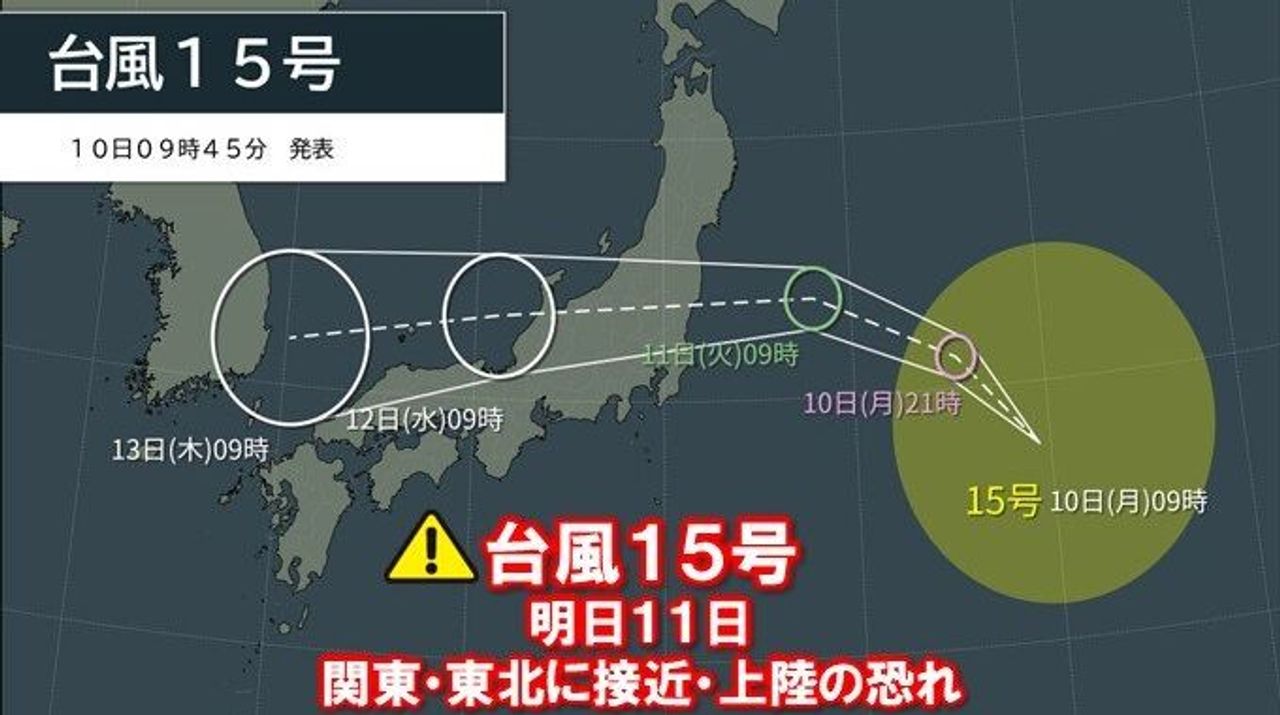
Typhoon No. 15 is expected to move very close to the Kanto and Tohoku regions on the 11th, with a risk of making landfall. Its path is described as unusual, approaching Honshu from the east and moving westward—an 異例 (irei) 進路 (shinro) that could bring heavy rain and strong winds.
Typhoon No. 15 Approaching Eastern Japan
According to the report, Typhoon No. 15 will 接近 (sekkin, approach) Kanto and Tohoku on August 11, with the possibility of 上陸 (jōriku, landfall). Because of its unusual course from the east toward western Honshu, forecasters warn of severe weather, especially heavy rain and violent winds in eastern Japan.
After affecting Kanto and Tohoku, the typhoon is also expected to move closer to the Hokuriku region. In news language, this kind of forecast is often expressed with the phrase 〜見込みです (~mikomi desu), meaning “it is expected that” or “it is forecast that.”
Travel Disruptions During Obon
This weather system is arriving during お盆休み (obon yasumi), the Obon holiday period. Obon is one of Japan’s major holiday seasons, when many people travel to their hometowns to honor their ancestors. Because travel increases dramatically during this time, the report urges people to watch for possible impacts on 交通機関 (kōtsū kikan, transportation systems).
Travelers are advised to check the latest typhoon information and pay attention to potential disruptions to trains, flights, and other forms of public transportation.
Cultural Context: Why Obon Matters
Obon usually takes place in mid-August and is a deeply rooted Buddhist-influenced tradition. Families return to ancestral homes, visit graves, and participate in community dances known as 盆踊り (bon odori, Bon dance).
Because so many people travel at once, roads, trains, and airports are often crowded even in normal conditions. When a typhoon approaches during Obon, the risk of disruption becomes much more serious. That’s why news reports specifically highlight the overlap with お盆休み (obon yasumi).
Understanding this cultural background helps you see why the article emphasizes transportation warnings.
Learn Japanese from This Article
Key Vocabulary
| Japanese | Romaji | Meaning |
|---|---|---|
| 接近 | sekkin | approach |
| 上陸 | jōriku | landfall (of a typhoon) |
| 異例 | irei | unusual, unprecedented |
| 進路 | shinro | course, route (of a storm) |
| 見込み | mikomi | outlook, forecast, expectation |
| 交通機関 | kōtsū kikan | transportation systems, public transport |
| お盆休み | obon yasumi | Obon holiday period |
Notice how many of these words are commonly used in weather reports. Learning them helps you understand real Japanese news.
Grammar Spotlight 1: 〜おそれがあります
Pattern: Verb (dictionary form) + おそれがあります
Meaning: There is a risk that… / There is a possibility that… This is formal language often used in news reports and official announcements.
Example from the article:
- 上陸するおそれがあります。 Jōriku suru osore ga arimasu. There is a risk that it will make landfall.
More examples:
大雨になるおそれがあります。 Ōame ni naru osore ga arimasu. There is a risk of heavy rain.
交通機関に影響が出るおそれがあります。 Kōtsū kikan ni eikyō ga deru osore ga arimasu. There is a possibility that transportation will be affected.
This expression sounds more cautious and official than simply saying “〜かもしれません” (~kamo shiremasen, might).
Grammar Spotlight 2: 〜見込みです
Pattern: Verb (plain form) + 見込みです
Meaning: It is expected that… / It is forecast that…
Example based on the article:
- 北陸にも接近する見込みです。 Hokuriku ni mo sekkin suru mikomi desu. It is expected to approach Hokuriku as well.
This structure is common in weather forecasts, economic reports, and official predictions.
Useful Expression
- 最新の台風情報を確認してください。 Saishin no taifū jōhō o kakunin shite kudasai. Please check the latest typhoon information.
You’ll often hear 確認してください (kakunin shite kudasai, please confirm/check) in announcements and safety advisories.
Continue Learning
To strengthen your reading skills and recognize words like 接近 and 進路 in real news:
- Reading and Writing in Japanese II: Hiragana and Katakana
- Introduction to Kanji: Pictorial Foundations of Japanese Script
- Basic Vocabulary Building: Embracing Words Without Latin Ties
Weather reports are an excellent way to learn practical, real-world Japanese. They use clear, formal structures and essential vocabulary that you’ll encounter again and again.
これからもよろしくお願いします。 Kore kara mo yoroshiku onegaishimasu.