
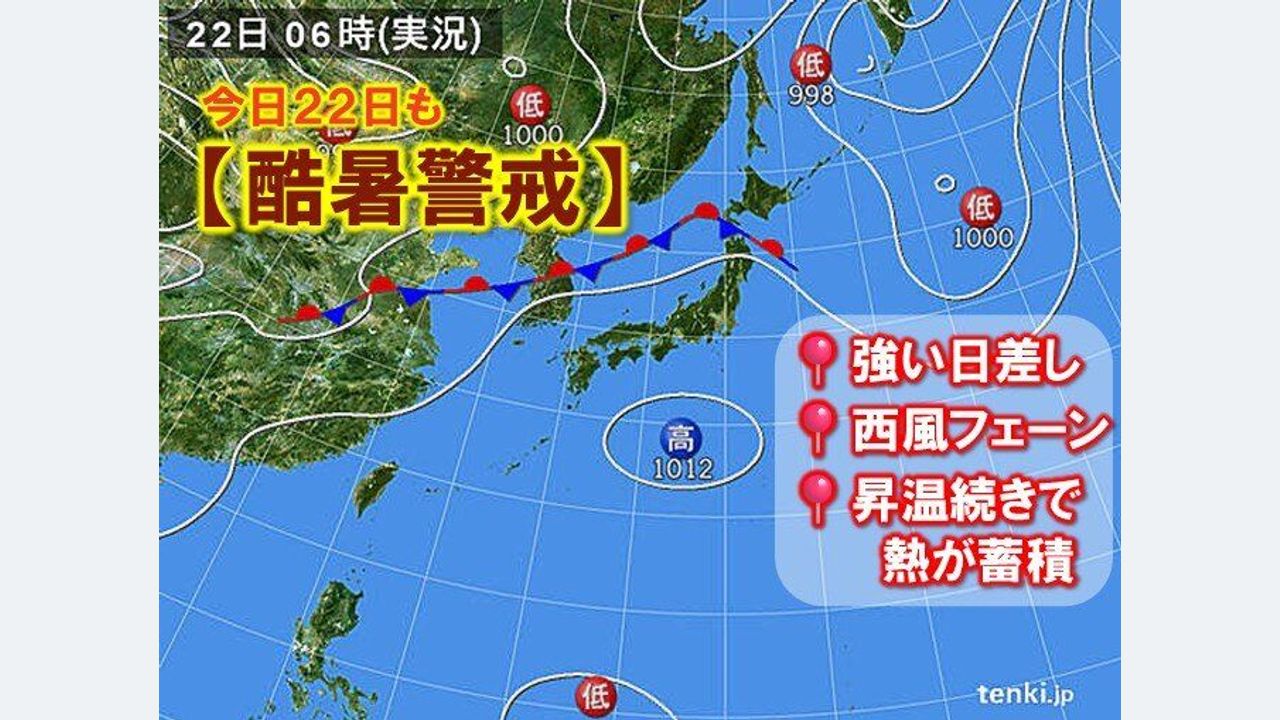
At 12:30 p.m. today, the temperature in Tenryū, Hamamatsu City, Shizuoka Prefecture reached 39.2°C. In Nagoya, it hit 39.0°C. Parts of Tokyo climbed above 38°C. Japan is facing what officials describe as 危険な暑さ (kiken na atsusa) — dangerous heat.
Record-Breaking Heat Across Japan
According to reports on the 22nd, the highest 気温 (kion, air temperature) recorded by early afternoon was 39.2°C in Tenryū, Hamamatsu City. Nagoya City 記録しました (kiroku shimashita, recorded) 39.0°C, approaching what is known as a 酷暑日 (kokusho-bi), an extremely hot day nearing the 40°C range.
Even within Tokyo — referred to in Japanese as 都内 (tonai, within Tokyo) — some areas exceeded 38°C.
The phrase often used in Japanese weather reports is:
- 気温が上がっている (kion ga agatte iru) — “the temperature is rising.”
The grammar pattern 〜ている (-te iru) here shows a continuing state. It’s not just that the temperature rose once; it is in the ongoing state of rising.
A Strong Warning Against Heatstroke
Authorities are urging people to avoid the heat and take strict precautions against 熱中症 (necchūshō, heatstroke).
The advice includes staying in rooms with 冷房 (reibō, air conditioning) and avoiding outdoor exposure.
In Japanese, you might hear:
- 冷房の効いた室内で過ごすなど、暑さを避けてください。 Reibō no kiita shitsunai de sugosu nado, atsusa o sakete kudasai. “Spend time in air-conditioned rooms, for example, and avoid the heat.”
Notice the use of 〜など (nado), meaning “such as” or “for example.” It gives one example (staying in air-conditioned rooms) without listing every possible precaution.
The warning also emphasizes:
- 熱中症に厳重に警戒してください。 Necchūshō ni genjū ni keikai shite kudasai. “Please be extremely cautious about heatstroke.”
The phrase 厳重に警戒する (genjū ni keikai suru) means “to be on strict alert.”
Cultural Context: Why Heat Warnings Matter in Japan
Japanese summers are known for high humidity and intense heat. Weather agencies and news outlets frequently use specific temperature benchmarks. A 酷暑日 (kokusho-bi) signals heat close to 40°C — a level that poses serious health risks.
Public announcements during extreme heat are direct and urgent. It’s common to hear repeated reminders about hydration, air conditioning use, and checking on vulnerable people. The language tends to be polite but firm, reflecting the importance of community awareness and safety.
Learn Japanese from This Article
Let’s break down key vocabulary and grammar you can use right away.
Key Vocabulary
| Japanese | Romaji | Meaning |
|---|---|---|
| 危険な暑さ | kiken na atsusa | dangerous heat |
| 気温 | kion | air temperature |
| 記録する | kiroku suru | to record; to set (a record) |
| 酷暑日 | kokusho-bi | extremely hot day (around 40°C level) |
| 都内 | tonai | within Tokyo |
| 冷房 | reibō | air conditioning (cooling) |
| 熱中症 | necchūshō | heatstroke |
Grammar Spotlight
1. 〜ている (Continuing State)
Structure: Verb (て-form) + いる
Used to describe an ongoing action or a continuing condition.
Example from the article:
- 気温が上がっている。 Kion ga agatte iru. “The temperature is rising.”
More examples:
- 雨が降っている。 Ame ga futte iru. “It is raining.”
- 風が強くなっている。 Kaze ga tsuyoku natte iru. “The wind is getting stronger.”
In weather reports, this form is extremely common.
2. 〜など (Such as; For Example)
Structure: Noun + など
Used to give a non-exhaustive example.
- 冷房の効いた室内で過ごすなど、暑さを避けてください。 Reibō no kiita shitsunai de sugosu nado, atsusa o sakete kudasai. “Spend time in air-conditioned rooms, for example, and avoid the heat.”
More examples:
- 水やお茶などを飲んでください。 Mizu ya ocha nado o nonde kudasai. “Drink water or tea, for example.”
It implies there are other options too.
Useful Expressions
〜を超えている (~ o koete iru) — “to exceed ~”
- 38℃を超えている。 San-jū hachi-do o koete iru. “It exceeds 38°C.”
厳重に警戒してください (genjū ni keikai shite kudasai) — “Please be extremely cautious.”
These are phrases you’ll frequently hear in Japanese news broadcasts.
Continue Learning
Ready to strengthen your reading skills?
- Reading and Writing in Japanese II: Hiragana and Katakana: Ready to dive deeper? Our lesson on Reading and Writing in Japanese II: Hiragana and Katakana will help you master these concepts.
- Introduction to Kanji: Pictorial Foundations of Japanese Script: Working on your reading skills? Our Introduction to Kanji: Pictorial Foundations of Japanese Script lesson is a great next step.
- Basic Vocabulary Building: Embracing Words Without Latin Ties: Curious about the Japanese used here? Our Basic Vocabulary Building: Embracing Words Without Latin Ties lesson covers this in depth.
Extreme heat vocabulary is practical, immediate Japanese — the kind you’ll actually hear on the news and in daily life. Mastering it brings you one step closer to understanding real Japanese as it’s spoken in Japan.
これからもよろしくお願いします。 Kore kara mo yoroshiku onegaishimasu.