
450人月。実質2カ月。 That’s how dramatically one Japanese company says generative AI transformed a seemingly impossible system overhaul.
At AWS Summit Japan 2026, held June 25–26 at Makuhari Messe, Ishii from Hitomairu (Tokyo’s Kita Ward) revealed how Kakuyasu—a century-old liquor distributor—used 生成AI (seisei AI, generative AI) to decode a 30-year-old 基幹システム (kikan shisutemu, mission-critical system). What would have taken an estimated 450 person-months by hand was reduced to about two months in practice.
Let’s look at what happened—and what Japanese you can learn from it.
A 30-Year-Old Core System No One Could Touch
Kakuyasu built its core system around 30 years ago using Visual Basic (now VB.NET) and Oracle databases. Over time, it was expanded again and again to fit the needs of liquor wholesaling.
By 2025, the system had become rigid. The company had grown dependent on outside ベンダー (bendaa, vendors) for maintenance. Internally, no one fully understood how it worked.
The article describes the system as having fallen into a state where it was:
- Untouchable
- Unreadable
- Unfixable
In Japanese, this kind of situation is often described using the grammar pattern 〜に陥る (〜ni ochiiru), meaning “to fall into (a negative state).” The system had effectively 硬直に陥った (kouchoku ni ochiitta) — fallen into paralysis.
Adding pressure, the company’s VMware contract would expire in July 2027. There was a deadline they couldn’t ignore.
A Company-Wide Transformation
The system renewal wasn’t just about IT.
In July 2025, the holding company changed its name from Kakuyasu Group to Hitomairu. The shift symbolized a deeper transformation: from “a company that delivers alcohol” to “a company that earns money by delivering.” In other words, from liquor wholesaler to logistics company.
Ishii described the project as:
“The first and last heart surgery to completely rebirth the company.”
He even called the name change a 背水の陣 (haisui no jin)—a “no retreat” strategy, like an army backed up against a river with no way out.
This wasn’t just a system update. It was corporate rebirth.
No Design Documents. Missing Code. 450 Person-Months.
When Ishii joined the project, he found:
- No design documents
- Some program code missing
- No environment to test under real production conditions
- 2,200 user screens
- 3,000 database tables
- 1,200 ストアドプロシージャ (sutoado puroshiija, stored procedures)
Even worse, critical business ロジック (rojikku, business logic)—such as price calculations, inventory valuation, credit management, and bottle return handling (a unique practice in the liquor industry)—was buried deep inside programs that no one could clearly see or extract.
A manual analysis was estimated at 450人月 (450 person-months). Ishii recalled:
“Even after one year, we wouldn’t even have a map. The deadline was two years away. We were on the verge of sinking.”
AI-Driven and Business-Driven: Two Wheels
The breakthrough came from combining two approaches:
1. AI-Driven Development
Using Amazon’s クラウド (kuraudo, cloud) platform AWS, the team ran Anthropic’s coding AI “Claude Code” on Amazon Bedrock.
The AI analyzed all 1,200 stored procedures and extracted six core business logics, including:
- Data movement between tables
- Inventory valuation
- Sales price calculations
- Credit calculations
- Inventory allocation
- Collection of empty containers (a liquor industry custom)
They also recreated the Oracle production environment on AWS to compare and verify behavior.
2. Business-Driven Development
Technology alone wasn’t enough.
The company gathered staff from sales, merchandising, stores, logistics, and accounting. They translated the AI’s technical analysis into real-world operational language.
They sorted through:
- Screens no longer used
- Screens that looked similar but served slightly different functions
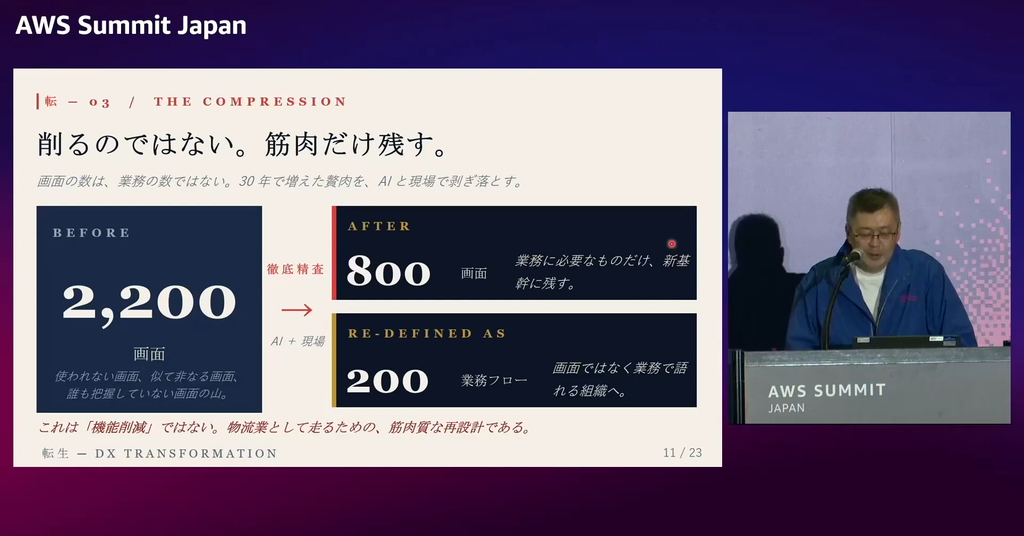
Out of 2,200 screens, they reduced the system to about 800 essential ones.
Ishii emphasized:
“This wasn’t feature reduction. It was a muscular redesign so we could run as a logistics company.”
And importantly:
“Neither AI alone nor the business teams alone could have moved forward. Only when the two wheels meshed did we make progress.”
Cultural Context: Why “Core Systems” Matter in Japan
In Japan, a 基幹システム (kikan shisutemu) often runs everything from accounting to inventory to logistics. Many were built decades ago during Japan’s economic growth period and expanded gradually.
Replacing them is famously difficult. Companies often delay リフレッシュ(刷新) (rifuresshu / sasshin, renewal or overhaul) because:
- The systems still technically “work”
- Documentation may be incomplete
- Business processes are tightly embedded in code
That’s why using 生成AI (seisei AI) to reverse-engineer business logic is attracting attention. It offers a new way to modernize without starting completely from scratch.
Learn Japanese from This Article
Key Vocabulary
| Japanese | Romaji | Meaning |
|---|---|---|
| 基幹システム | kikan shisutemu | mission-critical / core system |
| 生成AI | seisei AI | generative AI |
| ストアドプロシージャ | sutoado puroshiija | stored procedure |
| ベンダー | bendaa | vendor |
| クラウド | kuraudo | cloud (computing) |
| ロジック | rojikku | (business) logic |
| 刷新 | sasshin | renewal, overhaul |
| 背水の陣 | haisui no jin | do-or-die strategy |
Notice how many of these are written in katakana—especially tech terms. Japanese freely adapts global IT vocabulary into its own sound system.
Grammar Spotlight
1️⃣ 〜に陥る(おちいる)
Meaning: To fall into (a negative condition)
Pattern: Noun + に + 陥る
Example:
硬直状態に陥った。 kouchoku joutai ni ochiitta. It fell into a state of paralysis.
危機に陥る。 kiki ni ochiiru. To fall into crisis.
This expression is often used in news reports to describe serious situations.
2️⃣ 〜を余儀なくされる
Meaning: To be forced to do something
Pattern: Verb (dictionary form) + ことを余儀なくされる
Example:
- 刷新を余儀なくされた。 sasshin o yoginaku sareta. They were forced to carry out a renewal.
This formal expression frequently appears in business and political reporting.
Useful Expression
背水の陣(はいすいのじん)
Originally from Chinese military history, this idiom means placing yourself in a position with no escape—so you must succeed.
In business news, it often describes bold, high-stakes decisions.
Continue Learning
Working on your reading skills? Our Katakana Essentials: Adapting Global Words to Japanese lesson is a great next step.
Ready to dive deeper? Our lesson on Reading and Writing in Japanese II: Hiragana and Katakana will help you master these concepts.
Curious about broader vocabulary patterns? Explore Basic Vocabulary Building: Embracing Words Without Latin Ties.
A 30-year-old system once thought impossible to untangle was decoded in two months. For Japanese learners, this story isn’t just about AI—it’s a window into how Japanese companies talk about risk, renewal, and transformation.
And it gives you real-world business Japanese you’ll actually see in the news.
これからもよろしくお願いします。 Kore kara mo yoroshiku onegaishimasu.