
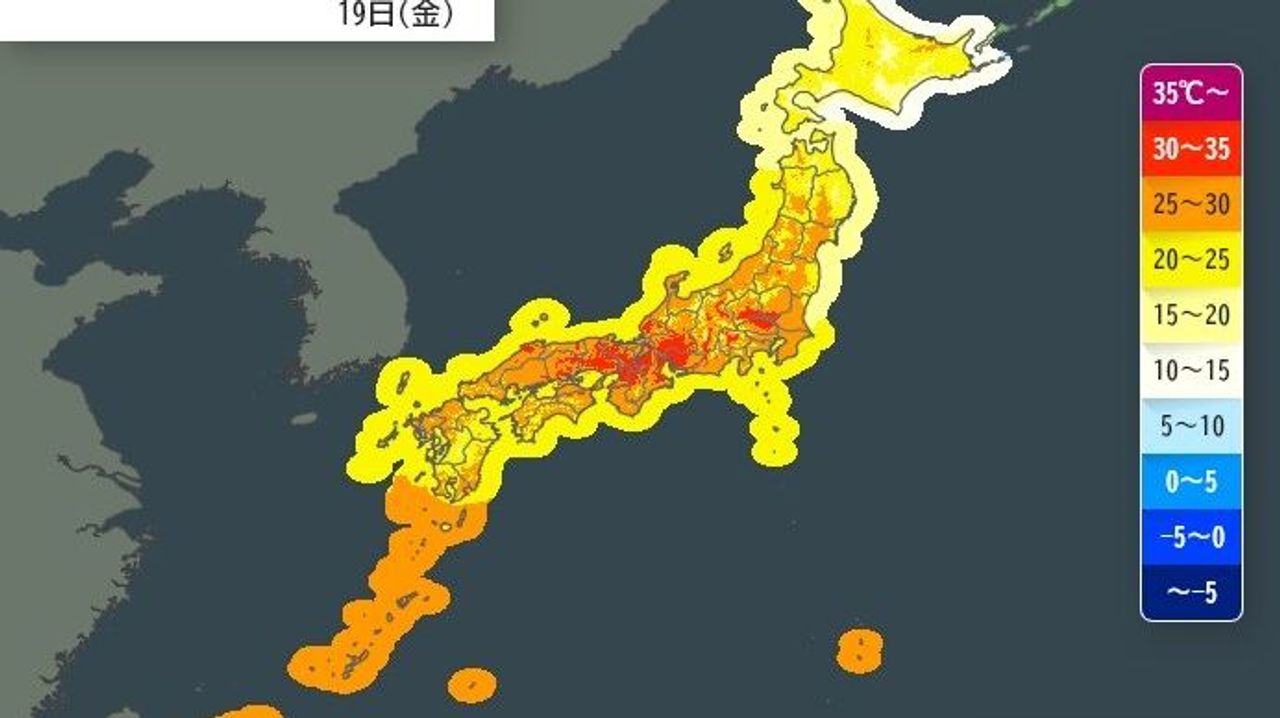
On Friday the 19th, clear skies are expected to spread mainly across the Kanto, Tokai, and Kinki regions, with strong sunlight beating down throughout the day.
According to the 予想 (yosō, forecast), 最高気温 (saikō kion, daily high temperature) will climb to 33°C in Nagoya City and 32°C in Osaka. In areas experiencing a 梅雨の中休み (tsuyu no nakayasumi, a break during the rainy season), caution against 熱中症 (necchūshō, heatstroke) is advised.
Sunny Skies Centered Around Kanto, Tokai, and Kinki
The forecast says that 関東や東海、近畿を中心に (Kantō ya Tōkai, Kinki o chūshin ni)—“mainly centered around the Kanto, Tokai, and Kinki regions”—there will be 晴れ間 (harema, sunny spells or breaks in the clouds).
The expression 〜を中心に (~ o chūshin ni) means “centered around” or “mainly in.” You’ll hear it often in weather reports and news broadcasts. It highlights the main focus area while leaving open the possibility that other regions may also be affected.
With strong 日差し (hizashi, sunlight) that will 照り付ける (teritsukeru, blaze or beat down), the day is expected to feel intensely hot despite it being the rainy season.
Temperatures Rising in Major Cities
The daily 最高気温 (saikō kion) is forecast to reach:
- 33°C in Nagoya
- 32°C in Osaka
The report uses the common forecast ending 〜でしょう (~ deshō), which means “probably” or “likely.” In weather news, this softens the statement slightly, signaling a professional prediction rather than absolute certainty.
For example:
- 強い日差しが照り付けるでしょう。 Tsuyoi hizashi ga teritsukeru deshō. Strong sunlight will probably beat down.
You’ll frequently hear 〜でしょう in formal contexts like news reports and weather forecasts.
A Break in the Rainy Season
Japan’s rainy season, known as 梅雨 (tsuyu), usually brings persistent clouds and steady rain in early summer. However, there are periods called 梅雨の中休み (tsuyu no nakayasumi), literally “a break in the middle of the rainy season.”
These breaks can bring sudden sunshine and rising temperatures. Because people may not expect extreme heat during the rainy season, warnings about 熱中症 (necchūshō, heatstroke) are especially important.
Even without midsummer temperatures, strong 日差し and high humidity can increase the risk of heat-related illness.
Learn Japanese from This Article
Key Vocabulary
| Japanese | Romaji | Meaning |
|---|---|---|
| 晴れ間 | harema | sunny spell; break in the clouds |
| 日差し | hizashi | sunlight; rays of the sun |
| 照り付ける | teritsukeru | to beat down (sunlight); to blaze |
| 最高気温 | saikō kion | high temperature (daily maximum) |
| 予想 | yosō | forecast; prediction |
| 梅雨の中休み | tsuyu no nakayasumi | a break during the rainy season |
| 熱中症 | necchūshō | heatstroke |
Try reading this sentence on your own:
梅雨の中休みとなる地域では熱中症にご注意ください。 Tsuyu no nakayasumi to naru chiiki de wa necchūshō ni go-chūi kudasai. In regions experiencing a break in the rainy season, please be careful about heatstroke.
Notice the polite request form ご注意ください (go-chūi kudasai), often used in public announcements.
Grammar Spotlight
1. 〜を中心に (mainly; centered around)
Structure: [Noun] + を中心に
Examples:
関東を中心に晴れ間が広がるでしょう。 Kantō o chūshin ni harema ga hirogaru deshō. Sunny spells will likely spread mainly around Kanto.
大阪を中心に気温が上がります。 Ōsaka o chūshin ni kion ga agarimasu. Temperatures will rise mainly around Osaka.
This pattern is extremely common in news reporting.
2. 〜でしょう (probably; likely)
Used for predictions and assumptions.
- 最高気温は33℃まで上がるでしょう。 Saikō kion wa sanjūsan-do made agaru deshō. The high temperature will probably rise to 33°C.
In everyday conversation, it can also express gentle confirmation:
- 暑いでしょう? Atsui deshō? It’s hot, isn’t it?
Continue Learning
- Want to learn more about general? Check out our lesson on Reading and Writing in Japanese II: Hiragana and Katakana.
- Working on your reading skills? Our Introduction to Kanji: Pictorial Foundations of Japanese Script lesson is a great next step.
- Ready to dive deeper? Our lesson on Basic Vocabulary Building: Embracing Words Without Latin Ties will help you master these concepts.
Weather reports are some of the best real-world Japanese practice you can get. They’re short, formal, and full of useful patterns you’ll hear every day.
これからもよろしくお願いします。 Kore kara mo yoroshiku onegaishimasu.