
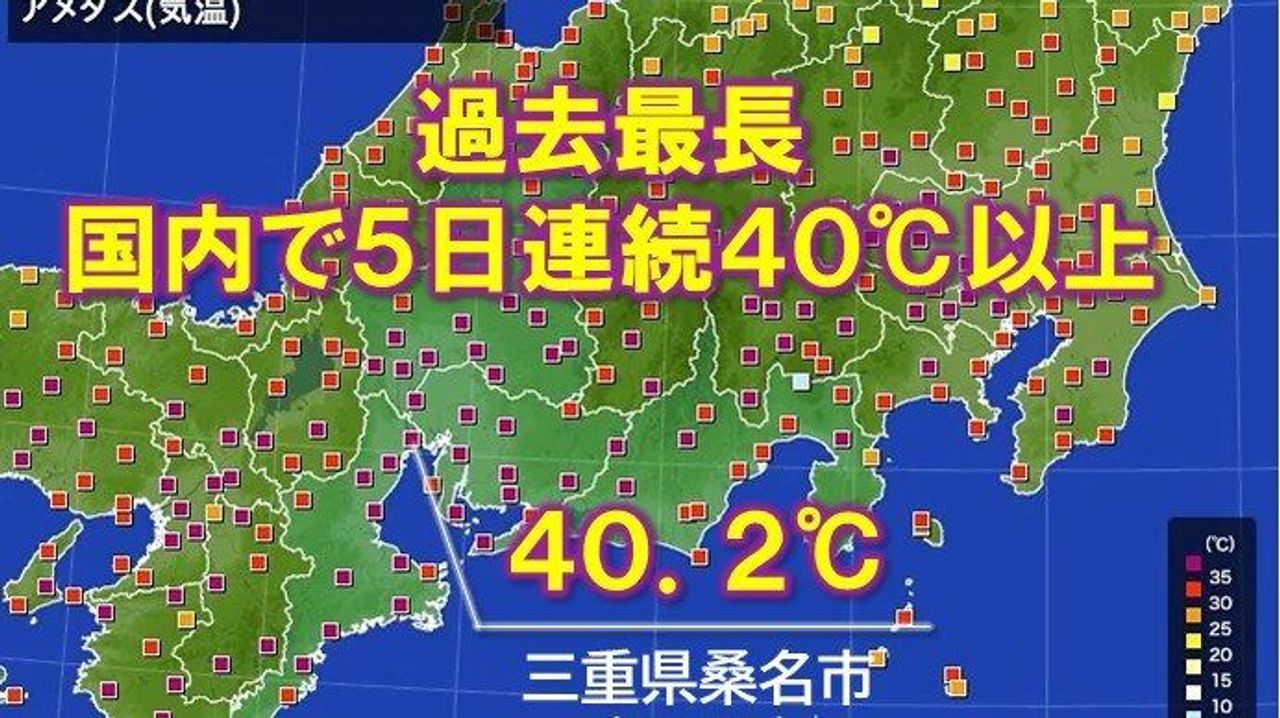
At 12:37 p.m. on the 25th, the temperature in Kuwana City, Mie Prefecture reached 40.2°C. With that single measurement, the city officially recorded a 酷暑日 (kokushobi)—an extremely hot day of 40°C or higher.
Even more striking, this marked the fifth consecutive day that temperatures of 40°C or above have been recorded somewhere in Japan. According to the report, this is the longest such streak in the past, breaking the previous record.
40.2°C Observed in Mie Prefecture
On July 25, in 三重県桑名市 (Mie-ken Kuwana-shi), the temperature was 観測 (kansoku, observed) at 40.2°C at 12:37 p.m.
In Japanese weather reporting, the verb 観測する (kansoku suru) is commonly used for official scientific measurements—especially for temperature, rainfall, and earthquakes. It emphasizes that the number is not just a guess, but a formally recorded observation.
Because the temperature exceeded 40°C, the day 酷暑日になりました (kokushobi ni narimashita)—“became an extremely hot day.” In Japan, 40°C is a significant threshold. When temperatures cross that line, it is treated as major news.
Five Days in a Row — A Record Broken
The article states:
国内で40℃以上の酷暑日が観測されるのは5日連続で、過去最長記録を更新しました。
This means that within Japan (国内で, kokunai de), temperatures of 40°C or higher have been observed for five days in a row.
The phrase 5日連続 (itsuka renzoku) means “five consecutive days.” 連続 (renzoku) is a very useful word for describing events that happen continuously without interruption.
What makes this especially significant is that it 過去最長記録を更新しました (kako saichō kiroku o kōshin shimashita)—it updated, or broke, the longest record in the past.
- 過去 (kako) = the past
- 最長記録 (saichō kiroku) = the longest record
- 更新する (kōshin suru) = to update; to break (a record)
In other words, this five-day streak is now the longest on record.
Why 40°C Is Such a Big Deal in Japan
Japan’s summers are already known for high humidity. Even temperatures in the mid-30s Celsius can feel intense due to the moisture in the air.
That’s why crossing the 40°C mark—and doing so for five consecutive days—is particularly noteworthy. The term 酷暑日 (kokushobi) itself contains:
- 酷 (koku) – severe, harsh
- 暑 (sho) – heat
- 日 (hi / bi) – day
It literally means “a severely hot day.”
Weather announcements in Japan are precise and standardized, and temperature milestones like this often become part of the national conversation.
Learn Japanese from This Article
Let’s turn this news into a language lesson.
Key Vocabulary
| Japanese | Romaji | Meaning |
|---|---|---|
| 観測 | kansoku | observation (especially scientific/weather) |
| 酷暑日 | kokushobi | extremely hot day (40°C or higher) |
| 連続 | renzoku | consecutive; in a row |
| 過去 | kako | the past |
| 最長記録 | saichō kiroku | longest record |
| 更新 | kōshin | to update; to break (a record) |
Try saying this sentence:
5日連続で40℃以上を観測しました。 Itsuka renzoku de yonjū-do ijō o kansoku shimashita. “We observed temperatures above 40°C for five consecutive days.”
Grammar Spotlight
1. 〜になる — “to become; to reach a state”
Structure: Noun + に + なる
Example from the article:
酷暑日になりました。 Kokushobi ni narimashita. “It became an extremely hot day.”
More examples:
有名になりました。 Yūmei ni narimashita. “It became famous.”
夏になりました。 Natsu ni narimashita. “It has become summer.”
This pattern is essential in Japanese. Instead of saying something “is” a certain way, Japanese often expresses a change into that state.
2. 〜のは〜で — “As for ~, it is ~ and…”
Structure: [Clause] + のは + [description/result] + で
From the article:
40℃以上の酷暑日が観測されるのは5日連続で… Yonjū-do ijō no kokushobi ga kansoku sareru no wa itsuka renzoku de… “As for extremely hot days of 40°C or more being observed, it is five consecutive days…”
This structure highlights one topic and then explains or evaluates it.
Another example:
日本語を勉強するのは楽しいです。 Nihongo o benkyō suru no wa tanoshii desu. “As for studying Japanese, it is fun.”
Useful Expression
記録を更新する Kiroku o kōshin suru “To break a record”
Example:
世界記録を更新しました。 Sekai kiroku o kōshin shimashita. “They broke the world record.”
You’ll hear this expression often in sports, weather reports, and business news.
Continue Learning
Strengthen your reading skills and vocabulary:
- Reading and Writing in Japanese II: Hiragana and Katakana: Want to learn more about general? Check out our lesson on Reading and Writing in Japanese II: Hiragana and Katakana.
- Introduction to Kanji: Pictorial Foundations of Japanese Script: Working on your reading skills? Our Introduction to Kanji: Pictorial Foundations of Japanese Script lesson is a great next step.
- Basic Vocabulary Building: Embracing Words Without Latin Ties: Want to learn more about general? Check out our lesson on Basic Vocabulary Building: Embracing Words Without Latin Ties.
Extreme heat, record-breaking streaks, and precise weather language—news like this is full of practical Japanese you’ll encounter again and again. Keep noticing these patterns, and your reading skills will steadily grow.
これからもよろしくお願いします。 Kore kara mo yoroshiku onegaishimasu.