
On June 2, 2026, Lawson kicked off its four-week “festival” campaign with a loud online shout: 超ハッピーすぎ! チャレンジ (chō happī sugī! charenji) has officially begun. And just hours after it started, popular items were already disappearing from shelves.
The convenience store chain’s limited-time event is being described as nothing less than a 祭り (matsuri)—a festival. But as many customers quickly discovered, this is also a full-on 争奪戦 (sōdatsusen), a scramble to grab products before they’re gone.
Let’s take a closer look at what’s happening—and which item might save you from the frustration of 品切れ (shina-gire), or “sold out.”
A Four-Week “Super Happy” Event
Starting Tuesday, June 2, Lawson is holding the 超ハッピーすぎ! チャレンジ (chō happī sugī! charenji) over a period of four weeks. In Japanese, this is expressed as:
4週間にわたり開催される yon shūkan ni watari kaisai sareru “Held over four weeks.”
The key word here is 開催 (kaisai), meaning “to hold” or “to host” an event.
This year’s campaign includes not only the usual “extra-large” promotion (often called 盛りすぎチャレンジ) but also a new企画 (project) called 合わせすぎチャレンジ, which roughly means “over-the-top combo challenge.”
In the first week, popular items such as:
- 高菜チャーシューおにぎり (takana chāshū onigiri) – mustard greens & pork rice ball
- ハムサンド (hamu sando) – ham sandwich
- プレミアムロールケーキ (puremiamu rōru kēki) – premium roll cake
were released. However, many Lawson stores quickly reported 品切れ (shina-gire), completely sold out.
Because these promotions are so popular, buying them can feel 運任せ (unmakase)—left entirely to luck.
The “Reliable” Bento That’s Easier to Get
Among the week’s 目玉商品 (medama shōhin), or “featured products,” there is one standout that’s reportedly less dependent on luck:
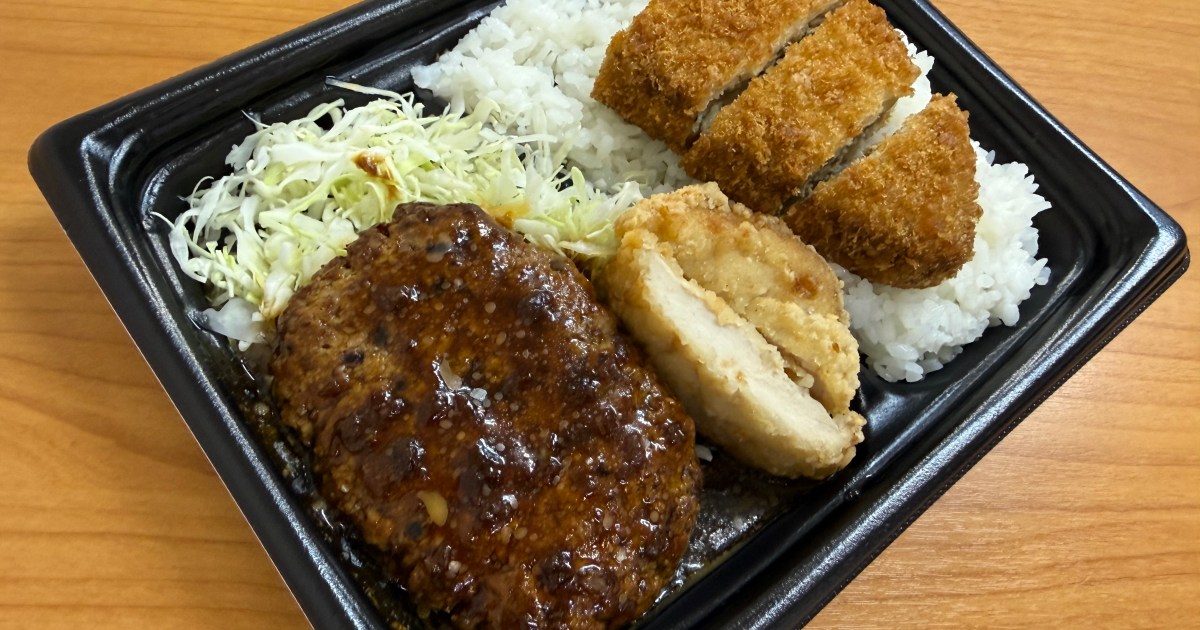
合わせすぎ! ハンバーグ&竜田×メンチ弁当 awasesugi! hanbāgu & tatsuta × menchi bentō “Over-the-Top Combo! Hamburger & Tatsuta × Menchi Bento”
This 697-yen boxed meal combines:
- Hamburger steak
- Chicken tatsuta-age (Japanese-style fried chicken)
- A menchi-katsu (fried minced meat cutlet)
Normally, the rice area of this type of bento is just plain white rice. In this version, a menchi-katsu is added on top, dramatically increasing both visual impact and perceived value. As the article puts it, it’s a very “mischievous” (playfully excessive) meat-on-meat-on-meat combination.
Why It’s Less “Luck-Based”
So why is this particular bento less 運任せ (unmakase)?
Because it’s made in Lawson’s in-store kitchen called:
まちかど厨房 machikado chūbō “Corner Kitchen”
These kitchens are 併設 (heisetsu)—attached—to certain Lawson stores. If a store has a Machikado Chūbō, they can keep preparing more as long as ingredients are available. In some cases, customers can even request one on the spot.
That’s very different from factory-made bento boxes, which must wait for the next shipment once sold out.
However, there’s one catch: if a store does not have a まちかど厨房 (machikado chūbō) attached, you won’t be able to buy this item there at all.
Don’t Forget the Oversized Karaage-kun
Another relatively easy-to-get item during Week 1 is:
でからあげクン 夢のMIX味 6個入(288円) de karaage-kun yume no MIKKUSU aji “Big Karaage-kun Dream Mix Flavor (6 pieces)”
Because it’s a hot snack prepared in-store, it’s also less likely to stay sold out for long.
In short: if you want to join the festival without relying purely on luck, in-store prepared items may be your safest bet.
Lawson’s four-week 祭り (matsuri) has just begun—and June is shaping up to be a hot month for convenience store fans.
Cultural Context: Why “Festivals” at Convenience Stores?
In Japan, limited-time food promotions are often described as a 祭り (matsuri), even when there are no traditional lanterns or yukata involved. The word creates excitement and a sense of shared participation.
Convenience store chains like Lawson, FamilyMart, and 7-Eleven regularly hold seasonal campaigns. Because products are limited and sometimes increased in size or value, customers feel urgency. That’s where words like:
- 争奪戦 (sōdatsusen) – scramble
- 品切れ (shina-gire) – sold out
- 運任せ (unmakase) – left to luck
naturally enter everyday conversation.
These events reflect a broader Japanese consumer culture: limited-time offers create excitement and repeat visits.
Learn Japanese from This Article
Key Vocabulary
| Japanese | Romaji | Meaning |
|---|---|---|
| 祭り | matsuri | festival |
| 品切れ | shina-gire | sold out, out of stock |
| 争奪戦 | sōdatsusen | scramble, fierce competition |
| 目玉商品 | medama shōhin | featured/highlight product |
| 開催 | kaisai | to hold (an event) |
| 運任せ | unmakase | leaving it to luck |
| 併設 | heisetsu | attached, combined with |
Grammar Spotlight
① 〜にわたり — “over (a period of time)”
Structure: [Time period] + にわたり
Used to describe something that continues over a span of time.
Example from this article: 4週間にわたり開催される。 yon shūkan ni watari kaisai sareru “It will be held over four weeks.”
More examples:
3日間にわたりイベントが行われます。 mikka-kan ni watari ibento ga okonawaremasu “The event will be held over three days.”
全国にわたり人気があります。 zenkoku ni watari ninki ga arimasu “It’s popular throughout the country.”
② 〜まいとする — “determined not to…”
Structure: [Verb dictionary form] + まいとする
Used to express determination to avoid something.
From the article’s tone: “祭りに乗り遅れまいと…” matsuri ni noriokuremai to… “Determined not to miss the festival…”
More examples:
遅れまいと急ぎました。 okuremai to isogimashita “I hurried so I wouldn’t be late.”
失敗するまいと努力する。 shippai suru mai to doryoku suru “To make an effort so as not to fail.”
Useful Expressions
- 売り切れ続出 (urikire zokushutsu) – “sold-outs occurring one after another”
- お得感がある (otoku-kan ga aru) – “feels like a good deal”
- アツいぞ! (atsui zo!) – “It’s hot!” (figuratively: exciting, intense)
Continue Learning
📚 Want to understand the verb forms used here? Check out Masu Form: Mastering Polite Everyday Speech.
📚 Want to learn more about lifestyle? Check out our lesson on Greetings and Self-Introductions: Authentic Entry Phrases.
📚 Want to learn more about lifestyle? Check out our lesson on Basic Vocabulary Building: Embracing Words Without Latin Ties.
Basic Vocabulary Building: Embracing Words Without Latin Ties
これからもよろしくお願いします。 Kore kara mo yoroshiku onegaishimasu.