
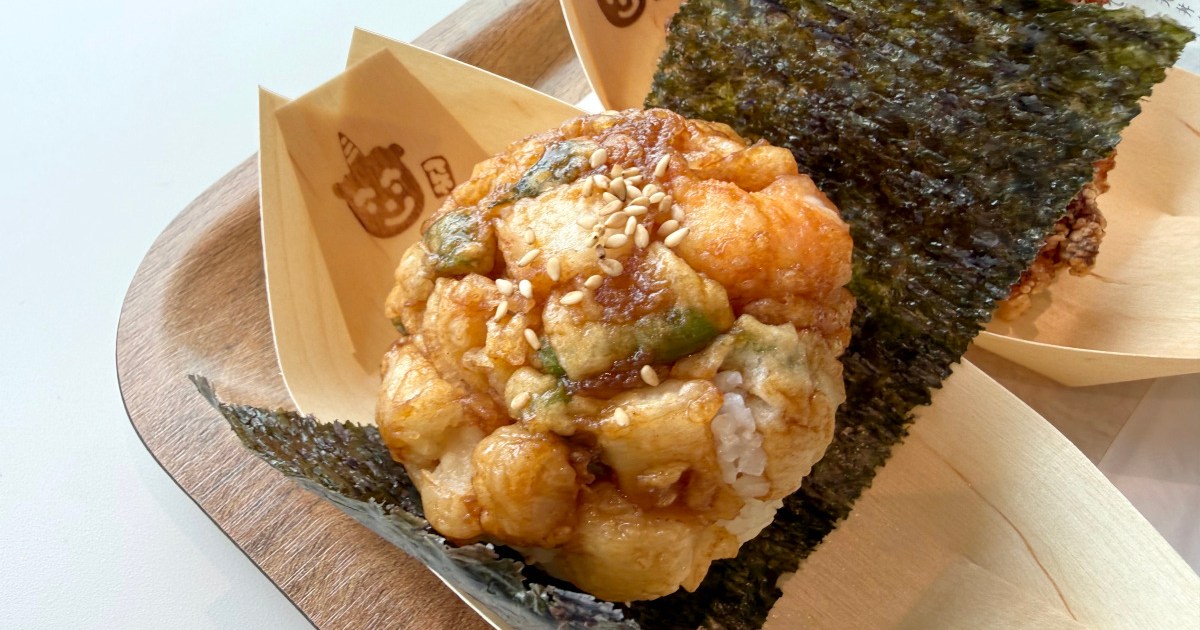
On July 7, 2026, a brand-new fast food concept called おにどん (onidon) officially joins the Royal family of restaurants in Japan—and it’s built around something surprisingly simple: a tempura rice ball that tastes like a tendon bowl.
If you’ve ever eaten at てんや (Tenya), you already know it as one of Japan’s largest tempura rice bowl chains. For many people, affordable 天丼 (tendon, tempura over rice) became widely accessible thanks to Tenya. So when news broke that Tenya would open a new 業態 (gyoutai, business format), expectations were high.
That new format is Onidon.
What Is “Onidon”?
The name says it all. おにどん (onidon) is short for “おにぎりの天丼” (onigiri no tendon)—literally, a tendon in rice ball form.
At a pre-opening 発表会 (happyoukai, press event), it was revealed that the concept was developed as “Japanese fast food that can compete globally.” Interestingly, the idea almost became a chicken burger. After various twists and turns, the team arrived at Onidon instead.
The origin? A staff まかない (makanai, employee meal). A Tenya employee turned tendon into a rice ball for staff, and the idea stuck. From there, it evolved into a full-scale brand under Royal Holdings.
The first location opened at:
おにどん エキュートエディション御茶ノ水店 Outside the ticket gates (改札外, kaisatsugai) on the 2nd floor of JR Ochanomizu Station, Tokyo.
Business hours:
- Weekdays: 10:00–22:00 (Last order 21:30)
- Weekends & holidays: 10:00–21:00 (Last order 20:30)
Not Quite Tenmusu… Not Quite Onigiri
At first glance, you might think of 天むす (tenmusu)—a Nagoya specialty of shrimp tempura inside a rice ball.
But after tasting it, the reporter noted: this is not tenmusu.
Tenmusu often relies heavily on sauce flavor. Onidon, however, balances rice and tempura equally. In one bite, you experience seaweed, rice, shrimp, lotus root, and squid together—creating something closer to a compact tendon bowl than a simple rice ball.
Tenya recommends pairing Onidon with pork miso soup or fried chicken. There are 10 varieties in total, including deluxe versions. Prices start at 310 yen, with the original version (元祖おにどん, ganso onidon) priced at 370 yen.
Considering recent price increases for convenience store rice balls, that may actually feel reasonable.
One important point: the shop does not make them in advance. They 提供する (teikyou suru, serve/provide) each one freshly prepared.
A New Fast Food Expansion?
Royal Holdings plans to monitor customer response before further 展開 (tenkai, expansion). Potential future locations include commercial facilities, airports, and highway rest areas.
The reporter even suggested that if Onidon opens in airports, it could become extremely popular.
After all, turning Tenya’s tendon into a rice ball? That’s delicious—に決まっている (ni kimatte iru, “there’s no doubt about it”).
Cultural Context: Why This Is Interesting in Japan
In Japan, major restaurant groups often operate multiple brands under one corporate umbrella. Tenya belongs to Royal Holdings, alongside brands like Royal Host, Sizzler, and Shakey’s.
However, fast food is relatively unusual for this group. That makes Onidon’s 開業 (kaigyou, opening of a business) notable.
There’s also something very Japanese about the origin story. Many famous dishes begin as まかない (makanai), staff meals created informally in restaurant kitchens. Some of Japan’s most beloved comfort foods started this way.
Onidon blends three deeply Japanese elements:
- おにぎり (onigiri) – everyday comfort food
- 天ぷら (tempura) – classic Edo-style cuisine
- ファストフード – modern convenience culture
It’s traditional and contemporary at the same time.
Learn Japanese from This Article
Key Vocabulary
| Japanese | Romaji | Meaning |
|---|---|---|
| 業態 | gyoutai | business format; type of business |
| 開業 | kaigyou | opening (a business) |
| 発表会 | happyoukai | press conference; announcement event |
| まかない | makanai | staff meal |
| 展開 | tenkai | development; expansion |
| 提供する | teikyou suru | to provide; to serve |
| 改札外 | kaisatsugai | outside the ticket gates |
| に決まっている | ni kimatte iru | it’s certain; there’s no doubt |
Grammar Spotlight
1️⃣ 〜とのこと
Meaning: “I heard that…” / “It is said that…”
Used to report information indirectly.
Example from this article style:
新業態を開業するとのことです。 Shin gyoutai o kaigyou suru to no koto desu. I heard that they will open a new business format.
出来立てを提供するとのことです。 Dekitate o teikyou suru to no koto desu. It is said that they serve everything freshly made.
This pattern is common in news reporting.
2️⃣ 〜に決まっている
Meaning: “It’s definitely…” / “There’s no doubt that…”
Expresses strong certainty.
Structure: Plain form + に決まっている
- てんやの天丼をおにぎりにしたら、おいしいに決まっている。 Tenya no tendon o onigiri ni shitara, oishii ni kimatte iru. If you turn Tenya’s tendon into a rice ball, it’s definitely delicious.
Use this when you feel something is obvious or guaranteed.
Useful Expressions
様子を見る(ようすをみる) yousu o miru – to wait and see how things go
元祖(がんそ) ganso – original; founding version
世界で戦える(せかいでたたかえる) sekai de tatakaeru – able to compete globally
Continue Learning
Want to learn more about how Japanese handles time expressions like business hours and dates? Check out our lesson:
Understanding how Japanese describes schedules will help you read shop information like this naturally.
Onidon may look simple, but it represents something uniquely Japanese: refining a classic dish, reshaping it into a new form, and serving it fresh at a train station.
Next time you’re at Ochanomizu Station, you might want to step outside the ticket gates and try one for yourself.
これからもよろしくお願いします。 Kore kara mo yoroshiku onegaishimasu.