
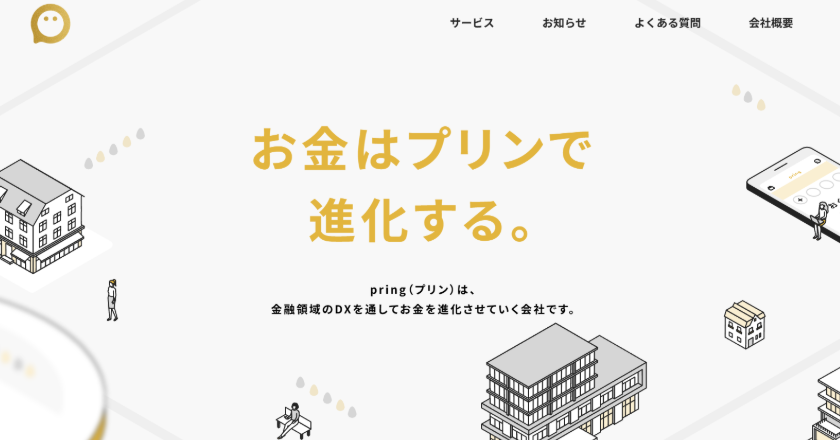
On May 22, Google’s Japanese money transfer app 「pring」 (purin) announced that it will end all services on December 1, 2026. The company had been acquired by Google in 2021 for an estimated 10 billion yen or more—but the much-anticipated integration into Google Pay never happened.
A Costly Acquisition That Led to Closure
The アプリ (apuri, app) pring was originally established in May 2017 as a subsidiary of Metaps, a Japanese tech company. It was a スタートアップ (sutaatoappu, startup company) that also received investment from major financial institutions, including Mizuho Financial Group.
In March 2018, pring officially launched its service. It allowed ユーザー (yuuzaa, users) to:
- Transfer money between individuals through linked bank accounts
- Make payments via QRコード決済 (kyuu-aaru koodo kessai, QR code payment)
In July 2021, Google announced that it had acquired all shares of pring. Metaps, the largest shareholder, sold its stake for approximately 4.9 billion yen, and Google also purchased shares from other investors such as Mizuho. The total acquisition cost was believed to be at least 10 billion yen.
At the time, some people questioned the decision. PayPay already dominated Japan’s QR code payment market, with around 40 million users and more than 40% market シェア (shea, share). In comparison, pring had only several hundred thousand users—just a tiny portion of the market.
Many wondered: Why did Google buy it?
The Plan That Never Happened
One key reason may have been pring’s contracts with major banks, known in Japanese as メガバンク (megabanku). Pring had agreements for bank transfers with these large institutions. Observers believed Google might use this financial network to add money transfer functions to Google Pay.
However, that integration never took place.
The company gradually scaled back operations. In June 2024, pring stopped accepting new registrations. The number of connected financial institutions was also reduced step by step.
Now, the service will officially end.
What Happens Next?
According to the announcement, pring will abolish its funds transfer business on August 24, 2026. Major functions such as:
- チャージ (chaaji, loading money)
- Money transfers
- Payments
will be discontinued in stages.
If users still have a remaining balance as of September 1, the funds will automatically be refunded to their registered bank accounts. Pring will cover the bank transfer fees.
In Japanese, the company 〜と発表した (to happyou shita), meaning “announced that” it would terminate services. The phrase appears frequently in news reporting, and you’ll see it almost daily in Japanese headlines.
Despite the large acquisition and expectations, pring will close 統合は実現しないまま (tougou wa jitsugen shinai mama)—“without integration being realized.” The expression 〜まま (mama) shows that something remained unchanged or incomplete.
Cultural Context: Japan’s QR Payment Competition
Japan’s move toward cashless payments accelerated in the late 2010s. Multiple companies—including PayPay, LINE Pay, Rakuten Pay, and others—competed for dominance in QRコード決済.
Unlike some countries where one or two apps dominate, Japan’s digital payment landscape has been highly competitive. This makes market シェア especially important—and difficult to gain.
Google’s purchase of a relatively small スタートアップ surprised many observers, particularly because pring’s user base was modest compared to major competitors.
Understanding this background helps you see why the closure is notable in Japan’s tech and finance world.
Learn Japanese from This Article
Key Vocabulary
| Japanese | Romaji | Meaning |
|---|---|---|
| アプリ | apuri | app, application |
| サービス終了 | saabisu shuuryou | service termination |
| スタートアップ | sutaatoappu | startup company |
| QRコード決済 | kyuu-aaru koodo kessai | QR code payment |
| ユーザー | yuuzaa | user |
| シェア | shea | market share |
| チャージ | chaaji | to load money onto an account |
| メガバンク | megabanku | major Japanese bank |
| 買収 | baishuu | acquisition |
| 発表した | happyou shita | announced |
Notice how many of these words are written in katakana. Modern Japanese tech news is full of loanwords.
Grammar Spotlight
1️⃣ 〜と発表した
Structure: Plain form + と発表した
Meaning: “Announced that…”
Example from the article:
- Googleはサービスを終了すると発表した。 Google wa saabisu o shuuryou suru to happyou shita. Google announced that it will end the service.
Another example:
- 会社は新しいアプリを発売すると発表した。 Kaisha wa atarashii apuri o hatsubai suru to happyou shita. The company announced that it will release a new app.
This structure is extremely common in Japanese news writing.
2️⃣ 〜まま
Meaning: Remaining in a certain state; without change
Example from the article:
- 統合は実現しないまま終了した。 Tougou wa jitsugen shinai mama shuuryou shita. It ended without the integration being realized.
Another example:
- ドアを開けたまま出かけた。 Doa o aketa mama dekaketa. I went out leaving the door open.
The nuance is important—it suggests something stayed in that condition.
Useful Expression
- 全サービスを終了する (zen saabisu o shuuryou suru) “To terminate all services”
You’ll often see this when apps or online platforms shut down.
Continue Learning
Working on your reading skills? Our Katakana Essentials: Adapting Global Words to Japanese lesson is a great next step.
Ready to dive deeper? Our lesson on Reading and Writing in Japanese II: Hiragana and Katakana will help you master these concepts.
Ready to expand your vocabulary even more? Our lesson on Basic Vocabulary Building: Embracing Words Without Latin Ties will strengthen your foundation.
Tech news like this isn’t just about companies—it’s full of practical, modern Japanese you’ll encounter every day. Keep reading, keep noticing patterns, and your understanding will steadily grow.
これからもよろしくお願いします。 Kore kara mo yoroshiku onegaishimasu.