
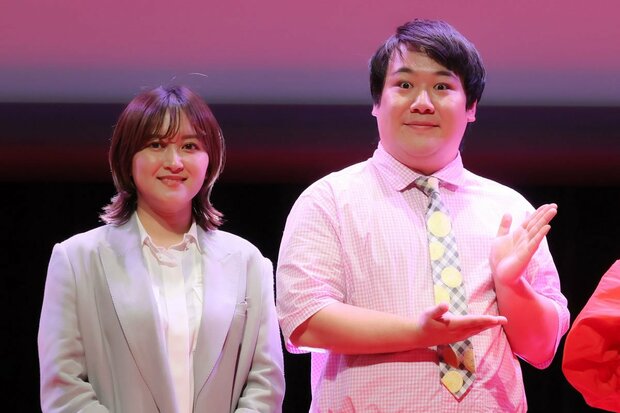
On May 20, comedy duo Lalande updated their YouTube channel—and revealed that member Nishida once met the current Emperor of Japan as a child.
What sounds like a once-in-a-lifetime encounter actually happened during Nishida’s 幼少期 (yōshōki, early childhood), when he was living overseas.
Nishida’s Early Years in Europe
In the video, Nishida and his partner Saya shared “new information” about each other. Nishida explained that he spent his 幼少期 (yōshōki) in Germany and Spain and is a 帰国子女 (kikokushijo)—a child who has returned to Japan after living abroad.
He then revealed something surprising:
At the time, the current Emperor was still the 皇太子 (kōtaishi, Crown Prince). When the Crown Prince visited Spain and toured several Japanese schools there, he came to the Madrid Japanese School, where Nishida was a student.
A Gaspatxo Presentation in Front of Royalty
During the visit, the Crown Prince went around different classrooms. Nishida recalled that he happened to be in a class where students were explaining how to make gazpacho—a traditional Spanish dish—in Spanish.
He later 振り返った (furikaetta, looked back and recalled):
“He saw me explaining gazpacho.”
As the Crown Prince was leaving, the students lined up for an お見送り (omio-kuri), a formal “seeing off.” Nishida shared that when the future Emperor came in front of him, he said:
“The gazpacho looked delicious.”
He added that His Majesty gave each student a few words.
When Saya heard this story, she reacted with surprise, 目を丸くしていた (me o maruku shite ita, widening her eyes), saying, “Really!? That’s amazing!”
Cultural Context: The Emperor and Respectful Language
In Japanese news, the Emperor is referred to as 陛下 (heika), meaning “His Majesty.” This is an honorific title used out of deep respect. Even in casual storytelling, public figures often maintain this respectful language.
The visit described here took place when the Emperor was still 皇太子 (kōtaishi), Crown Prince. Official visits to Japanese schools abroad are part of maintaining ties with Japanese communities overseas.
The word お見送り (omio-kuri) also reflects Japanese cultural politeness. Adding the honorific prefix お (o) makes the expression more respectful. Seeing someone off—especially a distinguished guest—is treated as a meaningful, ceremonial moment.
Understanding these layers of language helps you see how respect is built directly into Japanese vocabulary itself.
Learn Japanese from This Article
Let’s break down some of the key words and grammar patterns you saw.
Key Vocabulary
| Japanese | Romaji | Meaning |
|---|---|---|
| 幼少期 | yōshōki | early childhood |
| 帰国子女 | kikokushijo | child who returned to Japan after living abroad |
| 皇太子 | kōtaishi | Crown Prince |
| 陛下 | heika | His Majesty (the Emperor) |
| お見送り | omio-kuri | seeing someone off (honorific) |
| 振り返る | furikaeru | to look back; to recall |
| 目を丸くする | me o maruku suru | to widen one’s eyes in surprise |
Notice how several of these words—like 陛下 and お見送り—carry built-in respect. This is a key feature of Japanese.
Grammar Spotlight ①: 〜際(に)
Pattern: Verb (dictionary form) + 際(に) Noun + の際(に)
Meaning: “On the occasion of…” / “When…” (formal)
From the article context:
- Visiting Spain and touring schools = 〜回った際に
Example sentences:
日本に行く際に、お土産を買いました。 Nihon ni iku sai ni, omiyage o kaimashita. When I went to Japan, I bought souvenirs.
卒業の際に、先生に感謝を伝えました。 Sotsugyō no sai ni, sensei ni kansha o tsutaemashita. On the occasion of graduation, I expressed my gratitude to my teacher.
This structure is more formal than とき (toki), and you’ll often see it in news articles.
Grammar Spotlight ②: 〜てくれる
Pattern: Person + Verb (て-form) + くれる
Meaning: Someone does something for me (or someone in my in-group), with a nuance of gratitude.
From the story:
- 言ってくれた (itte kureta) — “(He) said (it) for me/us.”
Example sentences:
友だちが宿題を手伝ってくれました。 Tomodachi ga shukudai o tetsudatte kuremashita. My friend helped me with my homework.
先生がアドバイスをくれました。 Sensei ga adobaisu o kuremashita. My teacher gave me advice.
The nuance is important. It’s not just that the Emperor spoke—he spoke to them, for them, which is why くれる is used.
Useful Expression
- 目を丸くする (me o maruku suru) Literally “to make one’s eyes round.” It means to widen your eyes in surprise.
Example:
- 彼はそのニュースを聞いて、目を丸くした。 Kare wa sono nyūsu o kiite, me o maruku shita. He widened his eyes when he heard the news.
This is a very natural expression you’ll see in novels and news articles.
Continue Learning
To deepen your understanding of the language used in this article:
- Working on your reading skills? Our Introduction to Kanji: Pictorial Foundations of Japanese Script lesson is a great next step.
- To understand more about culture, explore our Honorifics: Keigo for Respectful Dialogue lesson.
- Curious about the Japanese used here? Our Basic Vocabulary Building: Embracing Words Without Latin Ties lesson covers this in depth.
Moments like this—an ordinary classroom, a simple dish like gazpacho, and a few kind words from a future Emperor—show how language, culture, and memory intertwine. By learning the words behind the story, you’re not just studying vocabulary. You’re stepping into the way Japanese people tell and remember meaningful experiences.
これからもよろしくお願いします。 Kore kara mo yoroshiku onegaishimasu.