
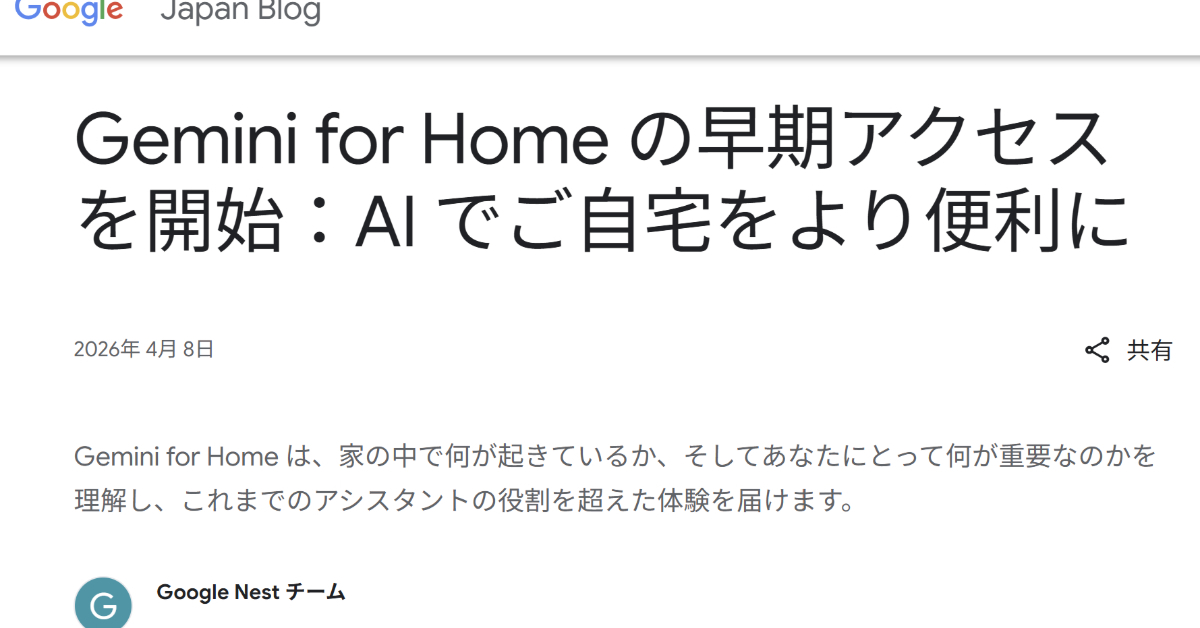
On April 8, Google announced that it has begun early access in Japan to its new AI assistant, “Gemini for Home,” which has been available in the United States since last October.
This marks a major step in the evolution of the home アシスタント (ashisutanto) in Japan—moving beyond simple voice commands to more natural, human-like conversations.
A New AI Assistant Specialized for the Home
Gemini for Home is an AI アシスタント (ashisutanto) 家庭向けに特化した (katei-muke ni tokka shita)—that is, specialized for home use. It is designed to upgrade devices such as スマートディスプレイ (sumaato disupurei, smart displays) and speakers, eventually replacing the traditional Google Assistant.
Unlike the previous assistant, which required fixed コマンド (komando, commands), Gemini for Home can understand conversational context and even vague expressions. That means smoother, more natural dialogue.
You can also choose from 10 new voices with more natural rhythm and intonation, allowing users to personalize their experience.
Understanding Complex and Vague Requests
One of the most impressive upgrades is Gemini’s ability to handle complex リクエスト (rikuesuto, requests) with human-like nuance.
For example, even if you don’t remember the exact title of a song, you could say:
「小惑星を爆破するために石油掘削の作業員が宇宙に行く映画の曲をかけて」 “Shōwakusei o bakuha suru tame ni sekiyu kussaku no sagyōin ga uchū ni iku eiga no kyoku o kakete.” “Play the song from the movie where oil drillers go to space to blow up an asteroid.”
Gemini understands that this refers to the movie Armageddon and can play the correct music.
It also handles スマートホーム (sumaato hoomu, smart home) controls intelligently. For instance:
- 「今から料理するからコンロの横の電気をつけて」 “Ima kara ryōri suru kara konro no yoko no denki o tsukete.” “I’m about to cook, so turn on the light next to the stove.”
Gemini interprets this as the kitchen light.
- 「書斎以外の電気を全部消して」 “Shosai igai no denki o zenbu keshite.” “Turn off all the lights except the study.”
It can even understand exceptions in instructions.
Another example:
- 「パッタイの材料を買い物リストに追加して」 “Pattai no zairyō o kaimono risuto ni tsuika shite.” “Add the ingredients for pad thai to my shopping list.”
Gemini infers the necessary ingredients and creates a list automatically. In other words, it works as a partner that understands the intention behind your request—not just the words.
Smart Cameras Become “AI Cameras”
With the introduction of Gemini, smart cameras are also evolving into “AI cameras.”
Previously, cameras mainly detected motion. Now, the AI can explain whether a package was delivered or if it was simply a moving shadow. It adds detailed descriptions to video history and notifications.
There is also a 「1日の要約」 (ichinichi no yōyaku, daily summary) feature. If you want to check what happened while you were away, Gemini automatically identifies important events from several hours of footage and provides a short summary with clips.
You can even search past video history using natural language in the Google Home アプリ (apuri, app). For example:
「子どもたちは何時に帰ってきた?」 “Kodomotachi wa nanji ni kaette kita?” “What time did the children come home?”
The system searches through hours or even days of footage to find the specific scene. According to Google, this dramatically improves convenience for security and family monitoring.
How to Join Early Access in Japan
Users who own compatible devices can join the early access program at no additional cost.
To register:
- Use Google Home バージョン (baajon, version) 4.0 or higher.
- Tap your profile icon.
- Select 「Homeの設定」 (Home no settei, Home settings).
- Choose 「早期アクセス」 (sōki akusesu, early access).
- Complete registration.
You’ll receive a notification once the feature becomes available.
Cultural Context: Why Natural AI Matters in Japan
Japan has long embraced voice-controlled technology, from home appliances to advanced robotics. However, traditional systems required very specific コマンド (komando). The shift toward understanding vague, contextual language reflects how Japanese communication often relies on implication and shared understanding.
A system that can interpret nuance—rather than just exact wording—fits naturally into everyday Japanese conversation styles.
Learn Japanese from This Article
Vocabulary
| Japanese | Romaji | Meaning |
|---|---|---|
| アシスタント | ashisutanto | assistant |
| スマートディスプレイ | sumaato disupurei | smart display |
| コマンド | komando | command |
| リクエスト | rikuesuto | request |
| スマートホーム | sumaato hoomu | smart home |
| アプリ | apuri | app (application) |
| バージョン | baajon | software version |
| 早期アクセス | sōki akusesu | early access |
Notice how many of these are written in katakana because they are loanwords. Tech Japanese relies heavily on katakana vocabulary.
Grammar Spotlight
1. 〜に特化した
Meaning: specialized in / focused on
Structure: Noun + に特化した + Noun
Example from article:
- 家庭向けに特化したAIアシスタント katei-muke ni tokka shita AI ashitsutanto “An AI assistant specialized for home use.”
More examples:
教育に特化したアプリです。 Kyōiku ni tokka shita apuri desu. “It’s an app specialized in education.”
初心者に特化したコース。 Shoshinsha ni tokka shita kōsu. “A course focused on beginners.”
2. 〜ようになる
Meaning: to become able to / to come to (a change of state)
This pattern expresses change or new ability.
Example idea from the article:
- 自然な会話ができるようになる。 Shizen na kaiwa ga dekiru yō ni naru. “It becomes able to have natural conversations.”
More examples:
日本語が話せるようになりました。 Nihongo ga hanaseru yō ni narimashita. “I became able to speak Japanese.”
曖昧な表現も理解できるようになった。 Aimai na hyōgen mo rikai dekiru yō ni natta. “It became able to understand vague expressions.”
Useful Expressions
〜以外(いがい) (igai) — except for
- 書斎以外の電気 “Lights except for the study”
〜を追加して (o tsuika shite) — add ~
- 買い物リストに追加して “Add it to the shopping list”
Continue Learning
Working on your reading skills? Our Katakana Essentials: Adapting Global Words to Japanese lesson is a great next step.
To understand more about tech vocabulary, explore our Basic Vocabulary Building: Embracing Words Without Latin Ties.
Ready to dive deeper? Our lesson on Reading and Writing in Japanese II: Hiragana and Katakana will help you master these concepts.
Google’s rollout of Gemini for Home in Japan shows how AI is moving from simple command-based tools to partners that understand nuance and intention. For Japanese learners, it’s also a perfect window into modern tech vocabulary—and how real Japanese is used in everyday life.
これからもよろしくお願いします。 Kore kara mo yoroshiku onegaishimasu.