
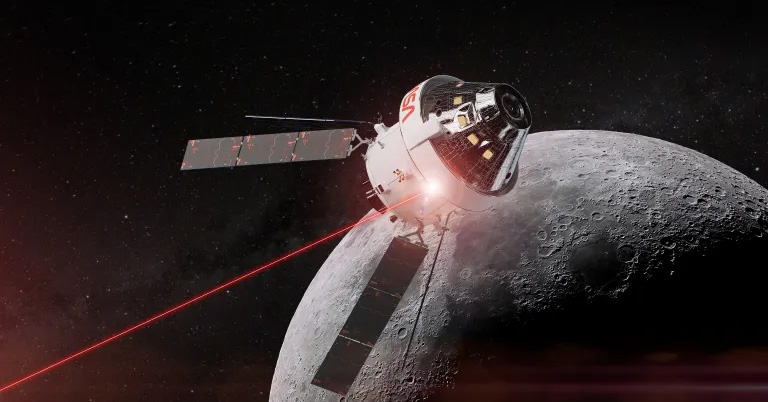
On April 1 (local time), NASA launched its crewed lunar mission “Artemis II,” sending the Orion spacecraft toward the Moon. Behind the scenes, two layers of radio networks—and, for the first time in a crewed lunar mission, a laser optical communication system—are supporting communication between the Moon and Earth.
At its closest approach to the Moon on the morning of April 7 (Japan time), Orion relied on this advanced system to stay connected across hundreds of thousands of kilometers.
Two Networks That Support the Mission
Artemis II is a 探査ミッション (tansa misshon), an exploration mission aimed at deepening humanity’s presence in space. For such a mission, communication is everything: voice, scientific data, images, flight plans, and even live video must travel safely back to Earth.
From launch—打ち上げ (uchiage)—until the spacecraft fired its engines to enter its lunar transfer orbit, communication was handled by the “Near Space Network.” Managed by NASA’s Goddard Space Flight Center, this system combines ground stations on Earth with 中継衛星 (chuukei eisei), or relay satellites, to communicate with Orion.
After Orion entered lunar transfer orbit, responsibility shifted to the “Deep Space Network,” managed by NASA’s Jet Propulsion Laboratory (JPL). This global network uses massive パラボラアンテナ (parabora antena), or parabolic antennas, located in California, Spain, and Australia. These antennas maintain near-continuous contact with spacecraft hundreds of thousands of kilometers away.
In Japanese, the article describes these networks as:
- 通信を担う (tsuushin o ninau) — “to take responsibility for communication”
The verb 担う (ninau) literally means “to shoulder” or “to carry,” and it’s often used when describing important roles or responsibilities.
From Radio Waves to Laser Beams
Traditional radio communication has limits when it comes to long-distance データ転送 (deeta tensou), or data transfer. To address this challenge, Artemis II carries a laser optical communication system called the “Orion Artemis II Optical Communications System” (O2O), jointly developed by MIT Lincoln Laboratory and NASA’s Goddard Space Flight Center.
This marks the first time laser optical communication is being demonstrated on a crewed lunar mission.
At the heart of O2O is a core terminal known as “MAScOT” (Modular, Agile, Scalable Optical Terminal). It’s described as being “about the size of a cat.” The system includes a 4-inch optical telescope mounted on a two-axis gimbal. The gimbal precisely points the telescope toward a ground station on Earth, sending an infrared laser beam accurately across space.
The results are impressive:
- Data transmission speeds of up to 260 Mbps
- Capable of sending 4K high-definition video from the Moon
- Over 100 times more data transfer compared to conventional radio, according to NASA’s demonstration tests
To explain why this system was added, the article uses another important grammar pattern:
- 〜に対応するため (~ni taiou suru tame) — “in order to deal with…” or “to address…”
For example, the laser system was introduced to address the limitations of radio communication over long distances.
The 40-Minute Blackout
Early on April 7 (Japan time), when Orion passed behind the Moon, it experienced about 40 minutes of communication loss—a ブラックアウト (burakkuauto), or blackout.
This happens because radio waves are blocked by the Moon itself. It’s a limitation that dates back to the Apollo program. Once Orion re-emerged from behind the Moon, the Deep Space Network reacquired the signal, and communication was restored.
To address this issue in future missions, NASA is advancing a project called “Lunar Communications Relay and Navigation Systems” (LCRNS). The plan involves placing relay satellites in lunar orbit so that even spacecraft on the far side of the Moon can maintain communication.
NASA is working with private companies under a 商用サービス (shouyou saabisu), or commercial service, framework. In 2024, Intuitive Machines was selected as the first commercial service provider for this effort.
The goal: eliminate blackouts on the Moon’s far side.
Cultural Context: Artemis and Japan’s Interest in Space
The Artemis program represents NASA’s renewed push toward sustained lunar exploration. In Japan, space development is closely followed, and news articles like this often focus on technological innovation—especially communication systems, robotics, and precision engineering.
The careful explanation of networks, antennas, and laser systems reflects Japan’s strong interest in how technology works, not just what it achieves.
Learn Japanese from This Article
Let’s break down some key vocabulary and grammar used in the original Japanese article.
Key Vocabulary
| Japanese | Romaji | Meaning |
|---|---|---|
| 探査ミッション | tansa misshon | exploration mission |
| 打ち上げ | uchiage | rocket launch |
| 中継衛星 | chuukei eisei | relay satellite |
| パラボラアンテナ | parabora antena | parabolic antenna |
| データ転送 | deeta tensou | data transfer |
| ブラックアウト | burakkuauto | communication blackout |
| 商用サービス | shouyou saabisu | commercial service |
Notice how many technical terms are written in katakana (ミッション, アンテナ, ブラックアウト). Japanese often adopts foreign technical vocabulary and adapts it to Japanese pronunciation.
Grammar Spotlight 1: 〜を担う
Pattern: Noun + を担う
Meaning: To take responsibility for; to play a key role in
Example from the article concept:
- 通信を担う。 Tsuushin o ninau. “To take responsibility for communication.”
More examples:
重要な役割を担う。 Juuyou na yakuwari o ninau. “To play an important role.”
次世代を担う人材。 Jisedai o ninau jinzai. “People who will lead the next generation.”
This expression is common in news writing and formal contexts.
Grammar Spotlight 2: 〜に対応するため
Pattern: Noun + に対応するため
Meaning: In order to deal with; to address
Example concept:
- 制約に対応するため、新システムを導入した。 Seiyaku ni taiou suru tame, shin shisutemu o dounyuu shita. “In order to address the limitations, a new system was introduced.”
This structure is very common in technology and business news.
Useful Expression
- 信号を再取得する Shingou o sai shutoku suru “To reacquire a signal”
You’ll often see this in space and telecommunications news.
Continue Learning
Curious about the Japanese writing systems used in this article—kanji, hiragana, and katakana?
- Reading and Writing in Japanese I: The Japanese Writing Systems Curious about the Japanese used here? Our Reading and Writing in Japanese I: The Japanese Writing Systems lesson covers this in depth.
Space exploration stories like this are packed with real-world, modern Japanese. By reading authentic news, you’re learning the language the way it’s actually used in Japan—technical, precise, and forward-looking.
これからもよろしくお願いします。 Kore kara mo yoroshiku onegaishimasu.