
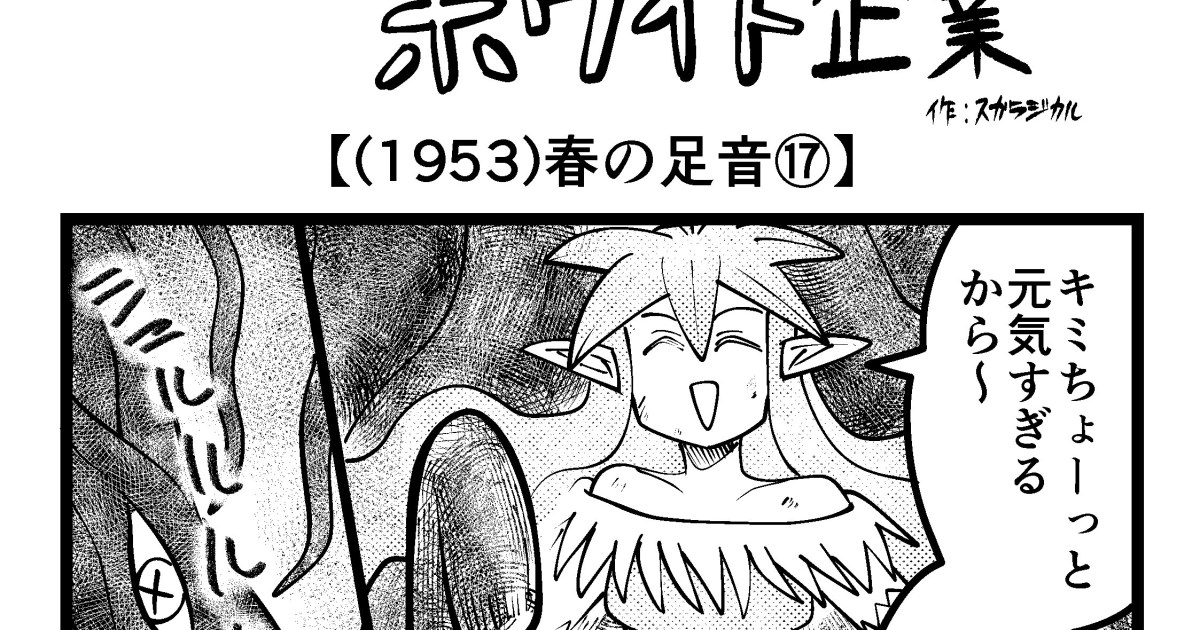
【4コマ】魔王軍はホワイト企業 1953話目「春の足音⑰」 was released on April 8, 2026, on Rocket News. The credit line is simple: 漫画:スガラジカル — the manga is by Sugarajikaru.
This installment continues a long-running four-panel comic series titled 魔王軍はホワイト企業 (Maō-gun wa howaito kigyō), “The Demon King’s Army Is a White Company.” The latest entry is labeled 1953話目 (1953 wa-me), meaning it’s the 1,953rd episode. The subtitle is 「春の足音⑰」 (Haru no ashioto jū-nana), “Footsteps of Spring (17),” suggesting this is the 17th part in a spring-themed mini-arc.
Readers are given navigation options:
- « 前の話へ (mae no hanashi e) — “To the previous episode”
- 第1回から読む (dai ikkai kara yomu) — “Read from episode 1”
- ▼キャラ一覧はこちら (kyara ichiran wa kochira) — “Character list is here”
Even in these short interface phrases, there’s a lot of practical Japanese you’ll see again and again online.
A Long-Running 4-Panel Series
The title begins with 【4コマ】 (yon-koma), meaning “four-panel comic.” In Japan, this format is a classic style of 漫画 (manga), especially for humor. Each episode typically consists of four vertically arranged panels that deliver a quick setup and punchline.
The numbering 1953話目 shows just how established this series is. The word 話 (hanashi) can mean “story” or “episode,” and when combined with a number and 目 (-me, indicating order), it marks which installment you’re on.
The phrase 第1回から読む uses a structure you’ll often see in blogs, news sites, and streaming platforms: “Start from episode 1.” It invites new readers to begin from the very beginning.
Cultural Context: Web Manga Navigation in Japan
Japanese online articles and comics often include clear navigation cues:
- 前の話へ (mae no hanashi e) — go to the previous episode
- 次の話へ (tsugi no hanashi e) — go to the next episode
- 第〜回 (dai ~ kai) — numbering for episodes or events
- 一覧 (ichiran) — a list or overview page
The word 一覧 is especially common. You’ll see it for character lists, product catalogs, schedule overviews, and more. It gives readers a structured way to browse content.
And then there’s こちら (kochira). While it literally means “this way” or “this person,” it’s frequently used in polite online language to mean “here.” Compared to a plain ここ (koko, “here”), こちら sounds softer and more formal.
Understanding these small interface words is part of learning Japanese the way people in Japan actually use it every day—not just textbook sentences, but real website language.
Learn Japanese from This Article
Let’s break down the key vocabulary and grammar you can take from this short but rich text.
Vocabulary
| Japanese | Romaji | Meaning |
|---|---|---|
| 漫画 | manga | comic; manga |
| 前 | mae | before; previous |
| 話 | hanashi | story; episode; talk |
| 第〜回 | dai ~ kai | the ~th time/episode |
| 読む | yomu | to read |
| 一覧 | ichiran | list; overview |
| こちら | kochira | this way; here (polite) |
| 4コマ | yon-koma | four-panel comic |
Try noticing how many of these words appear on Japanese websites. You’ll start recognizing them everywhere.
Grammar Spotlight 1: 第〜回 (Numbered Installments)
Pattern: 第 + number + 回
This structure is used to count events, meetings, competitions, or episodes.
Examples:
第1回から読む。 Dai ikkai kara yomu. “Read from episode 1.”
第3回のテストです。 Dai sankai no tesuto desu. “It’s the third test.”
第10回大会。 Dai jukkai taikai. “The 10th tournament.”
You’ll see this pattern in everything from school events to anime episodes.
Grammar Spotlight 2: 〜から + Verb (Starting From ~)
Pattern: [Starting point] + から + verb
In the article:
- 第1回から読む Dai ikkai kara yomu “Read starting from episode 1.”
More examples:
今日から勉強します。 Kyō kara benkyō shimasu. “I will study starting today.”
ここから入ります。 Koko kara hairimasu. “Enter from here.”
The particle から marks the starting point in time or space.
If you want to better understand verb forms like 読みます (yomimasu), check out our lesson on Masu Form: Mastering Polite Everyday Speech.
Useful Expressions from the Page
- 前の話へ — “To the previous episode”
- 第1回から読む — “Read from episode 1”
- 一覧はこちら — “The list is here”
These are perfect examples of real-world Japanese you’ll encounter outside of textbooks.
Continue Learning
📚 Want to understand the verb forms used here? Check out Masu Form: Mastering Polite Everyday Speech.
📚 Want to learn more about lifestyle? Check out our lesson on Greetings and Self-Introductions: Authentic Entry Phrases.
📚 Ready to dive deeper? Our lesson on Basic Vocabulary Building: Embracing Words Without Latin Ties will help you master these concepts.
Basic Vocabulary Building: Embracing Words Without Latin Ties
これからもよろしくお願いします。 Kore kara mo yoroshiku onegaishimasu.