
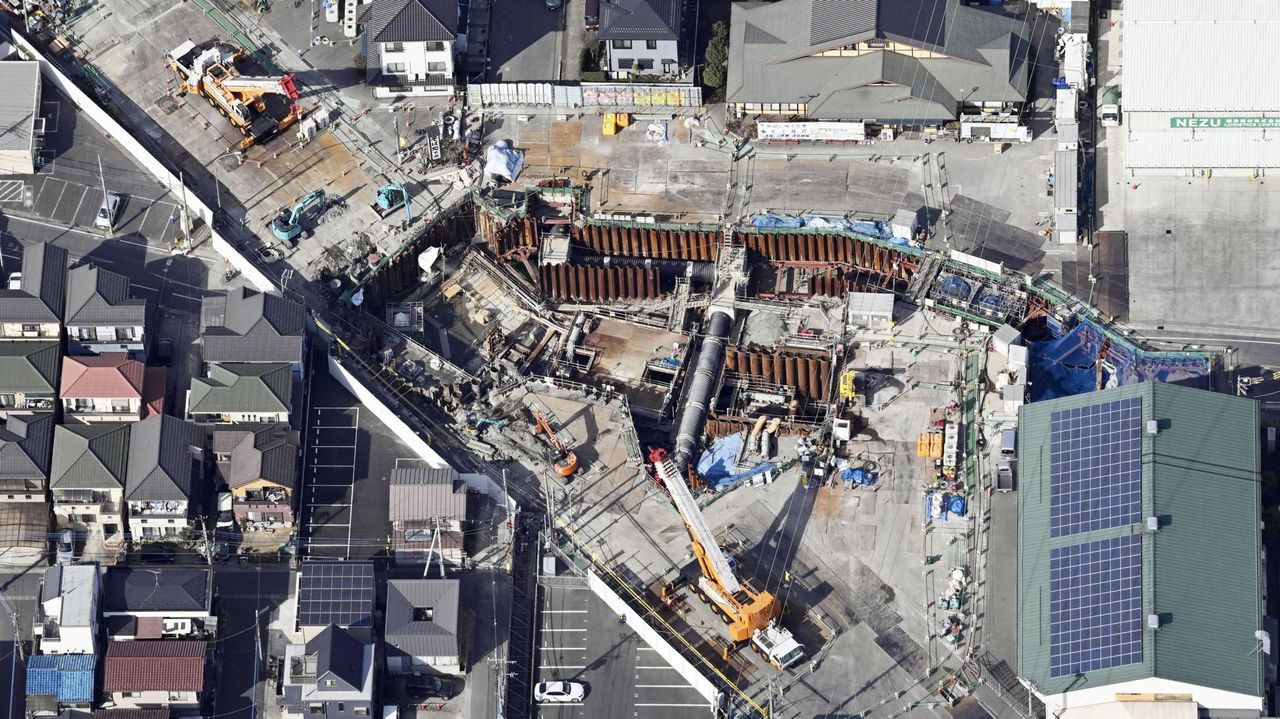
On March 27, the Japanese government approved a set of legal revisions in response to a road collapse accident in Yashio City, Saitama Prefecture. The goal: strengthen the maintenance of aging underground sewage pipes before more accidents occur.
The decision was made through a 閣議決定 (kakugi kettei) — a formal Cabinet decision — and includes proposed amendments to the Sewerage Act and the Road Act.
Let’s look at what this means, and what you can learn from the Japanese used in the report.
Stronger Measures for Aging Sewage Pipes
The accident in Saitama highlighted a serious issue: 老朽 (roukyuu), or deterioration over time. Across Japan, many sewage pipes were installed decades ago and are now aging.
In response to the accident — expressed in Japanese as 道路陥没事故を受け (douro kanbotsu jiko o uke) — the government outlined a new 方針 (houshin), or policy plan, aimed at reinforcing 維持管理 (iji kanri), meaning maintenance and management.
More Frequent Inspections
One major change is increasing inspection frequency. For areas where corrosion is especially severe, inspections will take place at least once every three years.
In Japanese, the article states:
- 腐食が特に進んでいる地点は「3年に1回以上」などとする方針。 Fushoku ga toku ni susunde iru chiten wa “san-nen ni ikkai ijou” nado to suru houshin. “The policy is to conduct inspections ‘once every three years or more’ in locations where corrosion is particularly advanced.”
Notice how specific and measurable the policy sounds — this precision is common in government announcements.
Preparing for Emergencies Through “Double Routing”
Another key measure is promoting 複線化 (fukusenka), literally “dual-lining” or “double routing.”
The idea is simple: if one sewage route becomes unusable due to a disaster or accident, another route should be available.
The article explains this with the verb 備える (sonaeru), meaning “to prepare for”:
- 災害や事故で使えなくなる事態に備え、別のルートで下水を流せるようにしておく。 Saigai ya jiko de tsukaenaku naru jitai ni sona e, betsu no ruuto de gesui o nagaseru you ni shite oku. “To prepare for situations in which the system becomes unusable due to disasters or accidents, sewage will be able to flow through another route.”
Japan, as a country prone to earthquakes and heavy rains, often emphasizes preparation and redundancy in infrastructure planning.
A New System for National and Local Cooperation
The government will also 創設 (sousetsu) — establish — a new system that strengthens cooperation between the national government and local municipalities in management and repairs.
Japan’s infrastructure is often managed at the municipal level, but large-scale support and coordination come from the national government. This reform aims to ensure smoother collaboration when dealing with deteriorating underground systems.
By combining multiple strategies, the government hopes to:
- Prevent underground cavities from forming near pipelines
- Detect problems early
This preventative concept is expressed through the word 抑止 (yokushi), meaning deterrence or prevention.
Cultural Context: Infrastructure and Responsibility
Infrastructure maintenance may not seem like a cultural topic at first glance. However, in Japan, public safety and long-term planning are deeply connected to social responsibility.
Words like 維持管理 (iji kanri) and 備える (sonaeru) reflect a mindset of careful stewardship — maintaining what already exists and preparing thoroughly for future risks.
You’ll often see these terms in government reports, disaster prevention plans, and public works discussions.
Learn Japanese from This Article
Let’s break down key vocabulary and grammar so you can use this language confidently.
Key Vocabulary
| Japanese | Romaji | Meaning |
|---|---|---|
| 閣議決定 | kakugi kettei | Cabinet decision |
| 老朽(ろうきゅう) | roukyuu | aging; deterioration over time |
| 維持管理 | iji kanri | maintenance and management |
| 方針(ほうしん) | houshin | policy; plan of action |
| 備える(そなえる) | sonaeru | to prepare for |
| 創設(そうせつ) | sousetsu | to establish (a system) |
| 抑止(よくし) | yokushi | deterrence; prevention |
These are formal, policy-level words — exactly the kind you’ll see in news articles and official statements.
Grammar Spotlight
1. 〜を受け
Meaning: “in response to”
Structure: Noun + を受け
Example from the article:
- 事故を受け、法改正案を決定した。 Jiko o uke, hou kaiseian o kettei shita. “In response to the accident, the legal revision was decided.”
This pattern is common in news writing. It connects a cause (often an event) with an official reaction.
2. 〜に向けた
Meaning: “aimed at,” “toward”
Structure: Noun + に向けた + Noun
Example from the article:
- 維持管理の強化に向けた改正案。 Iji kanri no kyouka ni muketa kaiseian. “A revision proposal aimed at strengthening maintenance.”
You’ll often see this in policy announcements, business strategies, and long-term plans.
Useful Expression
- 3年に1回以上(さんねんにいっかいいじょう) San-nen ni ikkai ijou “At least once every three years”
The pattern: Time period + に + frequency
Examples:
- 1年に1回 (ichi-nen ni ikkai) — once a year
- 2週間に1回 (ni-shuukan ni ikkai) — once every two weeks
Continue Learning
Working on your reading skills? Our Introduction to Kanji: Pictorial Foundations of Japanese Script lesson is a great next step.
Curious about the Japanese used here? Our Honorifics: Keigo for Respectful Dialogue lesson covers this in depth.
Want to learn more about culture? Check out our lesson on Basic Vocabulary Building: Embracing Words Without Latin Ties.
News articles like this are powerful learning tools. They show you how Japanese is actually used in society — in government, infrastructure, and real-world problem-solving.
Keep reading, keep noticing patterns, and keep building your intuition for how Japanese works in context.
これからもよろしくお願いします。 Kore kara mo yoroshiku onegaishimasu.