
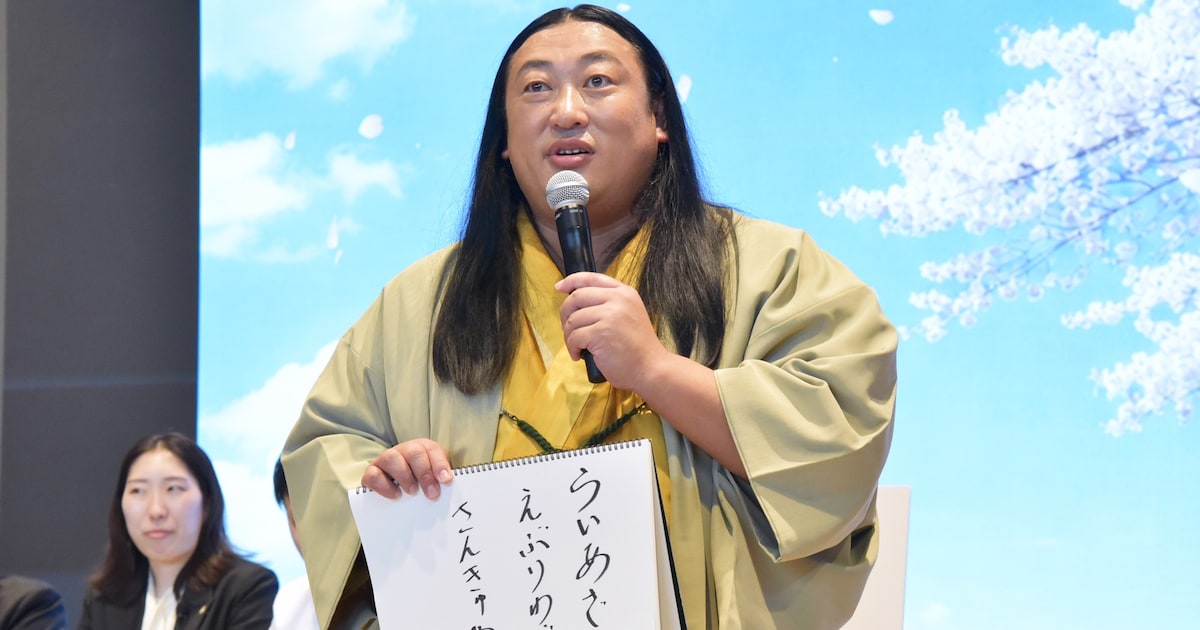
On March 26, 2026, comedian Robert Akiyama appeared in Tokyo—not as himself, but as the haiku master 秋山芭蕉 (Akiyama Bashō)—to critique poems about family restaurant food. His verdict? “季語とかはもう古い (kigo toka wa mō furui) — seasonal words are already outdated.”
The event was held ahead of Joyfull’s April 1 launch of its “Spring New Grand Menu.” In conjunction with (〜に伴い ni tomonai) the new menu release, the company hosted a press conference announcing both the dishes and a new TV commercial featuring Akiyama in full traditional attire.
Akiyama Bashō Takes the Stage
Joyfull’s official event, titled “2026 Spring Grand Menu & New TV-CM Presentation,” featured Akiyama in character as a refined haiku poet. He introduced himself by joking that he was “not a fake enka singer nor the leader of a suspicious organization.” Speaking in front of Joyfull’s president and employees, he added with a grin that he might as well rename himself “Joyfull Akiyama,” calling it open 媚び売り (kobiuri)—blatant flattery.
In the new commercial, Akiyama Bashō recites haiku inspired by the new dishes. While expressing humorous 謙遜 (kenson), or modesty, he quipped that maybe actor Motoki Masahiro would have been a better choice. At the same time, he praised the commercial for showing a “refreshing Kyoto feel” and even an “tea-like elegance.” Despite his mother in Kyushu telling him to cut his hair, Akiyama insisted that his long hairstyle is essential to his artistic identity.
“Seasonal Words Are Old-Fashioned”
The highlight of the event was a live poetry session titled “Akiyama Bashō Presents: Spring New Menu Haiku Gathering.” Employees involved in developing the new dishes read aloud their original haiku, and Akiyama publicly performed 添削 (tensaku), meaning corrections or revisions.
One employee presented this poem:
春が来た 豚肩白桃 お目見えだ Haru ga kita butakata hakutō omemie da “Spring has come—pork shoulder and white peach make their debut.”
Akiyama’s response? “Seasonal words are already old-fashioned. And if I were a pig, I’d find ‘pork shoulder’ a bit rude.”
Using a red pen, he rewrote it as:
恐縮です 豚のお肩に 白い桃 Kyōshuku desu buta no okata ni shiroi momo “I’m humbled—upon the honorable pig’s shoulder, a white peach.”
Here you can see his playful language shift. He replaced 春が来た (haru ga kita, “spring has come”)—a classic 季語 (kigo)—with 恐縮です (kyōshuku desu, “I’m humbled”), creating exaggerated politeness for comedic effect.
He didn’t just critique content. He demonstrated how to read the poems aloud properly, correcting pronunciation and rhythm つつ (tsutsu, while doing so) in a formal, literary style.
As the session continued, things became more extreme. At one point, he ignored the employees’ poems entirely and rewrote them from scratch. He even made an employee repeatedly sing a parody of “Love Is Over,” a song by Ouyang Fei Fei, because the employee said they liked it.
To close the session, Akiyama delivered a surreal haiku in English-sounding Japanese:
うぃあざわ えぶりわぶらざ さんきゅあす Ui azawa eburiwa buraza sankyuasu
It was his playful way of expressing world peace, love for humanity, and gratitude to the Earth—through exaggerated “English” written in Japanese sounds.
Tasting the New Menu… and Himself?
The event also included a tasting segment. Akiyama tried the dish:
肉旨!厚切り豚肩ロースステーキ にんにく醤油 Niku uma! Atsugiri butakata rōsu sutēki ninniku shōyu “Super tasty! Thick-cut pork shoulder steak with garlic soy sauce”
His reaction?
“うめー! (umee!) I want to taste the steam from the hot plate! In the end, I seriously want to be grilled on it!”
うめー (umee) is a very casual, slangy version of うまい (umai), meaning “delicious.” It’s loud, emotional, and very in-character for Akiyama.
Not wanting to “reduce the amount of meat,” he occasionally inserted his own hand between bites and gave it a gentle nibble—an example of his trademark 奇行 (kikou), or eccentric behavior. This light self-biting is called 甘噛み (amagami), meaning a soft nibble rather than a serious bite.
He also tasted the dessert:
ごろっと白桃とベリーのフロマージュパフェ Gorotto hakutō to berī no furomāju pafe “Chunky white peach and berry fromage parfait”
Calling it “perfect—not too sweet,” he then suddenly declared it was time to “return to pork” and went back to the steak.
Cultural Context: Haiku and Comedy
Traditional haiku follow a 5-7-5 syllable pattern and usually include a 季語 (kigo), a word that signals the season. Matsuo Bashō, the most famous haiku poet in Japanese history, helped define this structure in the 17th century.
By calling himself “Akiyama Bashō,” Robert Akiyama parodies that classical image. His claim that seasonal words are “old-fashioned” is intentionally provocative—it breaks one of haiku’s most sacred conventions for comedic effect.
This blend of high culture (classical poetry) and low culture (family restaurant promotions, food jokes, parody songs) is a hallmark of Japanese comedy.
Learn Japanese from This Article
Key Vocabulary
| Japanese | Romaji | Meaning |
|---|---|---|
| 添削 | tensaku | correction, revision (of writing) |
| 季語 | kigo | seasonal word used in haiku |
| 媚び売り | kobiuri | flattery, sucking up |
| 謙遜 | kenson | modesty, downplaying oneself |
| 奇行 | kikou | eccentric behavior |
| 甘噛み | amagami | gentle bite, nibble |
| うめー | umee | super tasty (slang of うまい) |
Grammar Spotlight
1. 〜に伴い (ni tomonai) — “accompanying; due to”
Formal expression often used in news writing.
新メニューの発売に伴い、イベントが開催された。 Shin menyū no hatsubai ni tomonai, ibento ga kaisai sareta. “Accompanying the release of the new menu, an event was held.”
You’ll frequently see this pattern in announcements and official statements.
2. 〜つつ (tsutsu) — “while doing; although”
Used in formal written Japanese.
指摘しつつ、実演もした。 Shiteki shitsutsu, jitsuen mo shita. “While pointing out issues, he also gave a demonstration.”
It implies two actions happening simultaneously, often with nuance.
Useful Expressions
- 恐縮です (kyōshuku desu) — “I’m humbled / I’m very sorry” (very polite, often humorous in exaggeration)
- お目見えだ (omemie da) — “makes its debut” (formal announcement style)
- うめー! (umee!) — Casual, masculine “So good!”
Continue Learning
Working on your reading skills? Our Katakana Essentials: Adapting Global Words to Japanese lesson is a great next step.
Ready to dive deeper? Our lesson on Basic Vocabulary Building: Embracing Words Without Latin Ties will help you master these concepts.
For kanji foundations, explore Introduction to Kanji: Pictorial Foundations of Japanese Script.
Comedy, classical poetry, food reviews, and playful language—all in one press event. Articles like this show how Japanese blends tradition and humor in ways textbooks rarely capture.
これからもよろしくお願いします。 Kore kara mo yoroshiku onegaishimasu.