
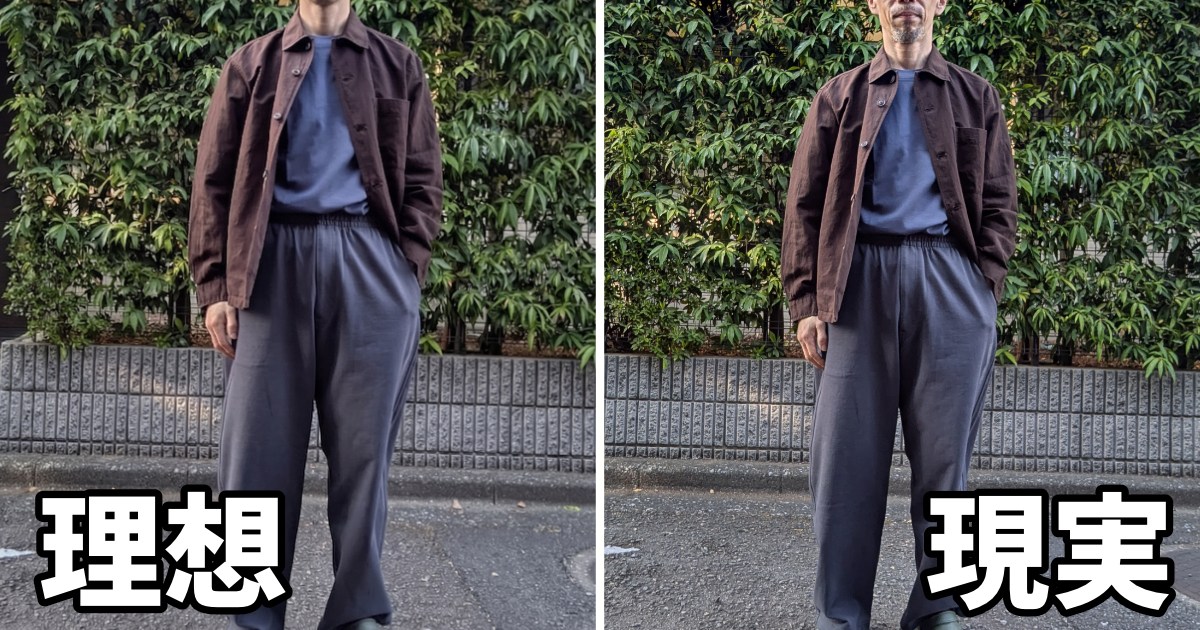
On March 20, 2026, Uniqlo released a new item: the スウェットカーブパンツ (suwetto kābu pantsu)—priced at 税込3990円 (zeikomi 3990 en), tax included. Online, a tall foreign model wears them effortlessly. But when one Japanese writer tried to copy the exact outfit, he says he somehow turned into “Tora-san.”
What happened?
The Gap Between the Model and Reality
The writer, Sato from Rocket News, has long had one request for apparel companies: please 起用する (kiyou suru)—appoint—Japanese models with more average Japanese body types.
Many brands, he explains, use tall, slim foreign models. The image looks great in advertisements. But when regular customers wear the same clothes, there can be a serious 乖離(かいり) (kairi)—a gap or divergence—between expectation and reality.
This time, the item in question was Uniqlo’s new sweat curve pants. They’re made of 100% cotton, lightweight French terry material, with a wide fit. The waist features elastic and a drawstring, and the front has a zipper. The hems also have adjustable cords so you can change the silhouette.
On the official site, the pants are styled in a cool, relaxed way. The model—187 cm tall—着こなす (kikonasu) them stylishly and effortlessly.
Sato? He is 169 cm tall and weighs 60 kg. Compared to others his age, he considers himself relatively slim.
But when he tried the full coordination himself—案の定 (an no jou), just as he expected—something felt off.
The Full Outfit Attempt
To match the online styling as closely as possible, Sato paired the sweat curve pants with:
- エアリズムコットンオーバーサイズTシャツ (Airism cotton oversized T-shirt) – 税込1990円 (zeikomi 1990 en)
- コットンリネンシャツジャケット (cotton linen shirt jacket) – 税込4990円 (zeikomi 4990 en)
The official model wore a purple short blouson, but the store didn’t have the same color in Sato’s size, so he had to 代用する (daiyou suru)—substitute—it with the shirt jacket instead.
Before even trying it on, he worried these wide sweatpants might look too casual on a “short-legged middle-aged man,” possibly going straight to pajama status without ever becoming real everyday wear.
And then he put them on.
Somehow… Tora-san?
The result, in his words, felt strangely “Japanese.” Not in a sleek, fashion-forward way—but in a nostalgic way.
He says he ended up looking like 寅さん(とらさん) (Tora-san), whose real name is 車寅次郎 (Kuruma Torajirō), the wandering, lovable protagonist from the long-running film series Otoko wa Tsurai yo.
Tora-san is known for his casual, slightly old-fashioned style: loose pants, simple jackets, a hat, and a travel bag. He’s a beloved cultural icon in Japan, representing the easygoing but sentimental “downtown” spirit.
When Sato looked at himself in the outfit, he sensed an undeniable Tora-san “vibe.” A subtle 違和感 (iwakan)—that uncomfortable feeling when something just isn’t quite right—lingered.
Then he leaned into it.
He put on a hat.
Surprisingly, it worked. Add a bag, and the balance improved even more. Once text was added to the photo like a movie poster, the transformation felt complete.
Instead of fighting the resemblance, embracing it made the outfit feel natural.
Why This Happens: Body Type and Image
Sato’s conclusion is simple: the average Japanese body type and the tall foreign model’s body type are very different. When brands repeatedly 起用する (kiyou suru) very tall, slim models, the styling image may not reflect how the clothes will look on typical Japanese customers.
The result? Some people may unintentionally transform into Tora-san.
It’s a humorous story, but it also highlights something important about fashion marketing—and expectations.
Cultural Context: Who Is Tora-san?
If you’re not familiar with Tora-san, here’s why this reference matters.
The Otoko wa Tsurai yo film series ran from 1969 to 1995 and is one of Japan’s most famous movie franchises. Tora-san is a traveling salesman with a warm heart and a slightly clumsy charm. His fashion is practical, relaxed, and unmistakably “Showa-era Japanese.”
So when Sato says he “became Tora-san,” Japanese readers immediately picture:
- Slightly loose, casual clothes
- A nostalgic, down-to-earth atmosphere
- A lovable but unfashionable middle-aged man
That cultural image makes the joke instantly clear in Japan.
Learn Japanese from This Article
Let’s look at key vocabulary and grammar that appeared in this story.
Vocabulary
| Japanese | Romaji | Meaning |
|---|---|---|
| 起用する | kiyou suru | to appoint; to use (someone for a role) |
| 着こなす | kikonasu | to wear something stylishly |
| 案の定 | an no jou | as expected; just as I thought |
| 税込 | zeikomi | tax included |
| 代用する | daiyou suru | to substitute; to use as a replacement |
| 乖離(かいり) | kairi | gap; divergence |
| 違和感 | iwakan | a sense that something feels off |
Notice how many of these words are common in reviews, fashion discussions, and opinion pieces.
Grammar Spotlight 1: 〜てしまう
Pattern: Verb (て-form) + しまう
This expresses:
- Doing something unintentionally
- Regret
- Something happening completely
Example inspired by the article:
寅さんになってしまった。 Tora-san ni natte shimatta. I ended up becoming Tora-san.
パジャマ直行になってしまう。 Pajama chokkō ni natte shimau. It’ll end up going straight to pajama status.
This pattern often carries emotional nuance—surprise, disappointment, or humor.
Grammar Spotlight 2: 〜ことなく
Pattern: Verb (dictionary form) + ことなく “Without doing ~”
From the article’s idea:
- 普段着に昇格することなく、パジャマになる。 Fudangi ni shōkaku suru koto naku, pajama ni naru. It becomes pajamas without ever being promoted to everyday wear.
This structure sounds slightly formal and is common in writing.
Useful Expression: Feeling a Gap
- イメージと現実の乖離がある。 Imēji to genjitsu no kairi ga aru. There’s a gap between the image and reality.
You can use this for fashion, language learning, or even life expectations!
Continue Learning
📚 Want to understand the verb forms used here? Check out Masu Form: Mastering Polite Everyday Speech.
📚 Ready to dive deeper? Our lesson on Greetings and Self-Introductions: Authentic Entry Phrases will help you master these concepts.
📚 Curious about the Japanese used here? Our Basic Vocabulary Building: Embracing Words Without Latin Ties lesson covers this in depth.
Basic Vocabulary Building: Embracing Words Without Latin Ties
これからもよろしくお願いします。 Kore kara mo yoroshiku onegaishimasu.