
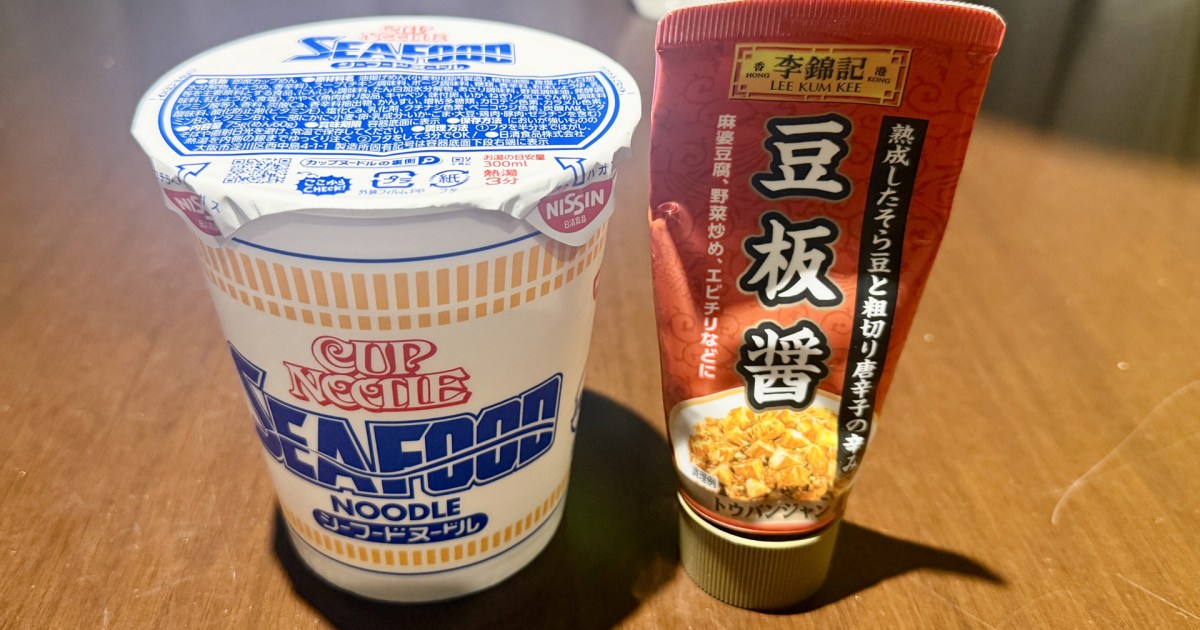
“Cup noodles only truly begin after you customize them.” That bold statement opens the latest installment of Rocket News’ popular “Cup Noodle Customization Championship.” This time, the spotlight is on a surprisingly simple combo: 日清カップヌードル シーフード (Nisshin Kappu Nūdoru Shīfūdo) and S&B 李錦記 豆板醤チューブ (S&B Rikyūki Tōbanjan Chūbu).
Just one spoon of spicy bean paste—and the soup turns bright red.
A Reader’s Addictive Discovery
The recipe came from a reader named Matsumoto, who responded to the site’s earlier 募集 (boshū)—a call for entries.
He wrote that although he had barely eaten instant or retort foods in his life, recently he became hooked on adding doubanjiang to Seafood Cup Noodles, mixing it well until the soup turns red.
He even joked that, despite reaching the halfway point of his life, he’s “racing toward the finale” because he can’t stop eating it.
In Japanese, he uses the powerful grammar pattern:
- 人生折り返し地点にさしかかったにもかかわらず、終幕に向けて爆走しております。 Jinsei orikaeshi chiten ni sashikakatta ni mo kakawarazu, shūmaku ni mukete bakusō shite orimasu. “Although I’ve reached the halfway point of my life, I’m racing full speed toward the final act.”
That phrase 〜にもかかわらず (ni mo kakawarazu) means “despite” or “although.” We’ll look at it more closely later.
Why Seafood Cup Noodles?
Interestingly, the hosts noticed that among all submissions, an overwhelming number used 日清カップヌードルのシーフードヌードル (Nisshin Kappu Nūdoru no Shīfūdo Nūdoru).
Why?
Commentator GO Hatori compared it to motorcycles: some models are especially satisfying to customize. Seafood Cup Noodles, with their slightly sweet and creamy base, seem to have that same “customization potential.”
In Japan, cup noodles aren’t just convenience food—they’re part of daily life. Tweaking them is almost like a hobby.
How to Make It
The instructions are refreshingly simple:
- Prepare the Seafood Cup Noodles as usual.
- Add about one teaspoon of doubanjiang—小さじ1杯〜お好み (kosaji ippai ~ okonomi), meaning “1 teaspoon or as you like.”
- Mix well.
- Adjust by adding more if needed.
The beauty of this recipe lies in its 手軽さ (tegārusa)—its convenience. You just squeeze the tube and stir.
Hatori first tried a slightly heaping teaspoon. The result?
“Pretty delicious,” he said. The flavor gained depth and thickness. But then he added more—because why not 足す (tasu), “add” a little extra?
With two heaping teaspoons, he described the taste as reminiscent of slightly spicy noodles you might find in a casual diner in Hong Kong or Taiwan. The “Asia-ness” increased dramatically.
He even said he might 挑戦する (chōsen suru), “challenge himself,” with three heaping teaspoons next time.
If you’re sensitive to spice, though, take caution.
A Hint of Sweetness Meets Spice
One key point: Seafood Cup Noodles are slightly sweet to begin with. That sweetness balances the heat of the doubanjiang.
This balance is important in Japanese flavor design. Many packaged foods lean slightly sweet because it pairs well with saltiness and spice. When you add doubanjiang, you’re not just making it spicy—you’re creating contrast.
Hatori even suggested adding sausage might work well, though he quickly caught himself before going too far down the customization rabbit hole.
That’s the danger, apparently. It’s addictive.
Cultural Context: The Joy of Customization
Japanese convenience food often invites personalization. From adding mayonnaise to yakisoba to cracking a raw egg into hot udon, “customizing” is part of the culture.
The word for this is カスタム (kasutamu), borrowed from English, but the mindset reflects something deeply Japanese: improving and refining even simple things.
Notice also how Matsumoto humbly says he only discovered Seafood Cup Noodles “late in life.” That self-deprecating tone is common in Japanese writing—it softens enthusiasm and makes it relatable.
Learn Japanese from This Article
Vocabulary
| Japanese | Romaji | Meaning |
|---|---|---|
| 減量 | genryō | weight reduction |
| 募集 | boshū | recruitment; call for entries |
| 愛用する | aiyō suru | to use regularly; to favor |
| お好み | okonomi | to one’s liking; as you like |
| 足す | tasu | to add |
| 挑戦する | chōsen suru | to challenge; to try |
| 手軽さ | tegārusa | convenience; easiness |
You’ll notice how naturally these words fit daily life conversations in Japan—not just formal writing.
For example:
私はこのチューブを愛用しています。 Watashi wa kono chūbu o aiyō shite imasu. “I regularly use this tube.”
辛さはお好みで調整してください。 Karasa wa okonomi de chōsei shite kudasai. “Adjust the spiciness as you like.”
Grammar Spotlight
1. 〜にもかかわらず (Despite; Although)
Structure: Plain form + にもかかわらず
Example from the article:
- 人生折り返し地点にさしかかったにもかかわらず、爆走しています。 Despite reaching the midpoint of life, I’m racing ahead.
Another example:
- 辛いものが苦手にもかかわらず、豆板醤を足してみました。 Although I’m bad with spicy food, I tried adding doubanjiang.
This expression sounds formal and is often used in writing.
2. 〜てみる (Try Doing)
Structure: Verb (て-form) + みる
From the article:
- 入れてみました。 I tried adding it.
Another example:
- 小さじ2を足してみようかな。 Maybe I’ll try adding two teaspoons.
This pattern expresses experimentation—perfect for cooking and customization.
Useful Expressions
- とりあえず (toriaezu) — “for now; first of all”
- 全然アリ (zenzen ari) — “totally acceptable” (casual)
- ハマる (hamaru) — “to get hooked on”
Example:
- 最近、この味にハマっています。 Saikin, kono aji ni hamatte imasu. “Recently, I’ve been hooked on this flavor.”
Continue Learning
Curious about how time and life stages are expressed in Japanese—like “reaching the halfway point of life”? Check out:
- Time and Dates: Tense-Free Expressions: Curious about the Japanese used here? Our Time and Dates: Tense-Free Expressions lesson covers this in depth.
One squeeze of doubanjiang, one stir, and suddenly your everyday cup noodles feel like a trip abroad. That’s the magic of customization—and the beauty of learning Japanese through real-life culture.
Would you try one teaspoon? Or go straight to three?
これからもよろしくお願いします。 Kore kara mo yoroshiku onegaishimasu.