
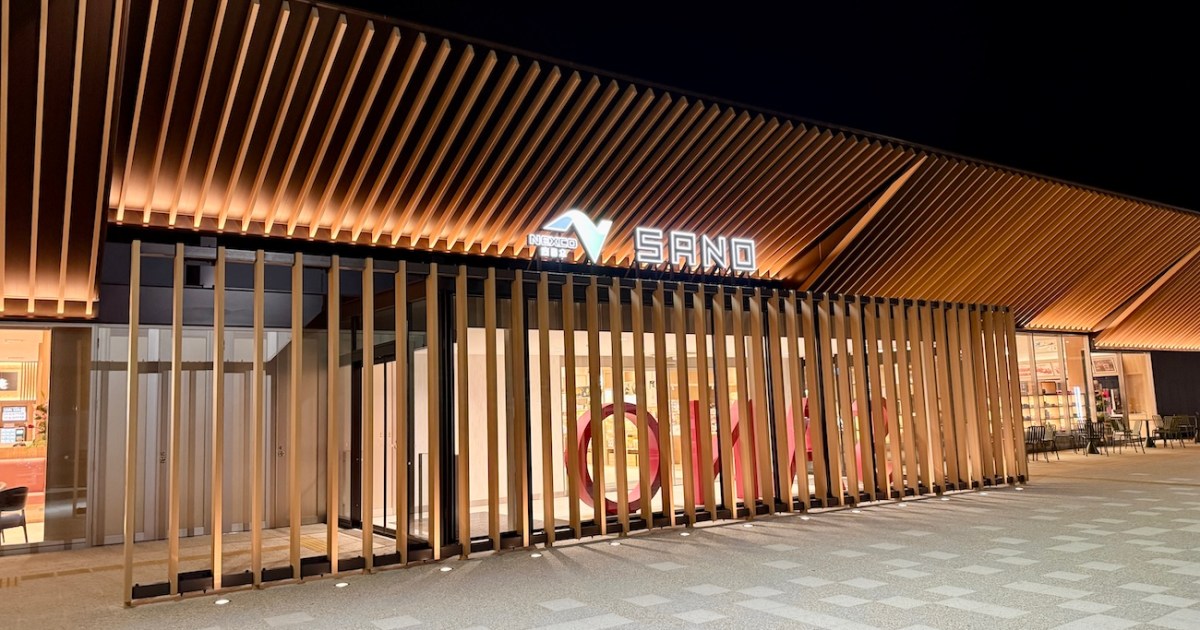
On March 17, 2026, the upbound side of 佐野サービスエリア(上り) (Sano sābisu eria (nobori)) officially reopened on the Tōhoku Expressway—marking the completion of a years-long リニューアル (rinyūaru, renewal). With this final phase finished, Sano SA has become what the writer calls its “complete form.”
And after seeing it in person, it’s hard to call it just a highway rest stop anymore.
A Service Area Designed as a “Park”
Construction on Sano SA began back in 2021. The downbound side opened first in 2022, and now the upbound side has followed, creating a fully renewed space.
What makes this service area unique is that the 上下線(じょうげせん) (jōgesen, upbound and downbound lanes) are connected by stairs. That means no matter which direction you’re driving, you can walk over and use the facilities on the other side.
Instead of treating each side separately, the entire space has been redesigned under a single “park” concept, making use of the natural surroundings and this easy access between both directions. In fact, NEXCO East Japan even refers to it as 「佐野パークSA」 (Sano Pāku SA).
The architectural supervision was handled by Kengo Kuma & Associates, the same firm behind the Japan National Stadium and Takanawa Gateway Station. The design emphasizes warmth and wood textures, giving the space a calm, natural feeling.
A Surprise from New York: The Chandelier
Right at the entrance, visitors are greeted by a luxurious chandelier. And not just any chandelier.
According to the explanation panel, it’s an authentic piece that was actually used at New York’s historic Plaza Hotel. Yes—the same Plaza Hotel known for hosting celebrities from around the world, including The Beatles in 1964.
Feeling a bit of New York history in Tochigi Prefecture? That unexpected contrast is part of the fun.
The Real 目玉(めだま): 24-Hour Sano Ramen
As impressive as the building is, the true 目玉 (medama, main attraction) is the food.
In 2025, 佐野ラーメン (Sano rāmen) won first place in Japan’s “Local Ramen General Election.” Now, with this renewal, a major development has arrived in the food court: the popular local shop 麺屋 ようすけ (Menya Yōsuke) has opened its first highway location under the name 麺屋 ようすけplus (Menya Yōsuke plus).
And here’s the big news: it’s 24時間営業(にじゅうよじかんえいぎょう) (nijūyojikan eigyō)—open 24 hours a day.
Being able to eat famous Sano ramen anytime, even late at night, is a game-changer for drivers.
The writer tried a bowl of Sano ramen at the special opening price of 850 yen. The soup was clear yet rich, light but full of flavor. The noodles were smooth and pleasantly textured. It balanced tradition and newness in a way that even locals would feel 納得 (nattoku, satisfied and convinced by the quality).
“If I ever crave Sano ramen at midnight,” the writer suggests, “I’ll just stop by the service area.”
A Wall of Ramen and No Blind Spots
Beyond the restaurant itself, there’s also a らーめんウォール (rāmen wōru, “ramen wall”) lined with more than 35 types of instant Sano ramen products. The sight is described as 圧巻(あっかん) (akkan, spectacular or overwhelming).
Classic Tochigi souvenirs are also fully stocked. In other words, there are no weak points.
Since the downbound side was only recently renewed in 2022, both directions now feel fresh and modern. With abundant dining options, souvenir shops, and the convenience of moving freely between 上下線 (jōgesen), Sano SA is likely to become an increasingly popular place to 立ち寄る(たちよる) (tachiyoru, stop by).
It may even become a destination in itself—not just a rest stop.
Cultural Context: Why Service Areas Matter in Japan
In many countries, highway rest stops are purely functional. In Japan, however, service areas (SA) and parking areas (PA) often become regional showcases.
They feature local specialties, limited-edition snacks, and famous restaurants. It’s common for travelers to plan which service areas they’ll 立ち寄る (tachiyoru) at—not just for gas or bathrooms, but for memorable food.
That’s why having a local ramen champion available 24時間営業 (nijūyojikan eigyō) is such a big deal. It reflects Japan’s dedication to quality and regional pride—even on the highway.
Learn Japanese from This Article
Key Vocabulary
| Japanese | Romaji | Meaning |
|---|---|---|
| リニューアル | rinyūaru | renewal, reopening after renovation |
| 上下線(じょうげせん) | jōgesen | upbound and downbound lanes |
| 立ち寄る | tachiyoru | to stop by |
| 目玉(めだま) | medama | highlight, main attraction |
| 圧巻(あっかん) | akkan | spectacular, overwhelming |
| 納得(なっとく) | nattoku | satisfaction, acceptance |
| 24時間営業(にじゅうよじかんえいぎょう) | nijūyojikan eigyō | open 24 hours |
Try making your own sentence: 夜中にラーメンが食べたくなったら、佐野SAに立ち寄ります。 Yonaka ni rāmen ga tabetakunattara, Sano SA ni tachiyorimasu. “If I crave ramen at night, I’ll stop by Sano SA.”
Grammar Spotlight
1. 〜といえば — “Speaking of…” / “When it comes to…”
Used to bring up a typical or well-known example.
佐野SAといえば、ラーメンです。 Sano SA to ieba, rāmen desu. “Speaking of Sano SA, it’s ramen.”
プラザホテルといえば、有名人が泊まるホテルです。 Puraza hoteru to ieba, yūmeijin ga tomaru hoteru desu. “Speaking of the Plaza Hotel, it’s a hotel where celebrities stay.”
This pattern is very common in conversation when connecting ideas naturally.
2. 〜たら — If / When
Used for conditions or “when that happens” situations.
夜中にお腹がすいたら、ラーメンを食べます。 Yonaka ni onaka ga suitara, rāmen o tabemasu. “If I get hungry at night, I eat ramen.”
東北道を通ったら、佐野SAに立ち寄ってください。 Tōhokudō o tōttara, Sano SA ni tachiyotte kudasai. “If you drive on the Tōhoku Expressway, please stop by Sano SA.”
Notice the polite 〜ます forms. Want to understand these verb endings better? Check out our lesson below.
Continue Learning
📚 Want to understand the verb forms used here? Check out Masu Form: Mastering Polite Everyday Speech.
📚 Ready to dive deeper? Our lesson on Greetings and Self-Introductions: Authentic Entry Phrases will help you master these concepts.
📚 Want to learn more about lifestyle? Check out our lesson on Basic Vocabulary Building: Embracing Words Without Latin Ties.
Basic Vocabulary Building: Embracing Words Without Latin Ties
これからもよろしくお願いします。 Kore kara mo yoroshiku onegaishimasu.