
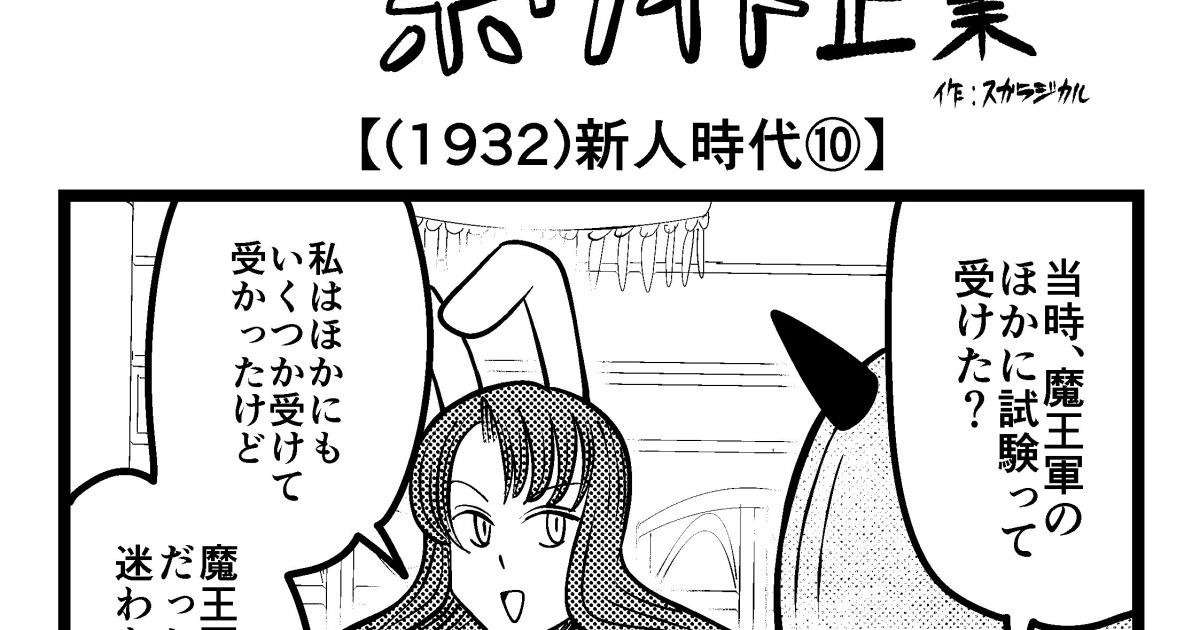
【4コマ】魔王軍はホワイト企業 1932話目「新人時代⑩」 was published on March 18, 2026, on Rocket News. The comic is illustrated by スガラジカル and continues the long-running series about an unusually “employee-friendly” Demon King’s army.
This installment is labeled 1932話目 (sen kyūhyaku sanjū ni hanashime)—episode 1932—and carries the subtitle 「新人時代⑩」 (shinjin jidai jū), meaning “Newcomer Days (10).” Readers can navigate using links such as 「前の話へ」 (mae no hanashi e, “to the previous episode”) or 「第1回から読む」 (dai ikkai kara yomu, “read from episode 1”). There is also 「キャラ一覧はこちら」 (kyara ichiran wa kochira, “character list is here”), guiding readers to an overview of the cast.
Even in this short set of navigation phrases, you can see how naturally Japanese structures information—and how much vocabulary you can pick up from a simple manga page.
What Is “魔王軍はホワイト企業”?
The title 魔王軍はホワイト企業 (maō-gun wa howaito kigyō) literally means “The Demon King’s Army Is a White Company.”
In Japan, a ホワイト企業 (howaito kigyō) is a company with good working conditions—the opposite of a “black company” (ブラック企業, burakku kigyō), known for overwork and harsh treatment.
The series is presented as a 4コマ (yonkoma) 漫画 (manga), meaning a four-panel comic strip. This format is common in Japanese newspapers and websites. Each episode is short, but with 1932 installments, it’s clearly a long-running and beloved series.
The subtitle 「新人時代⑩」 tells us this is the tenth entry in a sub-arc about someone’s “new employee days.” Even without more story details, the structure shows how Japanese media carefully numbers and organizes content.
How Navigation Language Works in Japanese Manga
Online manga platforms in Japan typically include simple navigation phrases:
- 前の話へ (mae no hanashi e) — “To the previous story”
- 第1回から読む (dai ikkai kara yomu) — “Read from episode 1”
- キャラ一覧はこちら (kyara ichiran wa kochira) — “Character list is here”
These short expressions are practical, polite, and compact—very much in line with Japanese web design.
Let’s break them down so you can start recognizing these patterns everywhere.
Cultural Context: The Meaning of “White Company”
The phrase ホワイト企業 (howaito kigyō) reflects modern Japanese work culture.
In Japan, discussions about work-life balance are often framed in terms of:
- ブラック企業 (burakku kigyō) — exploitative companies
- ホワイト企業 (howaito kigyō) — fair, supportive companies
By placing the Demon King’s army in the “white company” category, the manga creates humor through contrast. A villainous organization is run more ethically than some real-world companies—that irony is part of the appeal.
Even just from the title and episode labeling, you’re seeing how Japanese blends humor, social commentary, and structured numbering.
Learn Japanese from This Article
Vocabulary
| Japanese | Romaji | Meaning |
|---|---|---|
| 漫画 | manga | comic; manga |
| 前 | mae | before; previous |
| 話 | hanashi | story; episode; talk |
| 第〜回 | dai ~ kai | episode number; occurrence number |
| 読む | yomu | to read |
| 一覧 | ichiran | list; overview |
| こちら | kochira | this way; here (polite) |
Grammar Spotlight
1️⃣ 第〜回 (だい〜かい)
This counter is used to number episodes, events, or installments.
Pattern: 第 + number + 回
Examples:
- 第1回 (dai ikkai) — Episode 1
- 第10回 (dai jukkai) — Episode 10
- 第1932話目 (dai sen kyūhyaku sanjū ni hanashime) — 1932nd episode
You’ll see this in TV shows, manga, competitions, and events.
2️⃣ 〜から + Verb
This pattern means “starting from ~” or “since ~.”
Pattern: Noun + から + Verb
Example from the article:
- 第1回から読む Dai ikkai kara yomu “Read from episode 1.”
More examples:
今日から勉強します。 Kyō kara benkyō shimasu. “I will study starting today.”
日本から来ました。 Nihon kara kimashita. “I came from Japan.”
Notice the polite verb 読みます (yomimasu) form comes from 読む (yomu). If you’d like to better understand these polite forms, see the lesson below.
Useful Expressions You’ll See Online
- 前の話へ — To the previous episode
- 〜から読む — Read from ~
- 一覧はこちら — The list is here
Once you recognize these, navigating Japanese websites becomes much easier.
Continue Learning
📚 Want to understand the verb forms used here? Check out Masu Form: Mastering Polite Everyday Speech.
📚 To understand more about lifestyle, explore our Greetings and Self-Introductions: Authentic Entry Phrases lesson.
📚 Want to learn more about lifestyle? Check out our lesson on Basic Vocabulary Building: Embracing Words Without Latin Ties.
Basic Vocabulary Building: Embracing Words Without Latin Ties
これからもよろしくお願いします。 Kore kara mo yoroshiku onegaishimasu.