
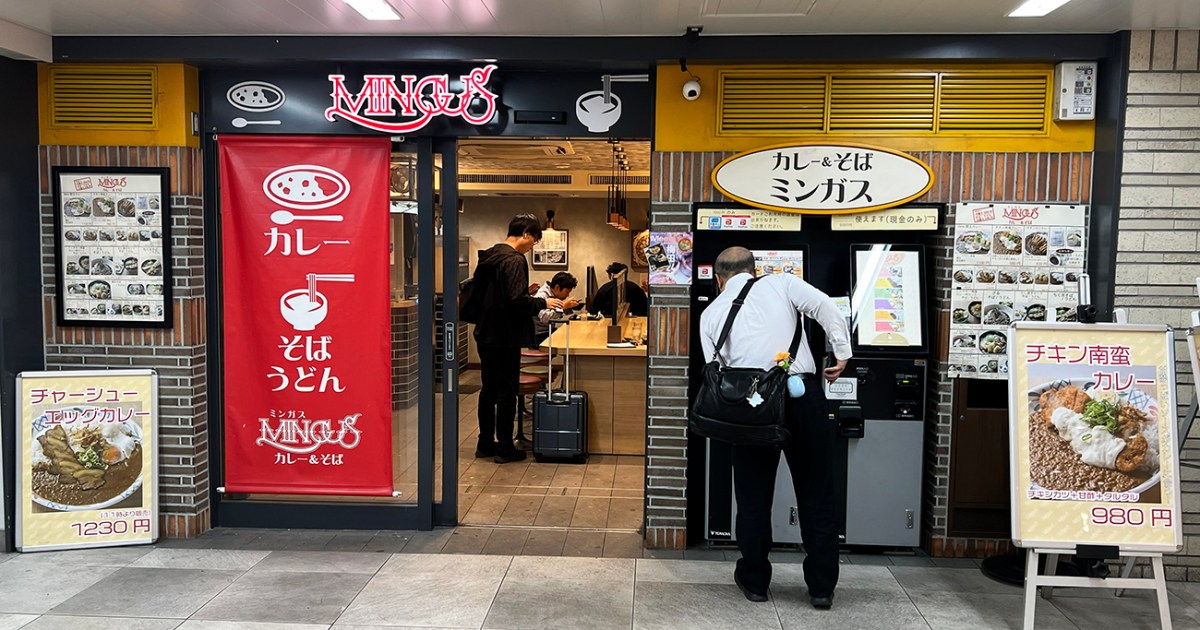
Curry & Soba Mingus at Osaka Umeda Station serves a 1,180-yen set that includes ざるそば (zaru soba) and chicken nanban curry rice, but the more surprising detail is its family line: the shop quietly carries the taste of 阪神そば (Hanshin Soba), a station soba brand founded in 1966. Rocket News visited the shop at the Hanshin Railway Osaka Umeda Station area and found a place that feels half curry shop, half station soba stand.
The shop sits near the 改札 (kaisatsu), or ticket gate, in the maze-like Umeda station area, where JR, Hankyu, Hanshin, and Osaka Metro all connect. According to Rocket News, the writer noticed the shop while walking nearby and, after checking the 券売機 (kenbaiki), or ticket vending machine, saw that the soba menu was just as full as the curry menu.
A shop that feels like both curry and station soba
From the outside, Mingus looks mainly like a curry shop. At lunchtime, though, the menu shows serious soba options too. The sign clearly says カレー&そば (karē & soba), “curry and soba,” and the balance between the two is what makes the shop stand out.
The writer bought a ticket for the ざるそばチキン南蛮カレー丼セット (zaru soba chikin nanban karē don setto), a chilled soba and chicken nanban curry bowl set, and then 入店 (nyuuten), entered the shop. Inside, the 雰囲気 (fun'iki), or atmosphere, felt more like a station soba place, with single-person counter seats along the wall.
The curry was described as a slightly sweet European-style curry with rich depth. Even though the menu board emphasizes toppings, the sauce itself gave the impression of a shop with its own curry identity. But the chilled soba was also strong: firm noodles, a smooth texture, and a rich, spicy dipping broth. The writer even called it unusually refined for Osaka soba.
The soba comes from a long-established station brand
The answer was on signs inside the shop. One explained that Mingus is a 老舗 (shinise), a long-established curry shop that has been in Umeda’s underground area for more than half a century. Another sign, titled 阪神そばからミンガスへ (Hanshin soba kara Mingusu e), showed where the soba side comes from.
Mingus was founded in 1972, making 2026 its 54th year. Hanshin Soba was founded in 1966, making it 60 years old. The writer was struck by this “hybrid” history: a curry shop with 54 years behind it, serving soba tied to a 60-year station soba brand.
When the writer asked a staff member about the relationship, they explained that Mingus opened as Mingus from the beginning and has the same operating company as Hanshin Soba. The curry-and-soba hybrid form began with the 2021 renewal tied to station 再開発 (saikaihatsu), redevelopment.
A quiet stop in busy Umeda
For station soba fans, that means an old Hanshin Soba taste can be found in a curry shop in Umeda. The source notes that Hanshin Soba is a long-running station soba shop at Amagasaki Station, which makes Mingus feel like a hidden shortcut for people who want that flavor in central Osaka.
The shop introduced here is カレー&そば ミンガス (Karē & Soba Mingusu), located in 大阪市北区梅田3丁目大阪駅前地下街7号 (Ōsaka-shi Kita-ku Umeda 3-chōme Ōsaka-ekimae chikagai 7-gō). Its hours are 7:30 a.m. to 10:00 p.m. on weekdays, 9:00 a.m. to 9:00 p.m. on weekends and holidays, and it closes for the year-end and New Year holiday period. The writer recommends it as a convenient meal during 観光 (kankou), sightseeing, in Osaka.
Learn Japanese from This Article
Vocabulary
| Japanese | Romaji | Meaning |
|---|---|---|
| 改札 | kaisatsu | ticket gate |
| 券売機 | kenbaiki | ticket vending machine |
| 入店 | nyuuten | entering a shop |
| 雰囲気 | fun'iki | atmosphere, vibe |
| 老舗 | shinise | long-established shop or business |
| 創業 | sougyou | founding of a business |
| 再開発 | saikaihatsu | redevelopment |
| 観光 | kankou | sightseeing, tourism |
Grammar Spotlight
〜ところ
Used for “when,” “just as,” or “in the middle of doing something,” often when something is discovered or happens at that moment.
From the article: 先日周辺をウロついていたところ、改札のところにこっそり味のある店が佇んでいることに気づいた。 Senjitsu shuuhen o urotsuite ita tokoro, kaisatsu no tokoro ni kossori aji no aru mise ga tatazumonde iru koto ni kidzuita. “The other day, while I was wandering around the area, I noticed a quietly charming shop standing near the ticket gate.”
Example: 駅を歩いていたところ、小さなそば屋を見つけました。 Eki o aruite ita tokoro, chiisana sobaya o mitsukemashita. “While I was walking through the station, I found a small soba shop.”
Example: メニューを見ていたところ、カレーとそばのセットがありました。 Menyuu o mite ita tokoro, karē to soba no setto ga arimashita. “While I was looking at the menu, I saw a curry-and-soba set.”
〜に伴う
Used for “accompanying,” “due to,” or “associated with” a change or event.
From the article: カレーとそばのハイブリッドになったのは駅の再開発に伴う2021年のリニューアルオープンかららしい。 Karē to soba no haiburiddo ni natta no wa eki no saikaihatsu ni tomonau 2021-nen no rinyūaru ōpun kara rashii. “It seems the curry-and-soba hybrid began with the 2021 reopening associated with the station’s redevelopment.”
Example: 工事に伴う休業で、店はしばらく閉まっていました。 Kouji ni tomonau kyuugyou de, mise wa shibaraku shimatte imashita. “Because of a closure accompanying construction, the shop was closed for a while.”
Example: 再開発に伴う変更で、駅の中の店も新しくなりました。 Saikaihatsu ni tomonau henkou de, eki no naka no mise mo atarashiku narimashita. “With changes associated with redevelopment, the shops inside the station also became new.”
Useful Expressions
カレー&そば karē & soba “Curry and soba” — a simple but useful sign phrase when a shop serves both.
阪神そばからミンガスへ Hanshin soba kara Mingusu e “From Hanshin Soba to Mingus” — useful for seeing how 〜から〜へ shows movement or transition from one thing to another.
ガチ名店 gachi meiten “A seriously great shop” or “the real deal” — very casual, emphatic Japanese.
Continue Learning
- Time and Dates: Tense-Free Expressions: Curious about the Japanese used here? Our Time and Dates: Tense-Free Expressions lesson covers this in depth.
これからもよろしくお願いします。 Kore kara mo yoroshiku onegaishimasu.