
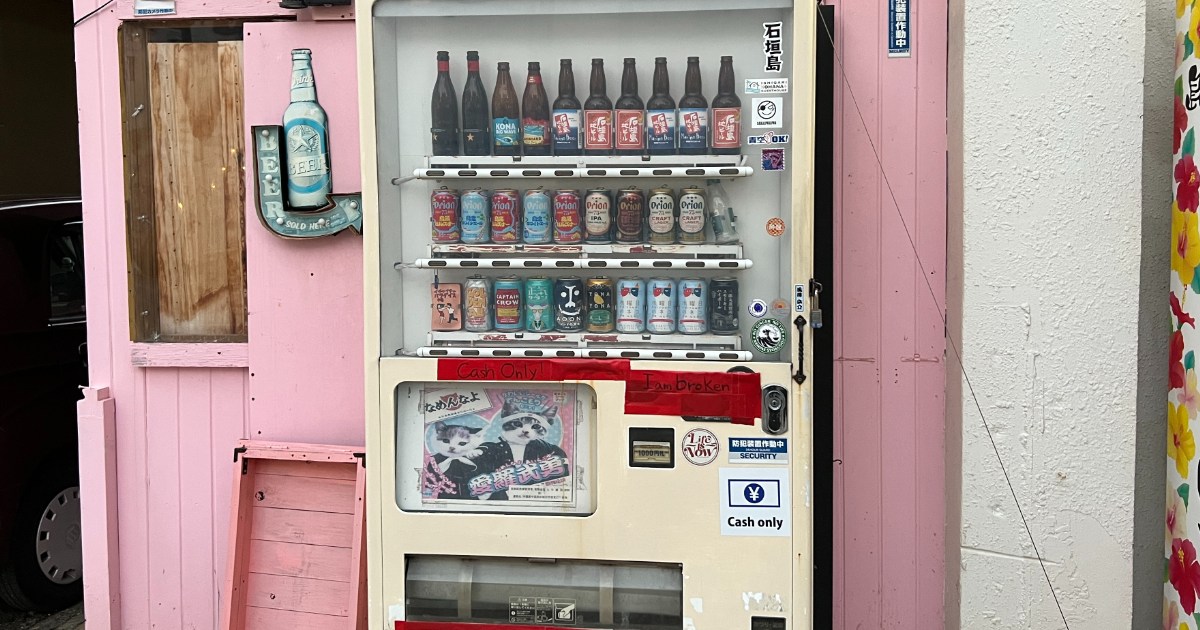
Red tape covered the bill slot. A handwritten note read: “I am broken.” During the day, it looked like nothing more than a useless 自販機 (jihanki)—a vending machine that refused to take a 1,000-yen bill. But after 9:00 p.m., that same machine opened like a door, revealing a seven-seat hidden bar in Ishigaki.
Here’s what happened on a quiet street near the famous 730 交差点 (kōsaten) in Okinawa.
A Strange Vending Machine in the Middle of Town
Walking along City Hall Street from the 730 intersection in central Ishigaki, you’ll see several vending machines lined up. They sell craft beer and local island brews—an island lineup that feels very much like something 離島ならでは (ritō narade wa)—unique to a remote island.
But one machine stood out.
Instead of neatly displayed product samples, it showed empty cans and bottles. The bill slot was covered with red tape. A sticker said “Cash only.” Another sign mentioned 1,000-yen bills. Yet the handwritten message claimed: “I am broken.”
Out of curiosity, the writer tried inserting a new 1,000-yen bill. As expected, it was rejected.
“Well, if it’s broken, it can’t be helped,” he thought, and decided to 素通りする (sudōri suru)—to pass by without stopping. On small islands, delays in repairs aren’t unusual, so it didn’t seem strange at first.
But that “broken” machine was hiding something far beyond expectations.
At 9:00 p.m., the Machine Opened
Later that night, after 9:00 p.m., the same street looked different. A pink neon sign glowed above the vending machine. It read: “IT’S A BEAUTIFUL DAY TO START.”
And below it—the “broken” vending machine was open.
It wasn’t a machine at all. It was a door.
Behind it was a stylish 隠れ家 (kakurega)—a hidden bar called 甘党男子 (Amatō Danshi). There was almost no visible sign. If you didn’t know about it, you would probably never find it.
Inside, there were only seven seats. Brick-style walls were decorated with beer signs and motorcycle racing plates. A small Dragon Quest slime plush watched from a shelf. The space was tiny, but that smallness created a secret-base feeling. It was surprisingly 居心地がいい (igokochi ga ii)—cozy and comfortable.
Behind the counter, the smiling master welcomed guests.
A Bar for Sweets Lovers
The concept? A bar that combines alcohol and sweets—designed for people with a sweet tooth.
Drinks start at 1,100 yen. Sweets start at 900 yen. There’s a 500-yen table charge, and it’s cash only.
Why create such an unusual entrance?
The master explained that he once worked at a French restaurant in Tokyo. On the second floor was a hidden bar with a secretive atmosphere. He was deeply 魅了される (miryou sareru)—captivated—by that mysterious feeling.
As a child, he also built secret bases in trees. Recreating that excitement felt natural. The vending machine itself came through a 縁 (en)—a personal connection—with the previous owner, who worked in vending machine installation. Instead of using it normally, he transformed it into a dummy door for his hideaway.
And the small space? That is exactly the point.
“Because it’s so small,” he said, “different kinds of communication and encounters happen here. We get inbound tourists too, so locals, visitors, and people from overseas can have conversations they wouldn’t usually have.”
The narrow space こそ (koso) is the bar’s greatest strength.
A Surprisingly High-Level Menu
The recommended pairing: a gin and tonic with gateau chocolate.
The small appetizer included pistachios, almonds, even Godiva chocolate, plus matcha yokan and strawberries. For a bar snack, this was impressive.
The gin and tonic used Okinawan craft gin called Masahiro Gin. Garnished with lime and even a tropical orchid, it looked beautiful. The clean gin aroma and slight bitterness of tonic water blended perfectly. Honestly, the quality rivaled classic bars in central Tokyo.
Then came the homemade gateau chocolate. Rich cacao flavor, moist texture, topped with powdered sugar and whipped cream, served with grapefruit and orange. Not overly sweet, balanced with fruit acidity—it paired perfectly with the refreshing gin.
A hidden vending machine door leading to a cocktail of this level? Few would expect it.
Cultural Context: Japan’s Love of Hidden Spaces
Japan has a long tradition of small, tucked-away bars and restaurants. Especially in cities like Tokyo, tiny counter-only establishments are common. The idea of a 隠れ家 (kakurega)—a “hideaway”—appeals to the Japanese sense of discovery and exclusivity.
The concept of using a fake vending machine door adds a modern twist. Vending machines are everywhere in Japan, so transforming one into a secret entrance feels playful and very Japanese.
And notice the emphasis on connection. The word 縁 (en) reflects the cultural importance of relationships and fate. The bar’s existence itself came from such a connection.
Learn Japanese from This Article
Key Vocabulary
| Japanese | Romaji | Meaning |
|---|---|---|
| 交差点 | kōsaten | intersection |
| 自販機 | jihanki | vending machine |
| 素通りする | sudōri suru | to pass by without stopping |
| 隠れ家 | kakurega | hideaway; hidden spot |
| 居心地がいい | igokochi ga ii | cozy; comfortable |
| 魅了される | miryou sareru | to be captivated |
| 縁 | en | connection; fate |
Grammar Spotlight
1️⃣ 〜ならでは(の)
Used to express something unique or characteristic of a place or situation.
Structure: Noun + ならでは(の)
Example from the article:
- 離島ならではの品揃え ritō narade wa no shina-zoroe A selection unique to a remote island.
More examples:
沖縄ならではの味です。 Okinawa narade wa no aji desu. It’s a flavor unique to Okinawa.
石垣島ならではの雰囲気があります。 Ishigaki-jima narade wa no fun’iki ga arimasu. It has an atmosphere unique to Ishigaki.
2️⃣ 〜こそ
Used for strong emphasis—“exactly,” “precisely,” or “this is what makes it…”
Example from the article idea:
- この狭さこそが最大の武器です。 Kono semasa koso ga saidai no buki desu. This smallness is exactly its greatest strength.
More examples:
今こそ挑戦する時です。 Ima koso chōsen suru toki desu. Now is exactly the time to challenge yourself.
失敗こそ成功のもとです。 Shippai koso seikō no moto desu. Failure is precisely the source of success.
Useful Expression
- ダメ元でやってみる dame moto de yatte miru To try something without expecting success (but hoping anyway).
This perfectly describes putting a 1,000-yen bill into a “broken” vending machine—just in case!
Continue Learning
- Want to understand the verb forms used here? Check out Masu Form: Mastering Polite Everyday Speech.
- Ready to dive deeper? Our lesson on Basic Vocabulary Building: Embracing Words Without Latin Ties will help you master these concepts.
- Want to learn more about lifestyle? Check out our lesson on Greetings and Self-Introductions: Authentic Entry Phrases.
If you ever find yourself walking near Ishigaki’s 730 intersection after 9:00 p.m., look for the neon glow. The “broken” vending machine might just open.
And if it does, consider yourself lucky—seven seats fill up quickly.
これからもよろしくお願いします。 Kore kara mo yoroshiku onegaishimasu.