
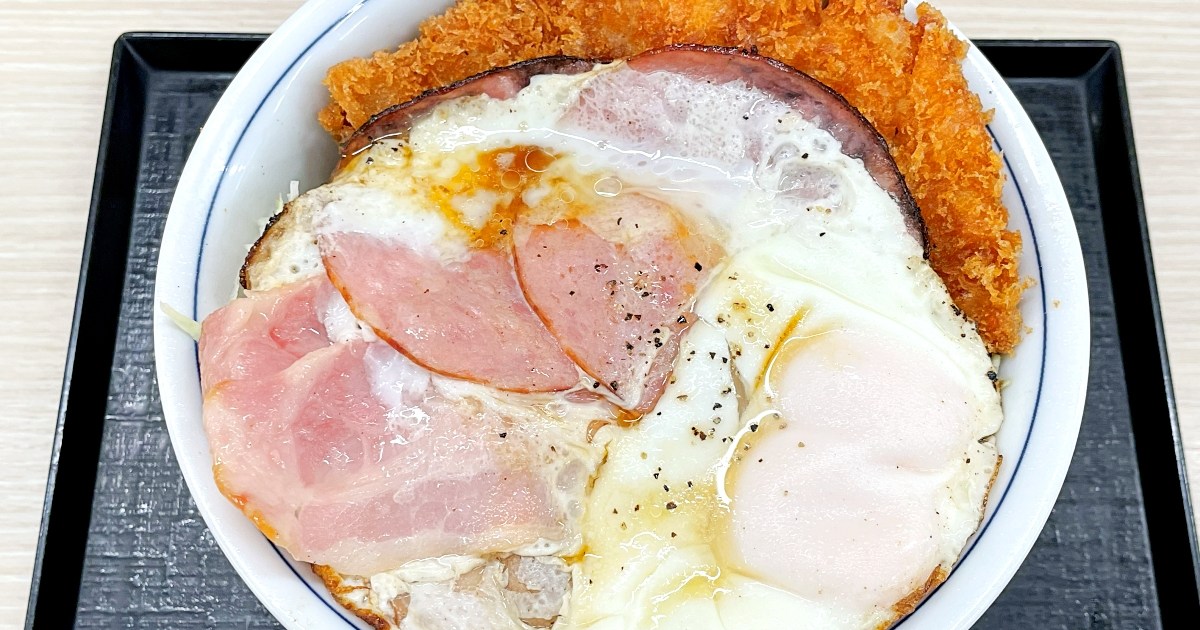
On March 13, 2026, tonkatsu chain Katsuya released (発売 hatsubai) a new limited-time bowl: ウルトラエッグカツ丼 (urutor eggu katsudon), priced at 税込 (zeikomi, tax included) 979 yen. Just two weeks after launching another over-the-top item, they’re already back with something even more chaotic—an “Ultra Egg” bowl that somehow combines breakfast and lunch into a single dish.
At first glance, it looks like a simple ham-and-eggs rice bowl. But beneath the eggs, something else is 潜んでいる (hisonde iru)—a full pork loin cutlet.
A “Time-Performance” Meal?
Katsuya describes this bowl as a タイパ飯 (taipa meshi), meaning a “time-performance meal.” The word タイパ comes from “time performance,” a trendy Japanese term about maximizing efficiency. Instead of eating breakfast and lunch separately, why not eat both at once?
The company’s press release even asks:
“Don’t you ever 無性に (mushou ni, irresistibly) crave char siu egg, bacon egg, sausage egg, and pork cutlet all together when you’re working hard?”
It’s such a strangely specific craving that it almost feels like a joke. But that’s part of Katsuya’s charm—their over-the-top marketing language is famous for being slightly absurd.
Meet “Chabeso”
Once the egg is broken open, the toppings are revealed and rescued from beneath the yolk. There’s:
- Char siu (Chinese-style pork)
- Bacon
- Bologna sausage
Katsuya gives these three processed meats a 総称 (soushou, collective name): チャベソー (cha-be-so).
- チャ from チャーシュー (chaashuu)
- ベ from ベーコン (beekon)
- ソー from ソーセージ (sooseeji)
“Chabeso” may sound random, but Japanese companies often create playful compound names like this. The writer jokes that the naming style resembles how some Japanese bands create quirky names.
Flavor-wise, the egg is seasoned simply with sweet-and-salty soy sauce and black pepper. Yet thanks to the variety of meats, the taste never becomes boring. Even though it’s technically an egg dish, the real star is meat—very on-brand for a tonkatsu chain.
Served over cabbage and rice, the top layer disappears あっという間に (atto iu ma ni, in the blink of an eye*).
And then…
“Hey.”
The pork cutlet appears.
The Hidden Main Character
It’s easy to forget this is a カツ丼 (katsudon, pork cutlet rice bowl). After finishing what feels like breakfast, suddenly you’re in the middle of lunch. The experience is described まるで朝ごはんから昼ごはんにワープしたかのようだ (maru de asagohan kara hirugohan ni waapu shita ka no you da)—“just as if you warped from breakfast to lunch.”
That’s the strange time-compression feeling this bowl creates.
The pork cutlet itself comes with soy-based sauce, though the writer feels it’s slightly lighter in flavor compared to Katsuya’s regular sauce cutlets. Adding extra sauce—and even some 漬物 (tsukemono, Japanese pickles)—makes it more satisfying.
After thoroughly enjoying, or 堪能 (tannou)-ing, the cutlet, one surprising thought arises while looking back at the promotional photo:
“Did I even eat egg?”
The memory of the egg—and even “Chabeso”—fades like a mirage. This bowl begins as breakfast, transforms into lunch, and somehow erases its own beginning.
Cultural Context: Why “Taipa” Matters
The concept of タイパ reflects a broader modern Japanese trend. Younger generations often talk about both コスパ (kosupa, cost performance) and タイパ (taipa, time performance*). It’s about efficiency—getting maximum value in minimum time.
A meal that compresses two meals into one may sound extreme, but it humorously reflects this cultural mindset. Katsuya exaggerates the idea to the point of absurdity—turning efficiency into entertainment.
Learn Japanese from This Article
Key Vocabulary
| Japanese | Romaji | Meaning |
|---|---|---|
| 発売 | hatsubai | release; launch (a product) |
| 税込 | zeikomi | tax included |
| 潜んでいる | hisonde iru | to be hidden; to lie concealed |
| 無性に | mushou ni | irresistibly; strongly for no clear reason |
| 総称 | soushou | collective name; generic term |
| あっという間に | atto iu ma ni | in the blink of an eye |
| 堪能 | tannou | thorough enjoyment |
| 漬物 | tsukemono | Japanese pickles |
Grammar Spotlight
1. 〜たばかり (just did something)
Used to express that something happened very recently.
Structure: Verb (past short form) + ばかり
Example from this situation:
- 新作を発売したばかりだ。 Shinsaku o hatsubai shita bakari da. “They just released a new product.”
This emphasizes how surprising it is that another new item appeared so soon.
2. まるで〜かのようだ (just as if; as though)
Used to describe something that feels like an unreal or exaggerated situation.
Structure: まるで + sentence + かのようだ
Example:
- まるで朝ごはんから昼ごはんにワープしたかのようだ。 Maru de asagohan kara hirugohan ni waapu shita ka no you da. “It’s just as if you warped from breakfast to lunch.”
This pattern is common in reviews and storytelling when describing unusual experiences.
Useful Expression
- 無性に〜たくなる Mushou ni ~ taku naru “To suddenly crave ~ for no particular reason.”
Example:
- 無性にラーメンを食べたくなる。 Mushou ni raamen o tabetaku naru. “I suddenly crave ramen.”
You’ll hear this often in food-related conversations.
Continue Learning
📚 Want to understand the verb forms used here? Check out Masu Form: Mastering Polite Everyday Speech.
📚 Ready to dive deeper? Our lesson on Greetings and Self-Introductions: Authentic Entry Phrases will help you master these concepts.
📚 To understand more about lifestyle, explore our Basic Vocabulary Building: Embracing Words Without Latin Ties lesson.
Basic Vocabulary Building: Embracing Words Without Latin Ties
これからもよろしくお願いします。 Kore kara mo yoroshiku onegaishimasu.