
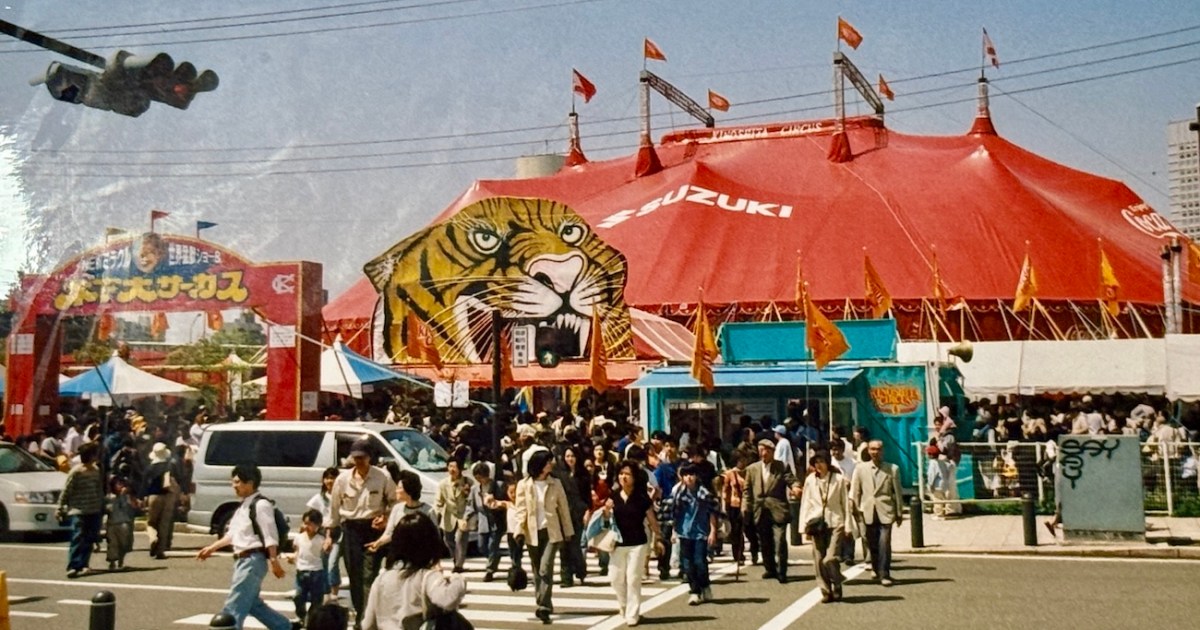
Nine years after joining the circus as an ordinary college student, a 32-year-old staff member finally stood in the center of the ring—not as backstage crew, but as a performer.
The story comes from the long-running series about Kinoshita Circus, one of Japan’s most historic traveling circuses. What makes this moment special isn’t just the debut itself. It’s the journey: nearly a decade spent building tents, running sound and lights, and supporting thousands of shows from behind the curtain before ever stepping into the spotlight.
From Backstage to Center Stage
The writer originally 入団した (nyuudan shita)—joined—the Kinoshita Circus during its 2004 Yokohama tour. At the time, he was a completely ordinary university student. Over the next nine years, he traveled across Japan on 巡業 (jungyou), touring from Hokkaido in the north to Okinawa in the south.
His role? 裏方 (urakata)—a backstage worker. He built tents, operated lighting and sound, and supported the stage from behind the scenes. He had watched countless performers debut. But this time was different.
After six months of practice, he was given the chance to 披露する (hirou suru) his skills in a final rehearsal. This wasn’t just a practice run. It was a make-or-break test to determine whether he would inherit the act.
The circus president sat at ringside. Nearly all the troupe members quietly watched from the seats behind. The air inside the empty tent was unnaturally still.
And then—the final rehearsal began.
“Super Cats” and the Final Test
The act was a comedic trampoline and vaulting box show called “Super Cats.” Set to lively music, he played a police officer chasing prisoners around the ring.
He blew his whistle, jumped on trampolines, leapt over vaulting boxes, fell down, got hit, and chased the “prisoners” with everything he had. The movements he had drilled into his body for half a year came out naturally.
The timing with his teammates matched perfectly. The jokes landed. It was, in his words, the best performance he had ever given.
After a few seconds of silence, the president spoke. It was decided that he would perform on stage starting Golden Week.
In Japanese, this kind of decision is often expressed with 〜ことになる (~koto ni naru), meaning “it has been decided that…” or “it turns out that…” In the article, his debut effectively 舞台に立つことになった—“it was decided that he would stand on stage.”
And just like that, at 32 years old, an “old rookie” was born.
A Small Discovery: The Power of a Whistle
During rehearsal, something unexpected happened.
In the final scene, the police officer (himself) is 突き落とされる (tsukiotosareru)—pushed off—from the vaulting box by a prisoner. Lying on his back on the mat, he blew his whistle.
Instead of a strong “ピーッ!” sound, the tent echoed with a weak, pitiful “ピィ〜〜.”
The entire troupe—including the president—burst into laughter.
He later learned that without the small ball inside a whistle, it makes a sad, breathy sound. By chance, the ball had gotten stuck, producing what he called the “perfectly pathetic” noise.
From then on, he prepared two whistles:
- A normal one for strong, heroic “ピーッ!”
- A ball-less one hidden in his pocket for the pathetic “ピィ〜〜” after being knocked down
It was his own small creative touch—one he continued using until retirement.
This detail reveals something important about Japanese performance culture: even in traditional arts, small refinements and personal ingenuity are valued. You don’t just inherit an act—you gradually make it your own.
Debut Day—and a Funny Memory
On the day of his debut, he invited his mother to the show.
There was just one problem.
He forgot to tell her he would be dressed as a police officer.
After the performance, she said, “Huh? You were in it?”
That, he writes, has become a fond memory.
When he ran onto the stage, he was illuminated by a pin spotlight—the same light he had used to illuminate others thousands of times from the sound and lighting booth. Now he stood fully bathed in it himself.
The laughter of his fellow performers and the applause of the audience overlapped inside the tent.
Rather than feeling like he had achieved a dream, he says it felt as if he had come back to life.
The Real Start
But inheriting an act doesn’t mean it’s finished.
The article emphasizes that receiving the role わけではない (wake de wa nai) that everything is complete. This grammar pattern means “it does not mean that…”
In other words: 芸を受け継いだ瞬間に完成するわけではない。 It does not mean the act is perfected the moment it is inherited.
With each new tour location, rehearsals continue. The director John Fox and choreographer Nagisa (a former Takarazuka performer) offer passionate advice. Performances are continuously refined.
In the circus world, you 磨き続ける (migaki tsuzukeru)—keep polishing—long after your debut.
The “old rookie” had finally stepped onto the stage. But in many ways, that was only the beginning.
Cultural Context: Touring Life in Japan
Traditional Japanese circuses like Kinoshita Circus operate on a 巡業 (jungyou) system—traveling from city to city and setting up large tents in temporary venues. This style of performance has deep roots in Japanese entertainment culture, similar to kabuki tours and regional festivals.
Golden Week, when his debut was scheduled, is one of Japan’s busiest holiday periods. A debut during this time means performing in front of large, energetic crowds—an especially meaningful milestone.
His story also reflects a Japanese value you’ll see again and again: long-term dedication. Spending nine years as 裏方 before stepping forward isn’t seen as wasted time. It’s preparation.
Learn Japanese from This Article
Key Vocabulary
| Japanese | Romaji | Meaning |
|---|---|---|
| 入団する | nyuudan suru | to join a group or organization |
| 裏方 | urakata | backstage staff |
| 巡業 | jungyou | touring performances |
| 成果 | seika | results; achievements |
| 披露する | hirou suru | to present; to perform |
| 突き落とす | tsukiotosu | to push someone off |
| 磨き続ける | migaki tsuzukeru | to continue polishing/improving |
Grammar Spotlight
1️⃣ 〜ことになる
Used when something is decided or circumstances result in something happening.
Structure: Verb (dictionary form) + ことになる
Example:
- ゴールデンウィークから舞台に立つことになった。 Gooruden Wiiku kara butai ni tatsu koto ni natta. It was decided that I would perform on stage from Golden Week.
This pattern often implies the decision was made by others or by circumstance—not purely personal choice.
2️⃣ 〜わけではない
Means “it does not mean that…” or “it’s not that…”
Structure: Plain form + わけではない
Example:
- 受け継いだ瞬間に完成するわけではない。 Uketsuida shunkan ni kansei suru wake de wa nai. It does not mean it’s complete the moment it’s inherited.
This is extremely common in essays and reflective writing.
Useful Expressions
- 初舞台(はつぶたい) (hatsubutai) — first time on stage; debut performance
- 最終関門(さいしゅうかんもん) (saishuu kanmon) — final hurdle
- 遅咲き(おそざき) (osozaki) — late bloomer
“Late bloomer” stories resonate deeply in Japan, where steady growth and perseverance are often celebrated more than quick success.
Continue Learning
📚 Want to understand the verb forms used here? Check out Masu Form: Mastering Polite Everyday Speech.
📚 Curious about the Japanese used here? Our Greetings and Self-Introductions: Authentic Entry Phrases lesson covers this in depth.
📚 Want to learn more about lifestyle? Check out our lesson on Basic Vocabulary Building: Embracing Words Without Latin Ties.
Basic Vocabulary Building: Embracing Words Without Latin Ties
これからもよろしくお願いします。 Kore kara mo yoroshiku onegaishimasu.