
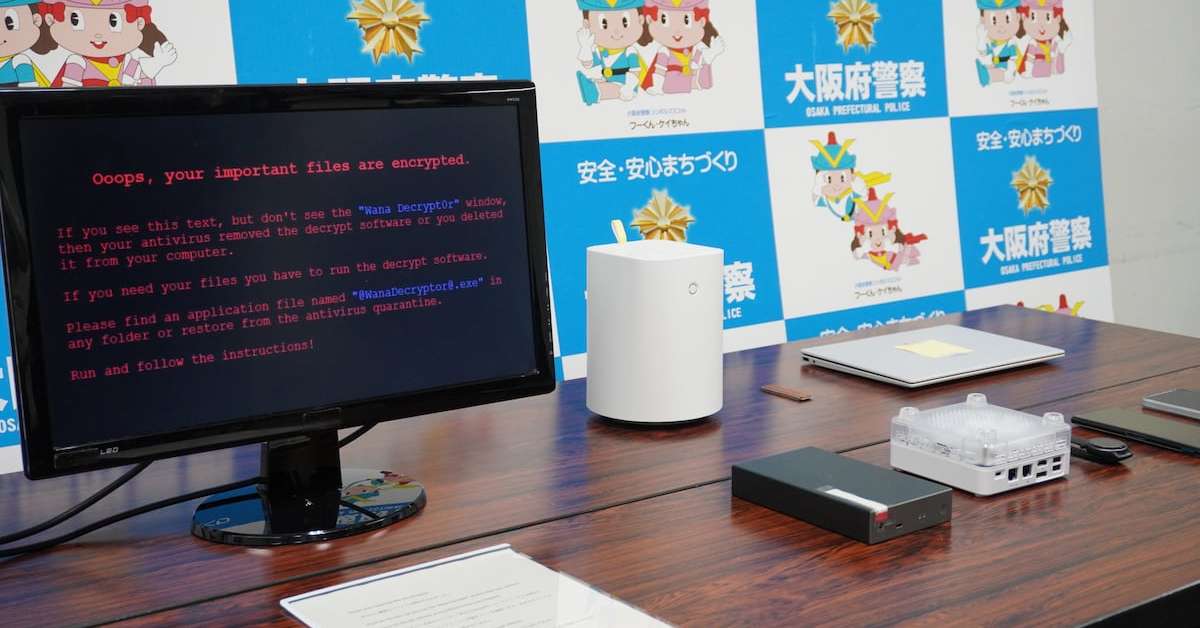
On March 5, Osaka Prefectural Police announced the arrest of a 38-year-old former IT company employee for allegedly installing a program that forced his workplace’s server to shut down. The damage? At least 20 million yen in recovery costs.
Arrest Over Fake Ransomware and Forced Shutdown
According to the police’s cybercrime division—サイバー犯罪 (saibā hanzai) investigators—the suspect was arrested on suspicion of interfering with business operations.
He allegedly embedded a malicious プログラム (puroguramu, program) into the company’s ファイルサーバー (fairu sābā, file server) in August 2025 while working at an IT company in Osaka.
The program did two things:
- Displayed a fake ランサムウェア (ransamu wea, ransomware) warning screen, making it appear as though the company’s system had been infected
- Automatically triggered a シャットダウン (shatto daun, shutdown) three hours after startup
By doing so, he allegedly caused major disruption to the company’s operations.
In Japanese news language, this is described as:
〜などしたとして (~nado shita to shite) “on suspicion of doing things such as…”
This formal expression is commonly used in crime reports to summarize alleged actions.
“Dissatisfaction and Revenge”
Police say the man admitted to the charges. In his statement, he reportedly said:
社長に対する不満と復讐心からやった。 Shachō ni taisuru fuman to fukushūshin kara yatta. “I did it out of dissatisfaction and a desire for revenge toward the company president.”
He also stated that he wanted to expose what he believed was the employees’ low セキュリティ意識 (sekyuriti ishiki, security awareness).
At the time of the incident, he was the company’s システム担当者 (shisutemu tantōsha, system administrator). He later resigned voluntarily.
Financial Impact: At Least ¥20 Million
Because of the incident, the company had to halt operations and investigate the cause. It reportedly paid large fees to recover data, resulting in damages of at least 20 million yen.
Police believe the suspect used his own work computer to carry out the act and are continuing to investigate the full details.
Cultural Context: Cybercrime and Trust in the Workplace
Japan places a strong emphasis on trust within organizations. A システム担当者 (shisutemu tantōsha) is often given broad access to company systems. That trust makes insider threats especially serious.
Cybercrime—サイバー犯罪 (saibā hanzai)—has become an increasing concern in Japan, just as in other countries. But cases involving internal staff can be particularly shocking, because they involve someone who was supposed to protect the system.
The suspect’s comment about low セキュリティ意識 (sekyuriti ishiki) also reflects an ongoing discussion in Japan about digital literacy and corporate cybersecurity preparedness.
Learn Japanese from This Article
Key Vocabulary
| Japanese | Romaji | Meaning |
|---|---|---|
| サイバー犯罪 | saibā hanzai | cybercrime |
| ファイルサーバー | fairu sābā | file server |
| ランサムウェア | ransamu wea | ransomware |
| シャットダウン | shatto daun | shutdown |
| プログラム | puroguramu | program (software) |
| セキュリティ意識 | sekyuriti ishiki | security awareness |
| システム担当者 | shisutemu tantōsha | system administrator |
Notice how many of these words are written in katakana. Japanese often adapts global tech vocabulary into its own phonetic system.
Grammar Spotlight ①: 〜などしたとして
Pattern: Verb (past plain form) + などしたとして
Meaning: “On suspicion of doing things such as…” (formal news expression)
Example from the article:
プログラムを組み込むなどしたとして逮捕された。 Puroguramu o kumikomu nado shita to shite taiho sareta. “He was arrested on suspicion of doing things such as embedding a program.”
You’ll frequently see this in crime reports. It summarizes actions without listing every detail.
Grammar Spotlight ②: 〜させる (Causative Form)
Pattern: Verb (dictionary form) → causative form (〜させる)
Meaning: “To make/let someone do something”
From the article:
シャットダウンさせるプログラム Shatto daun saseru puroguramu “A program that makes (the system) shut down”
Another example:
子どもに勉強させる。 Kodomo ni benkyō saseru. “Make the child study.”
The causative form is extremely common in both news and everyday Japanese.
Useful Expressions from News Reports
| Japanese | Romaji | Meaning |
|---|---|---|
| 容疑を認める | yōgi o mitomeru | to admit the charges |
| 業務を妨害する | gyōmu o bōgai suru | to obstruct business operations |
| 被害が生じる | higai ga shōjiru | damage occurs |
| 詳しい経緯を調べる | kuwashii keii o shiraberu | to investigate the detailed circumstances |
Learning these phrases helps you read real Japanese news with confidence.
Continue Learning
Working on your reading skills? Our Katakana Essentials: Adapting Global Words to Japanese lesson is a great next step.
To understand more about tech, explore our Basic Vocabulary Building: Embracing Words Without Latin Ties lesson.
To strengthen your script knowledge, check out Reading and Writing in Japanese II: Hiragana and Katakana.
Stories like this show how real-world Japanese is filled with specialized vocabulary, formal grammar, and cultural nuance. By reading authentic news, you’re learning Japanese the way it’s actually used in society—not simplified textbook sentences.
これからもよろしくお願いします。 Kore kara mo yoroshiku onegaishimasu.