
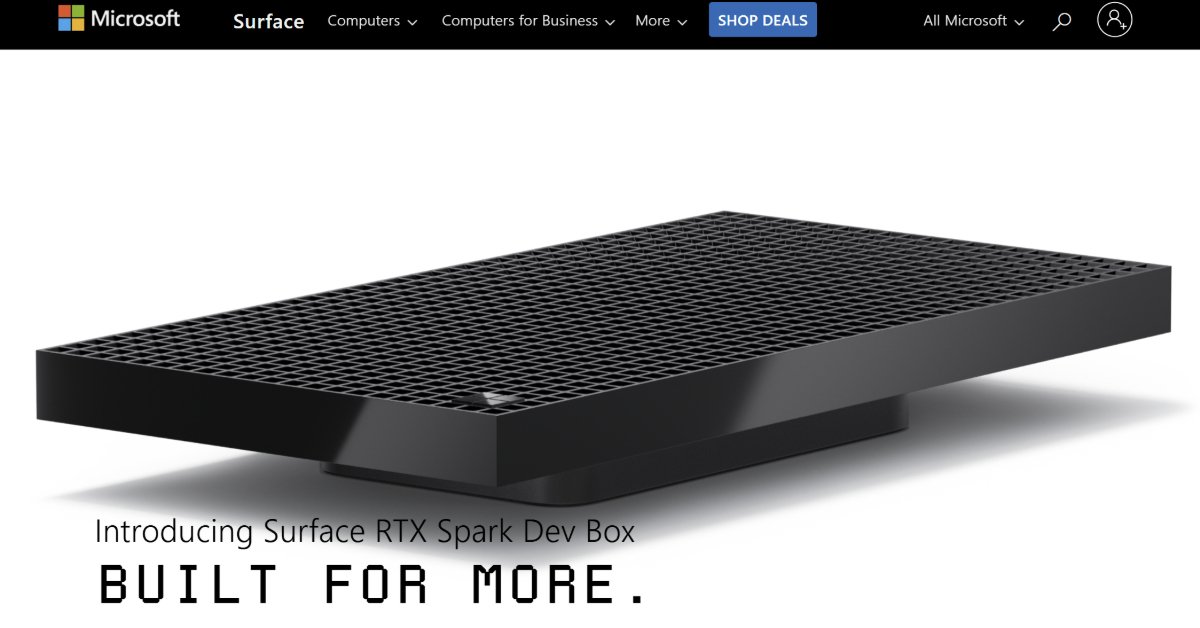
On June 2 (local time), Microsoft announced a new desktop PC at “Microsoft Build 2026”: the Surface RTX Spark Dev Box, a compact machine specifically built for AI workloads. Designed in collaboration with NVIDIA, this device is positioned as a developer-focused system for running local AI inference and fine-tuning large models right on your desk.
Let’s take a closer look—both at the technology and the Japanese you can learn from this news.
An AI PC Built for Developers
The Surface RTX Spark Dev Box is described as an AI ワークロード (waakuroodo, workload)-focused desktop. In Japanese, the phrase used is:
- AIワークロードに特化したデスクトップPC AI waakuroodo ni tokka shita desukutoppu PC “A desktop PC specialized in AI workloads”
The key phrase here, 〜に特化した (〜ni tokka shita), means “specialized in” or “focused on.” We’ll break that down later in the grammar section.
At the heart of the device is the newly designed SoC (System on a Chip) called RTX Spark, jointly developed by Microsoft and NVIDIA. It combines:
- An NVIDIA RTX GPU based on the Blackwell アーキテクチャ (aakitekucha, architecture), with up to 6,144 cores
- A 20-core NVIDIA Grace CPU based on the Arm architecture
- 128GB of ユニファイドメモリ (yunifaido memori, unified memory)
According to Microsoft, the system delivers up to 1 petaflop of AI performance at FP4 precision. It can run models with more than 120 billion parameters locally at interactive speeds.
Notice the word ローカル (rokaru). In tech Japanese, this usually refers to running something on your own machine rather than in the cloud.
From Cloud to Local: Fine-Tuning at Your Desk
One of the most notable points is that model ファインチューニング (fainchuuningu, fine-tuning) — which previously required cloud GPU instances — can now be done locally on this device.
In the original Japanese, the device is described as:
- 開発者向けの製品 kaihatsusha-muke no seihin “A product aimed at developers”
The expression 〜向けの (〜muke no) means “intended for” or “targeted at.” It clearly signals who the product is for.
The aluminum シャーシ (shaashi, chassis) also functions as a heat sink. The design assumes sustained high-load processing, such as:
- Long-running training jobs
- Inference with large models
- Complex agent pipelines
In other words, this isn’t just a flashy demo machine. It’s built for continuous, heavy AI computation.
Developer-Ready Software Environment
On the software side, the device ships with Windows 11 Pro pre-configured for developers.
The article explains that several settings are already enabled by default, including:
- Dark theme
- Developer Mode
- PowerShell 7 as the default shell
It also supports GPU passthrough and CUDA with WSL 2, and comes プリインストール (puriinsutooru, pre-installed) with:
- VS Code
- GitHub Copilot
- Git
- Python
- Node.js
Integration with Microsoft’s AI ecosystem — including Microsoft Foundry, AI Toolkit for VS Code, and Windows ML — is also set up from the start.
This reflects a broader trend in tech culture: reducing setup friction so developers can immediately focus on their actual ワークロード (waakuroodo, workload).
Release Plans
The Surface RTX Spark Dev Box is scheduled to be sold exclusively through Microsoft.com in the United States later this year. As with the recently announced Surface Laptop Ultra, pricing has not yet been disclosed.
Cultural Context: Why “Build” Matters
The announcement took place at “Microsoft Build,” the company’s annual developer conference. In Japan, tech conference announcements are often reported with detailed specs and direct quotes, reflecting a strong interest in engineering depth.
You’ll often see phrases like:
- 発表した (happyō shita) — “announced”
- 搭載する (tōsai suru) — “to be equipped with”
Japanese tech reporting tends to focus heavily on hardware configurations and architectural details, which makes it excellent reading practice if you’re interested in technical Japanese.
Learn Japanese from This Article
Key Vocabulary
| Japanese | Romaji | Meaning |
|---|---|---|
| ワークロード | waakuroodo | workload |
| ローカル | rokaru | local (on your own machine) |
| ファインチューニング | fainchuuningu | fine-tuning |
| アーキテクチャ | aakitekucha | architecture |
| ユニファイドメモリ | yunifaido memori | unified memory |
| シャーシ | shaashi | chassis |
| プリインストール | puriinsutooru | pre-installed |
| 特化した | tokka shita | specialized in |
| 〜向けの | 〜muke no | intended for |
Grammar Spotlight
1. 〜に特化した (Specialized in)
Structure: Noun + に特化した + Noun
Used to describe something that is specialized or focused on a particular area.
Example from the article:
- AIワークロードに特化したデスクトップPC AI waakuroodo ni tokka shita desukutoppu PC A desktop PC specialized in AI workloads
More examples:
教育に特化したアプリです。 Kyōiku ni tokka shita apuri desu. It’s an app specialized in education.
初心者に特化したコースです。 Shoshinsha ni tokka shita kōsu desu. It’s a course focused on beginners.
2. 〜向けの (For / Targeted Toward)
Structure: Noun + 向けの + Noun
Used to indicate the intended audience.
Example from the article:
- 開発者向けの製品 Kaihatsusha-muke no seihin A product for developers
More examples:
子ども向けの本です。 Kodomo-muke no hon desu. It’s a book for children.
上級者向けのレッスンです。 Jōkyūsha-muke no ressun desu. It’s a lesson for advanced learners.
Useful Expressions
- 発表した (happyō shita) — announced
- 搭載する (tōsai suru) — to be equipped with
- 出荷する (shukka suru) — to ship (products)
- 公表されていない (kōhyō sarete inai) — has not been made public
These verbs frequently appear in Japanese business and tech news, so mastering them will dramatically improve your reading speed.
Continue Learning
Curious about how Japanese handles dates like “6月2日(現地時間)に発表した” without explicitly marking tense the way English does? Check out:
Understanding these patterns will make news articles much easier to read.
Tech articles like this are packed with modern loanwords and grammar patterns used in real-world Japanese reporting. By studying them, you’re not just learning vocabulary—you’re learning how contemporary Japan talks about innovation and development.
これからもよろしくお願いします。 Kore kara mo yoroshiku onegaishimasu.