
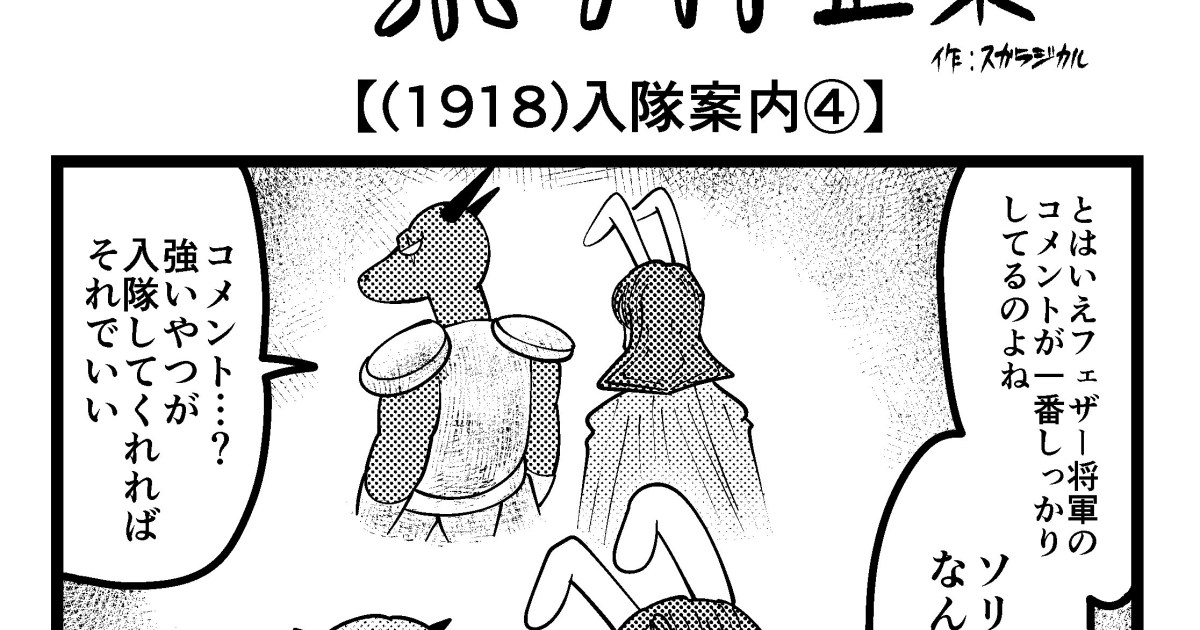
【4コマ】魔王軍はホワイト企業 1918話目「入隊案内④」 was published on Rocket News on March 4, 2026. The credit line is simple: 漫画:スガラジカル (manga: Sugarajikaru) — “Comic by Sugarajikaru.”
Even with just a few lines of text, there’s a lot of natural, everyday Japanese you can learn from this page structure alone.
A 4-Panel Comic Continues
The title begins with 【4コマ】 (yon-koma), meaning “4-panel comic.” In Japan, this vertical four-panel style is a classic format for 漫画 (manga), often used for short, comedic episodes.
The series title is:
- 魔王軍はホワイト企業 Maō-gun wa howaito kigyō “The Demon King’s Army Is a White Company”
This title uses a very natural Japanese structure: NのN-style connections and topic markers to stack information efficiently. Here, 魔王軍 (maō-gun, “Demon King’s army”) is the topic, marked by は, and it’s described as ホワイト企業 (howaito kigyō), a “white company” — meaning a company with good working conditions.
The episode number appears as:
- 1918話目 (1918 wa-me) — “Episode 1918”
The counter 話 (hanashi) means “story” or “episode,” and adding 目 makes it ordinal — “the 1918th.” You’ll often see this pattern in manga, TV shows, and web series.
The subtitle is:
- 「入隊案内④」 Nyūtai annai yon “Enlistment Guide (4)”
This suggests it’s the fourth part of a continuing “enlistment guide” storyline.
Navigation Language You’ll See Everywhere
Below the comic credit, there are simple navigation phrases:
« 前の話へ Mae no hanashi e “To the previous episode”
第1回から読む Dai ikkai kara yomu “Read from episode 1”
▼キャラ一覧はこちら Kyara ichiran wa kochira “Character list is here”
These short lines are gold for learners. They’re packed with common words you’ll encounter on Japanese websites.
Let’s break them down.
Cultural Context: How Japanese Web Comics Are Organized
Japanese online manga sites are very systematic. You’ll almost always see:
- A link to the 前の話 (mae no hanashi) — the previous episode
- A way to start from 第1回から (dai ikkai kara) — from episode one
- A 一覧 (ichiran) — a full list or overview
- A polite directional word like こちら (kochira) — “this way” or “here”
This reflects something very Japanese: clear structure and reader guidance. Instead of assuming you’ll scroll around, the site tells you exactly where to go next.
It’s also a great example of how Japanese uses compact noun phrases like 前の話 (“the previous story”) — literally “before + ’s + story.”
Learn Japanese from This Article
Key Vocabulary
| Japanese | Romaji | Meaning |
|---|---|---|
| 漫画 | manga | comic, manga |
| 前 | mae | before, previous |
| 話 | hanashi | story, episode, talk |
| 第〜回 | dai ~ kai | counter for numbered episodes/events |
| 読む | yomu | to read |
| 一覧 | ichiran | list, overview |
| こちら | kochira | this way, here (polite) |
Grammar Spotlight 1: NのN (Noun + の + Noun)
Pattern: N1 の N2 = N2 of N1 / N2 belonging to N1 / N2 described by N1
Example from the page:
- 前の話 mae no hanashi “the previous story” (literally, “before’s story”)
More examples:
魔王軍の案内 maō-gun no annai “The Demon King Army’s guide”
キャラの一覧 kyara no ichiran “A list of characters”
This structure is everywhere in Japanese. Instead of using apostrophes like in English, Japanese uses の to connect nouns.
Grammar Spotlight 2: 〜から (Starting Point)
Pattern: N + から + Verb “From N, (do something)”
From the article:
- 第1回から読む dai ikkai kara yomu “Read from episode 1”
Here, から marks the starting point.
More examples:
今日から読む kyō kara yomu “Read from today”
ここから始まる koko kara hajimaru “It starts from here”
Understanding から helps you talk about time, place, and even reasons (in other contexts).
Useful Expressions
こちら (kochira) — A polite way to say “here” Often used in customer service or website links.
第1回 (dai ikkai) — “Episode 1” or “First installment” The 第〜 pattern makes numbers sound formal and organized.
If you want to better understand verb forms like 読む, check out our lesson on polite verb usage.
Continue Learning
- Want to understand the verb forms used here? Check out Masu Form: Mastering Polite Everyday Speech.
- Curious about the Japanese used here? Our Basic Vocabulary Building: Embracing Words Without Latin Ties lesson covers this in depth.
- To understand more about lifestyle, explore our Greetings and Self-Introductions: Authentic Entry Phrases lesson.
Even a short comic header can teach you real, practical Japanese — the kind you’ll see every time you browse a Japanese website.
これからもよろしくお願いします。 Kore kara mo yoroshiku onegaishimasu.