
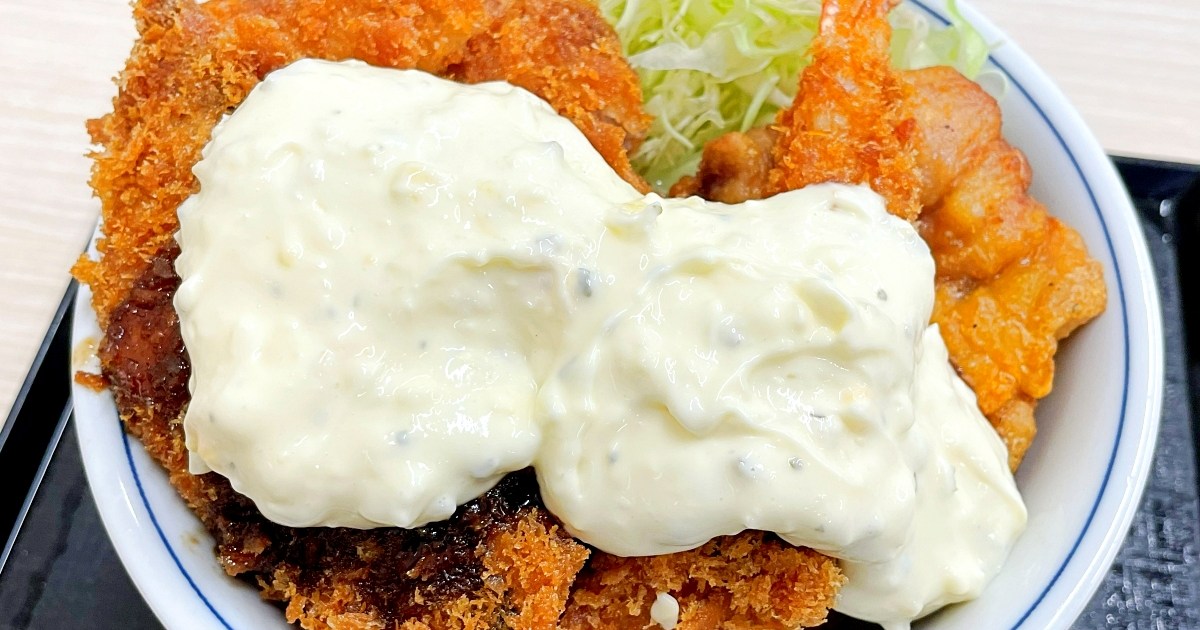
On February 26, 2026, something unexpected happened at a branch of かつや (Katsuya), Japan’s famous tonkatsu chain. A customer lifted an エビフライ (ebifurai, fried shrimp) with his chopsticks—and watched it snap clean in two under the sheer weight of tartar sauce.
The culprit? Not overcooking. Not bad luck. Just an overwhelming mountain of tartar.
The new 数量限定 (suuryou gentei, limited quantity) menu item, タルタル盛り揚げ丼 (tarutaru moriage don, “Tartar-Piled Fried Bowl”), has sparked one very serious question: Is this a masterpiece… or a glorious failure?
Four Fried Foods, One Sea of Tartar
Katsuya had only just released another item, 鍋焼きカツ煮 (nabeyaki katsuni), when this new bowl appeared. The prices are:
- 丼 (don, rice bowl): 869 yen (tax included)
- 定食 (teishoku, set meal with rice and sides): 979 yen (tax included)
Naturally, the reviewer chose the bowl. As he dramatically puts it, “Incidents always happen with the bowl, not the set meal.”
Inside the タルタル盛り揚げ丼 are four types of fried foods:
- エビフライ (ebifurai) – fried shrimp
- チキンカツ (chikin katsu) – chicken cutlet
- から揚げ (karaage) – Japanese fried chicken
- サバフライ (saba furai) – fried mackerel
For fans, the return of サバフライ was exciting—it hadn’t appeared since September in a seasonal seafood set. But when the bowl arrived, excitement quickly turned into 困惑 (konwaku, confusion).
Why?
Because everything was buried.
Under tartar sauce.
An almost alarming amount of tartar sauce.
The reviewer even wonders whether this is an acceptable amount for an adult to 摂取する (sesshu suru, consume). When tartar is scarce, you feel disappointed. But when there’s this much… you feel anxious.
The Unexpected Rupture
The location of the mackerel was still a mystery, so the reviewer started with the shrimp—the easiest piece to identify.
Then came the tragedy.
The moment he gently lifted the shrimp with chopsticks, it suffered a 断裂 (danretsu, rupture). It quietly broke in half, unable to withstand the tartar’s weight. The event was so sudden it wasn’t even captured on camera.
He compares it—dramatically—to the collapsing giant warrior from Nausicaä of the Valley of the Wind. Not rotten. Not defective. Just too heavy with sauce.
Underneath the tartar “swamp,” the mackerel was finally uncovered. But by then, the flavor was almost entirely tartar. The sauce had practically solidified into something that felt less like a topping and more like the main character.
At first glance, this might seem like a failure. Surely this is too much? Isn’t this just eating batter-coated tartar?
But then something changed.
The Tartar High
Gradually, the reviewer stopped resisting.
In fact, he began to enjoy drowning in the tartar sea.
He jokes about entering a state of “タルタルハイ” (tarutaru high)—a made-up term, perhaps, but perfectly descriptive. Once he crossed a certain line, his body seemed to adapt. What felt excessive at first no longer did.
This is where Japanese grammar gives us a powerful expression:
失敗作どころか、むしろ最高だ。 Shippaisaku dokoro ka, mushiro saikou da. “Far from a failure, it’s actually the best.”
The pattern 〜どころか (dokoro ka) means “far from…” or “not only… but actually the opposite.” It emphasizes a reversal stronger than expected.
What began as doubt transformed into praise.
Interestingly, when he reached the チキンカツ, which had less tartar on it, he found it 物足りない (monotarinai, not satisfying). That’s when he realized: there may be no going back.
As for the から揚げ, it was so thoroughly covered in tartar that no photo was shown—but it was reportedly enormous.
A bowl that breaks shrimp in half and possibly your sense of moderation? Definitely unusual.
Cultural Context: The Katsuya Phenomenon
Katsuya is known in Japan for hearty, affordable fried meals. The 丼 (don) style—fried food over rice—is particularly beloved because it’s simple, filling, and dramatic.
Japanese limited-time items (数量限定) often push boundaries. They’re designed to spark conversation, social media buzz, and curiosity. Excess itself becomes entertainment.
This article’s tone is also very Japanese: exaggerated, self-aware, and humorous. Comparing a broken shrimp to an anime apocalypse? That’s part of the fun.
Learn Japanese from This Article
Vocabulary
| Japanese | Romaji | Meaning |
|---|---|---|
| 数量限定 | suuryou gentei | limited quantity |
| 定食 | teishoku | set meal (with rice and sides) |
| 困惑 | konwaku | confusion; bewilderment |
| 摂取する | sesshu suru | to consume; to ingest |
| 想定外 | souteigai | unexpected; beyond expectations |
| 断裂 | danretsu | rupture; break |
| 物足りない | monotarinai | not satisfying; not enough |
Grammar Spotlight
1️⃣ 〜かもしれない — “might; maybe”
Used to express possibility.
失敗作かもしれない。 Shippaisaku kamoshirenai. “It might be a failure.”
食べきれないかもしれない。 Tabekirenai kamoshirenai. “I might not be able to finish it.”
This softens statements—very common in Japanese communication.
2️⃣ 〜どころか — “far from; not only… but actually…”
Used when reality is the opposite of what was expected.
少ないどころか、多すぎる。 Sukunai dokoro ka, oosugiru. “Far from being little, it’s too much.”
失敗どころか、大成功だ。 Shippai dokoro ka, daiseikou da. “Far from a failure, it’s a huge success.”
This pattern adds emotional punch and dramatic contrast.
Useful Expression
物足りない (monotarinai) Used when something isn’t enough—food, excitement, even conversation.
タルタルが少なくて物足りない。 Tarutaru ga sukunakute monotarinai. “There’s not enough tartar—it’s unsatisfying.”
Continue Learning
📚 Want to understand the verb forms used here? Check out Masu Form: Mastering Polite Everyday Speech.
📚 Ready to dive deeper? Our lesson on Greetings and Self-Introductions: Authentic Entry Phrases will help you master these concepts.
📚 Ready to dive deeper? Our lesson on Basic Vocabulary Building: Embracing Words Without Latin Ties will help you master these concepts.
Basic Vocabulary Building: Embracing Words Without Latin Ties
これからもよろしくお願いします。 Kore kara mo yoroshiku onegaishimasu.