
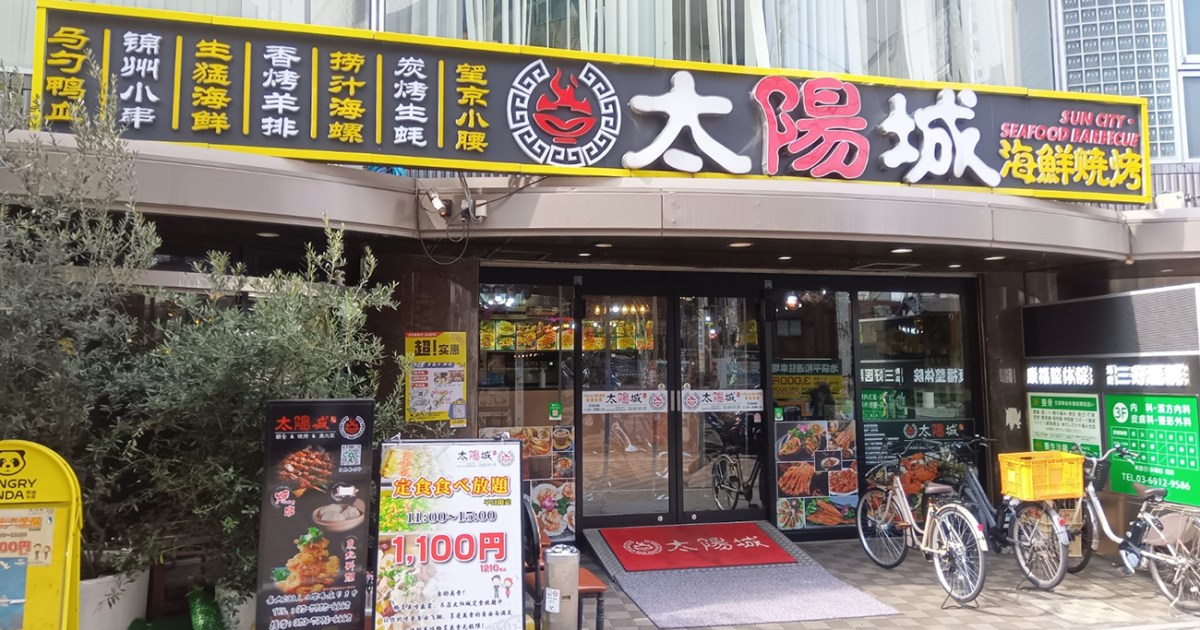
1210 yen. That’s the price—tax included—for a weekday 食べ放題 (tabehoudai, all-you-can-eat) lunch at a restaurant hidden in the far reaches of Ikebukuro’s Chinatown. No flashy gate. No red lanterns with dragons. Just a sign that suddenly appears like a final boss castle in a video game.
The restaurant’s name? 太陽城 (Taiyōjō, “Sun Castle”).
The “Castle” at the Edge of Ikebukuro Chinatown
Ikebukuro’s Chinatown centers around a lively nightlife street called Nishi-Ichibangai. The farther you walk from that main strip, the fewer “serious” Chinese restaurants you see.
But cross the street near Don Quijote’s west exit location and head into a back alley called Heiwa-dōri, and you’ll find it. At what feels like the very edge of the district, a bold 看板 (kanban, signboard*) appears: 太陽城.
The building itself isn’t glamorous—it’s inside a 雑居ビル (zakkyo biru, multi-tenant building), the kind of structure packed with unrelated businesses. Yet that only adds to the “dungeon” feeling. You can’t help but feel the deep, slightly mysterious 雰囲気 (fun’iki, atmosphere) as you approach.
The writer describes it almost like a quest: time to enter the castle.
A Surprisingly Spacious Buffet
According to the sign, Taiyōjō serves northeastern Chinese (Tōhoku/Tonbei) cuisine and offers a weekday lunch buffet from 11:00 a.m. to 3:00 p.m.
The system is simple: 前払い (maebarai, payment in advance). Pay 1210 yen, then enjoy the buffet.
Inside, the restaurant is more spacious than expected. Some “serious” Chinese lunch spots in Ikebukuro pack customers tightly together, but here the seating feels relaxed—almost luxurious by comparison.
For 1210 yen, that already feels like a win.
What’s on the Buffet?
About 16 different Chinese dishes line the buffet corner. The exact dish names aren’t listed, but meat dishes dominate the selection.
This isn’t toned-down, Westernized Chinese food. The plates include pork cartilage, bone-in chicken, and preparations that highlight bones and even 内臓 (naizou, internal organs/offal). There’s a boldness in how the ingredients are handled—an “aggressive” authenticity, as the writer puts it.
There were also large boiled shrimp served in their shells, spring rolls, sesame balls, rice porridge, and even a tea called 洛神花茶 (rakushinkacha), which the writer notes is hibiscus tea. It has a soft mouthfeel and leaves a refreshing aftertaste.
Interestingly, not knowing the exact dish names somehow adds to the authenticity. The experience feels less curated—and more real.
The Hidden Treasure: Chinese Skewers
Midway through the meal, a staff member quietly added something new to the buffet lineup.
焼烤 (shaokao).
These are Chinese-style grilled skewers, commonly seen on signboards around Ikebukuro’s Chinatown. However, seeing them at a lunch buffet—especially one in the 1000-yen range—is rare.
There was a rule: five skewers per person.
Still, that’s impressive.
The writer tried to grab the meat skewers often pictured on restaurant signs—but by the time he returned from placing his plate at the table, they were gone. Instantly finished by native Chinese customers. That alone suggests how unusual it is to find 焼烤 at a budget buffet.
He ended up trying a skewer that looked like potato chips instead. Surprisingly good.
Treasure found at the edge of the castle.
Cultural Context: What Is “Gachi Chūka”?
The article repeatedly uses the term “ガチ中華” (gachi chūka). “Gachi” means serious or legit. In Tokyo, this describes Chinese restaurants catering primarily to Chinese customers, not adjusted to Japanese tastes.
These places often:
- Serve regional Chinese dishes
- Offer bold flavors
- Use ingredients like cartilage or offal
- Have menus with minimal Japanese explanation
The deeper you go into Ikebukuro’s Chinatown, the stronger this authenticity becomes. Taiyōjō sits at the far edge—yet still delivers.
Interestingly, despite its dramatic exterior presence, the restaurant wasn’t crowded. Whether that’s because people feel intimidated by the atmosphere or simply haven’t discovered it yet, it makes for a relaxed but adventurous experience.
Restaurant Information
- Name: 太陽城 (Taiyōjō)
- Address: 2-49-10 Ikebukuro, Toshima-ku, Tokyo
- Hours: 11:00 a.m. – 5:00 a.m. (Weekday lunch buffet 11:00 a.m. – 3:00 p.m.)
- 定休日: 無休 (mukyuu, open every day)
Learn Japanese from This Article
Key Vocabulary
| Japanese | Romaji | Meaning |
|---|---|---|
| 食べ放題 | tabehoudai | all-you-can-eat |
| 雑居ビル | zakkyo biru | multi-tenant building |
| 看板 | kanban | signboard |
| 前払い | maebarai | payment in advance |
| 内臓 | naizou | internal organs; offal |
| 雰囲気 | fun’iki | atmosphere |
| 無休 | mukyuu | open every day; no holidays |
| 焼烤 | shaokao | Chinese-style grilled skewers |
Try using them in a sentence:
- 今日は食べ放題に行きます。 Kyō wa tabehoudai ni ikimasu. I’m going to an all-you-can-eat place today.
Grammar Spotlight
1️⃣ 〜ずにはいられない
Meaning: Cannot help but do; cannot resist doing
Structure: Verb (ない-form stem) + ずにはいられない
Example from the article’s tone:
- 歩くだけでディープさを感じずにはいられない。 Aruku dake de dīpusa o kanjizu ni wa irarenai. You can’t help but feel the “deep” atmosphere just by walking around.
Another example:
- 美味しくて食べずにはいられない。 Oishikute tabezu ni wa irarenai. It’s so delicious I can’t help eating it.
This structure expresses strong emotional reaction—very natural in reviews and storytelling.
2️⃣ 〜ほど…ない
Meaning: Not as… as…
Example pattern: A ほど B ない
- ここは思ったほど高くない。 Koko wa omotta hodo takakunai. It’s not as expensive as I thought.
You’ll often hear this in comparisons and personal impressions.
Useful Expressions
税込1210円です。 Zeikomi sen nihyaku jū en desu. It’s 1210 yen including tax.
平日限定です。 Heijitsu gentei desu. It’s limited to weekdays.
5本までです。 Gohon made desu. Up to five (sticks).
Notice the polite 〜ます/です forms throughout. Want to understand these verb forms better?
Continue Learning
- Want to understand the verb forms used here? Check out Masu Form: Mastering Polite Everyday Speech.
- To understand more about lifestyle vocabulary, explore our Basic Vocabulary Building: Embracing Words Without Latin Ties lesson.
- Interested in everyday interaction phrases? See Greetings and Self-Introductions: Authentic Entry Phrases.
A 1210-yen lunch might not sound like an adventure—but at the edge of Ikebukuro’s Chinatown, it becomes one. Sometimes, the real treasure isn’t luxury. It’s authenticity.
これからもよろしくお願いします。 Kore kara mo yoroshiku onegaishimasu.