
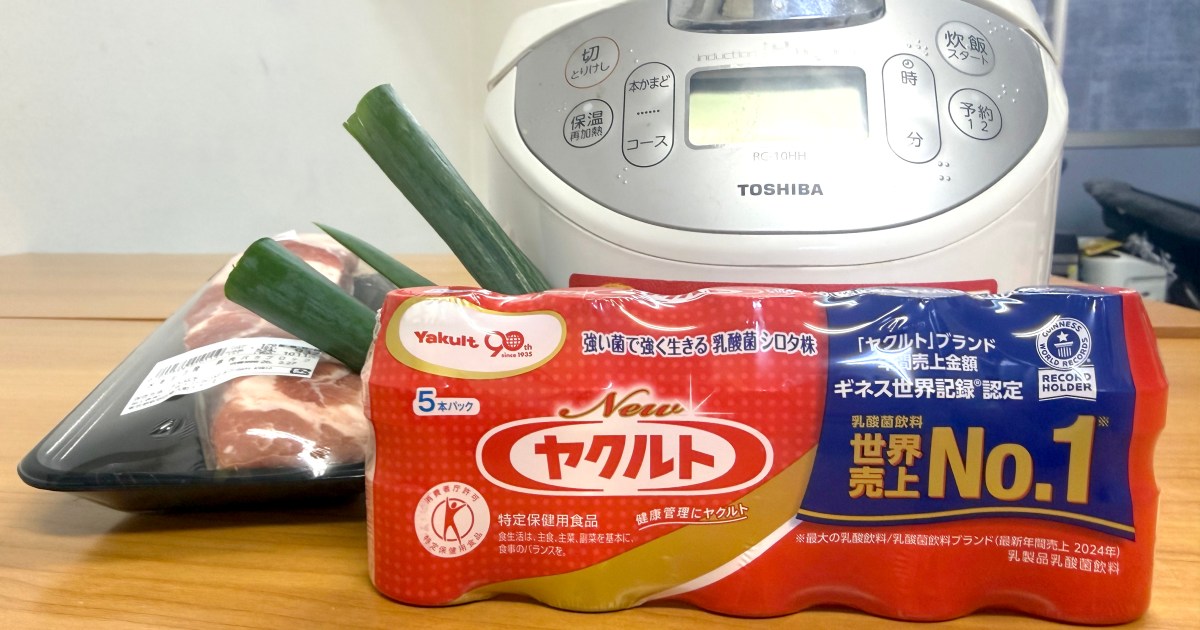
Four bottles of ヤクルト (Yakult) and a rice cooker. That’s all it took for one writer to create a version of 角煮 (kakuni, braised pork belly) so good his coworkers couldn’t stop saying “うまい!” (“Delicious!”).
The recipe, recently circulating on social media short videos, has been called a true “buzz recipe.” And the method? Just throw everything into a 炊飯器 (suihanki, rice cooker), press a button, and wait.
Yes—Yakult. In pork belly.
A Classic Dish Gets a Surprising Twist
Among rice cooker recipes, 豚の角煮 (buta no kakuni, braised pork belly) is a true 定番 (teiban, classic). Curry and 肉じゃが (nikujaga, simmered meat and potatoes) may come to mind first, but simmered dishes in general have great 相性 (aishō, compatibility) with the rice cooker’s steady, even heat.
Traditionally, the sweetness in kakuni comes from sugar. Sometimes people even use jam or juice. The manga Cooking Papa once featured a cola-based version of kakuni. So while Yakult sounds unusual, maybe it’s not that strange after all.
Still, there’s something that makes you pause: Yakult contains 乳酸菌 (nyūsankin, lactic acid bacteria). What effect would that have on the flavor? It’s the kind of thing that really makes you 気になる (ki ni naru, curious).
A quick online search for “炊飯器 ヤクルト 豚の角煮” reveals plenty of recipes. Measurements vary slightly—some add mirin, water, or sake. Some use pork shoulder instead of pork belly. For this test, the writer chose the simplest, most お手軽 (otegaru, easy and convenient) version.
Note: The original article recommends using a rice cooker with cooking functions and checking your manual before trying this.
The Recipe: Yakult Pork Belly in a Rice Cooker
Ingredients
- 500g pork belly block
- 4 bottles of Yakult
- Soy sauce (equal in volume to 1 bottle of Yakult)
- Green parts of a long onion (negi), to taste
Method
- Put all ingredients into the rice cooker.
- Press start.
- That’s it.
That’s the entire process.
“What Is That Smell?”
As it cooked, the writer excitedly commented, “It smells just like kakuni!”
But when he asked a coworker what he smelled, the response was less certain:
- “I know this smell…”
- “I’ve definitely smelled it before…”
- “…Lasagna?”
Other guesses included “an ethnic aroma,” “the diet soup I make,” and even “Yoshinoya.” (Yoshinoya is a famous Japanese beef bowl chain, known for its simmered meat aroma.)
It seems aroma perception varies from person to person.
The Final Result
In under an hour, the Yakult kakuni was ready.
Opening the lid revealed well-simmered pork. There was no visible trace of Yakult’s milky color in the sauce. If no one told you, you’d never guess it was made with a probiotic drink.
And the taste?
Surprisingly high level.
The meat wasn’t so soft that it fell apart with chopsticks. Instead, it was tender enough to slice easily with a knife—firm but not tough, with a satisfying texture that let you feel the pork fibers.
The sweetness was 控えめ (hikaeme, moderate). Rather than sugary, the dish had a gentle acidity that stood out. It was hard to believe the seasoning came from just soy sauce, green onion, and Yakult. That subtle sourness—could it be from the lactic acid bacteria?
To be sure, the rest of the team tasted it. Every single person agreed: “Delicious.” “Really delicious.”
The conclusion? This might be an unexpectedly powerful recipe. It’s undeniably お手軽, and undeniably tasty.
Cultural Context: Why Rice Cookers Do Everything
In many Japanese households, the 炊飯器 (suihanki) is more than just a rice cooker. Modern models often include settings for slow cooking, steaming, and even baking. That’s why one-button simmered dishes like kakuni have become so popular online.
You’ll often hear the expression:
角煮といえば炊飯器。 Kakuni to ieba suihanki. “Speaking of kakuni, you think of the rice cooker.”
The grammar 〜といえば〜 means “speaking of ~” or “when you mention ~, it reminds me of ~.” It connects two strongly associated ideas—like kakuni and rice cookers in modern Japanese home cooking.
Learn Japanese from This Article
Key Vocabulary
| Japanese | Romaji | Meaning |
|---|---|---|
| 炊飯器 | suihanki | rice cooker |
| 角煮 | kakuni | braised pork belly |
| 定番 | teiban | standard; classic |
| 相性 | aishō | compatibility; good match |
| 控えめ | hikaeme | moderate; not too much |
| 気になる | ki ni naru | to be curious about |
| お手軽 | otegaru | easy; convenient |
Grammar Spotlight
1. 〜といえば〜 (Speaking of ~)
Structure: A といえば B
Used when one topic reminds you of another.
Example: 炊飯器といえば角煮。 Suihanki to ieba kakuni. “Speaking of rice cookers, (you think of) kakuni.”
It highlights a strong association.
2. 〜ほど (To the extent that; so much that)
Structure: Verb / adjective + ほど
Example from the article context: 箸で崩れるほどやわらかい。 Hashi de kuzureru hodo yawarakai. “So soft that it falls apart with chopsticks.”
This pattern emphasizes degree—something is true “to the extent that” another thing happens.
Useful Expressions
気になるかも。 Ki ni naru kamo. “That might be interesting…” / “Now I’m curious.”
A very natural way to express mild curiosity in conversation.
言われなければわからない。 Iwarenakereba wakaranai. “You wouldn’t know unless someone told you.”
Perfect for surprising ingredients—like Yakult in pork belly.
Continue Learning
Want to learn more about time expressions you see in news and recipes? Check out our lesson on Time and Dates: Tense-Free Expressions.
Simple ingredients. One button. Surprisingly deep flavor.
Sometimes Japanese home cooking shows that creativity and convenience can have perfect 相性 (aishō).
これからもよろしくお願いします。 Kore kara mo yoroshiku onegaishimasu.