
“Total weight: 1kg.”
Those four words stopped a seasoned Shinjuku commuter in his tracks. In the vast maze of Shinjuku’s underground shopping area, a single phrase printed outside a small restaurant was enough to spark a full-on food battle.
A Surprise in Shinjuku’s Underground
As you may know, Shinjuku’s 地下街 (chikagai, underground shopping area) is enormous. It stretches from Shinjuku-sanchōme Station all the way to Nishi-Shinjuku Station and even Tochōmae Station. It’s often said to be one of the largest underground complexes in the world.
With a space that big, unexpected discoveries are bound to happen.
The writer—who had worked in Shinjuku for 10 years and walked these underground paths しょっちゅう (shocchuu, frequently)—considered himself pretty familiar with the area. And yet, even in a section he passes often, something new suddenly appeared.
Across from the famous 500-yen morning ramen shop Hyakujitsu Kō (百日紅), near Isetan and the Louis Vuitton store at street level, he noticed a sign. The words 総重量1kg (soujuuryou ichikiro, total weight 1 kilogram) practically 目に飛び込んできた (me ni tobikonde kita, jumped into his eyes).
It was a towering yakiniku rice bowl.
A Specialty Shop for Meat Lovers
The restaurant is called 焼肉丼 たれ櫻 (Yakiniku-don Tare Zakura). It’s a small, counter-focused shop that opened in September of last year. According to the article, it’s a rare specialty restaurant dedicated entirely to yakiniku rice bowls.
Their regular menu includes:
- 三元豚カルビ丼(950円) (sangen-buta karubi-don) – pork rib bowl
- 牛カルビ丼(1250円) (gyū karubi-don) – beef rib bowl
- 味噌チーズ焼肉丼(1300円) (miso chīzu yakiniku-don) – miso cheese yakiniku bowl
The rice is Koshihikari, a premium Japanese rice variety, and their signature sauce uses Kyoto-style miso.
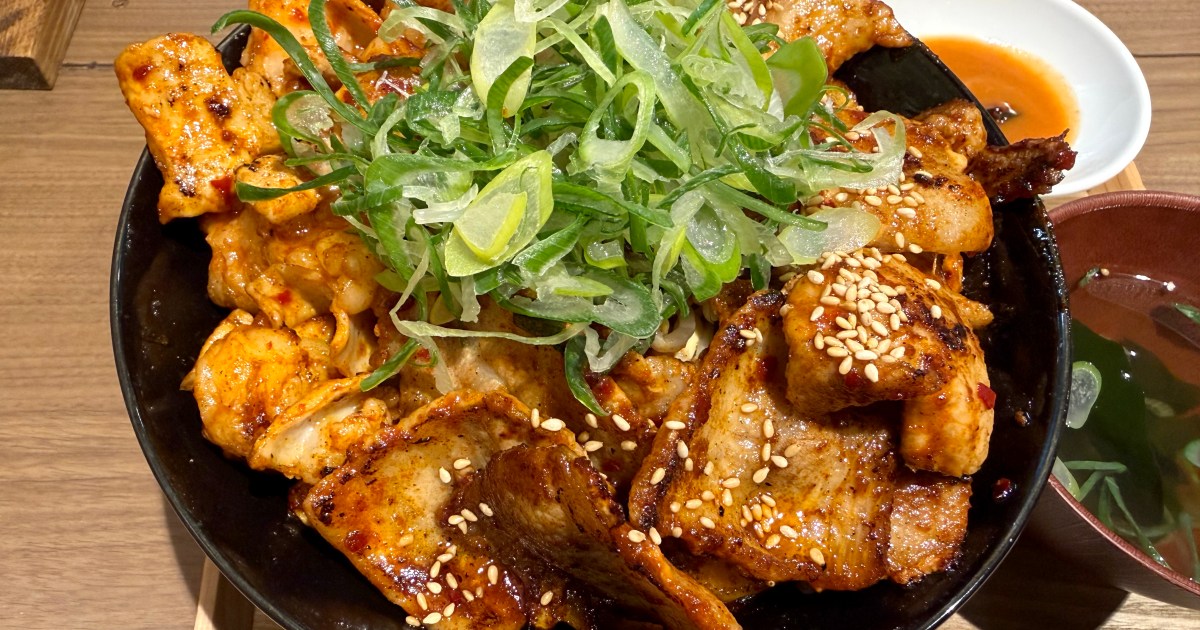
But that day, there was only one real choice: the 肉3種デカ盛り丼(2900円) (niku sanshu dekamori-don)—a three-meat extra-large bowl weighing 1kg.
The word デカ盛り (dekamori) means an extra-large portion. In Japan, dekamori dishes are almost a genre of their own, often challenging customers to finish massive servings.
The writer admits that, due to age, he can’t eat as much as he used to—but if he pushed himself, 1kg should still be possible… or so he thought.
Face-to-Face with 1kg of Meat
Less than 10 minutes after ordering, the bowl arrived.
Yes. It was huge.
He had been feeling confident—almost cocky—but when the bowl appeared, he realized he would 死闘を覚悟せざるを得なかった (shitō o kakugo sezaru o enakatta): he had no choice but to prepare for a fierce battle.
The three meats—pork ribs, beef ribs, and hormone (offal)—were all reliably delicious. The sauce wasn’t overly sweet; instead, it highlighted the natural flavor of the meat.
But the bowl was deep. Deceptively deep.
As he ate further, he discovered bean sprout namul and gochujang hidden inside. That inspired a new strategy: turn it into bibimbap by mixing everything together with a spoon.
This made the rice much easier to eat, and the bowl steadily shrank. Still, even as his hunger center was fully stimulated, there was plenty left. That’s what makes a デカ盛り a true dekamori.
A Narrow Victory
Several times, he almost asked for a take-home container. But in the end, he managed to 完食 (kanshoku, finish eating everything).
Completely full—腹パン (harapan, slang for “stomach bursting”)—he declared victory. Unsurprisingly, it was his last meal of the day.
And that’s the thing about Shinjuku’s underground maze. It’s so vast that even on a path you walk often, you might suddenly encounter a 1kg yakiniku bowl waiting to challenge you.
Shop Information
店名: 焼肉丼 たれ櫻 住所: 東京都新宿区新宿3-4-8 京王フレンテ新宿三丁目 B2F 営業時間: 11:00~22:00 定休日: 不定休 (futeikyuu, irregular holidays)
Cultural Context: Why “Dekamori” Matters
Japan isn’t just about small, delicate portions. There’s a parallel food culture built around speed, volume, and challenge.
The word デカ盛り combines デカい (dekai, big) and 盛り (mori, serving/portion). Restaurants that offer dekamori dishes often attract students, salary workers, and competitive eaters.
Finishing such a meal—完食—is a badge of honor.
At the same time, notice the humility in the writer’s tone. Even while challenging the bowl, he jokes about aging and nearly giving up. That self-awareness is very Japanese.
Learn Japanese from This Article
Key Vocabulary
| Japanese | Romaji | Meaning |
|---|---|---|
| 地下街 | chikagai | underground shopping area |
| デカ盛り | dekamori | extra-large portion |
| 総重量 | soujuuryou | total weight |
| しょっちゅう | shocchuu | frequently; often (casual) |
| 目に飛び込む | me ni tobikomu | to catch one’s eye |
| 完食 | kanshoku | to finish eating everything |
| 不定休 | futeikyuu | irregular holidays |
Try using one today. For example: 新宿の地下街はしょっちゅう通ります。 Shinjuku no chikagai wa shocchuu toorimasu. “I often pass through Shinjuku’s underground mall.”
Grammar Spotlight
1️⃣ 〜せざるを得ない
Meaning: “cannot avoid doing” / “have no choice but to do”
From the article: 死闘を覚悟せざるを得なかった。 Shitō o kakugo sezaru o enakatta. “I had no choice but to prepare for a fierce battle.”
Structure: Verb (negative stem) + せざるを得ない
Example: 行かざるを得ない。 Ikazaru o enai. “I have no choice but to go.”
This is slightly formal and often used in writing.
2️⃣ 〜くらい(に)
Meaning: “to the extent that…” / “so much that…”
Example from the article’s nuance: デカ盛りに出会うくらい広い。 Dekamori ni deau kurai hiroi. “It’s so big that you might even run into a massive bowl.”
Structure: Verb / adjective + くらい
Example: お腹がはち切れそうなくらい食べた。 Onaka ga hachikiresou na kurai tabeta. “I ate so much that my stomach felt like it would burst.”
Useful Expression
目に飛び込む (me ni tobikomu) Literally “to jump into one’s eyes,” meaning something suddenly catches your attention.
『総重量1kg』の文字が目に飛び込んできた。 “The words ‘1kg total weight’ jumped into my eyes.”
Continue Learning
- Want to understand the verb forms used here? Check out Masu Form: Mastering Polite Everyday Speech.
- Ready to dive deeper? Our lesson on Basic Vocabulary Building: Embracing Words Without Latin Ties will help you master these concepts.
- Want to learn more about lifestyle? Check out our lesson on Greetings and Self-Introductions: Authentic Entry Phrases.
Massive underground malls, hidden restaurants, and 1kg meat battles—this is everyday urban Japan. And through stories like this, you’re not just learning vocabulary. You’re stepping into real Japanese life.
これからもよろしくお願いします。 Kore kara mo yoroshiku onegaishimasu.