
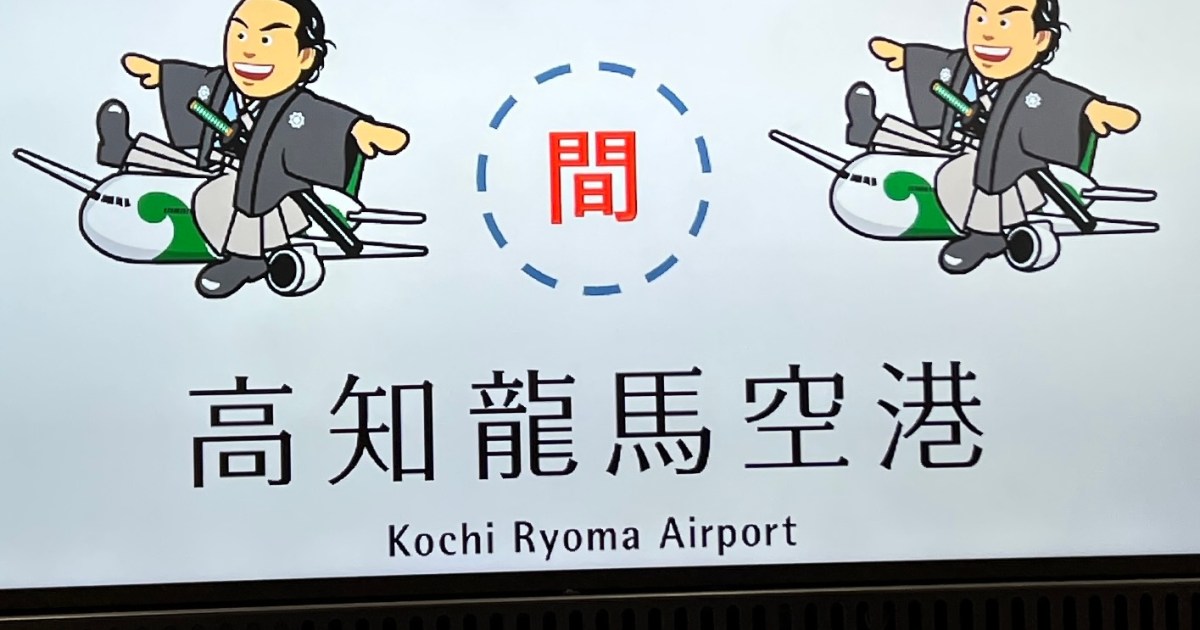
Only one airport in Japan officially includes a person’s name in its title. That airport is 高知龍馬空港 (Kōchi Ryōma Kūkō) — Kochi Ryoma Airport.
The name comes from the famous late Edo-period samurai 坂本龍馬 (Sakamoto Ryōma), a historical hero from Kochi Prefecture. In 2003, the airport underwent a 改称 (kaishou), or renaming, from 高知空港 (Kōchi Kūkō) to its current name. Since then, it has become the only airport in Japan whose official name includes a real person.
When a Rocket News reporter visited for the first time, he discovered something surprising: the airport doesn’t just carry Ryoma’s name. It absolutely celebrates him.
And yet, after fully enjoying the experience, one small but unforgettable 後悔 (koukai) — regret — remained.
An Airport Filled with Ryoma
The Ryoma theme starts the moment you land.
Inside the boarding bridge, the words 「桂浜」 (Katsurahama) and 「龍馬」 (Ryōma) appear. Katsurahama is a famous beach in Kochi closely associated with Sakamoto Ryoma, and it sets the tone immediately.
Step into the arrival lobby and you’re greeted by a statue of Ryoma himself. The base is engraved with 高知龍馬空港 (Kōchi Ryōma Kūkō) and 坂本龍馬 (Sakamoto Ryōma), and behind him stands a dramatic wave-shaped object. During special events, flower wreaths are sometimes placed on the statue — creating what the writer describes as a slightly surreal scene.
Upstairs on the second floor, there’s an incredibly realistic, life-sized Ryoma figure. Wearing a blue kimono and hakama, leaning against a bridge railing, he gazes into the distance — exactly the kind of expression you often see in historical depictions.
You’ll also find:
- A classic face-in-hole photo board
- Directional signs using Ryoma’s silhouette
- A message written in Tosa dialect (the local Kochi dialect):
「こりゃたまるか わしの名前がついちゅう 高知龍馬空港」 “Korya tamaruka, washi no namae ga tsuichū Kōchi Ryōma Kūkō.” “I can’t believe it — my name is on Kochi Ryoma Airport!”
The playful message suggests that even Ryoma himself might be surprised in the afterlife.
The Runway Is Shockingly Close
After enjoying all the Ryoma-themed displays, the reporter headed to the third-floor 展望デッキ (tenbou dekki), or observation deck.
The wooden deck feels open and spacious, with the blue “KOCHI RYOMA AIRPORT” sign standing out against the sky.
But the biggest surprise? The 滑走路 (kassouro) — runway — is incredibly close.
Even with a fence in between, you can watch planes take off and land from a very short distance. For airplane fans, it’s an unbeatable photo spot.
Inside the airport, you can also take a 記念写真 (kinen shashin), a commemorative photo, at a “Ryoma Purikura” photo booth. A sign reads:
「土佐みやげの写真ぜよ」 “Tosa miyage no shashin zeyo.” “A Tosa souvenir photo, indeed!”
“Tosa” is the old name for Kochi, and ぜよ (zeyo) is a dialect ending often associated with Ryoma.
Near the exit, another bold sign reads:
「どっぷりど級の極上田舎へ SUPER LOCAL KOCHI」 “To the ultimate, deeply local countryside — SUPER LOCAL KOCHI.”
The phrase 極上田舎 (gokujō inaka) — “ultimate countryside” — is part of Kochi’s tourism campaign. It proudly embraces its rural identity rather than hiding it.
A Car for Sale… in the Airport?
The airport may not be large, but its personality is strong.
In the lobby, the reporter noticed something unusual: a single Daihatsu Tanto car on display for sale, priced at 1,617,000 yen. Seeing a car sold in an airport lobby is rare. Since Kochi is likely car-dependent, there may be demand — but one lone car sitting there feels oddly surreal.
Nearby, an ATM corner features bold lettering:
「強力(ゴーリキ)ATM」 “Gōriki ATM” — “Powerful ATM.”
What makes it “powerful”? That remains unclear.
There’s even a changing room specifically for お遍路さん (ohenro-san), pilgrims walking the Shikoku 88-temple route — a deeply traditional Buddhist pilgrimage that passes through Kochi.
Another campaign poster reads:
「リョーマの休日」 “Ryōma no Kyūjitsu” — “Ryoma’s Holiday,”
a playful pun on the classic film Roman Holiday.
After exploring everything, the reporter felt he had truly 満喫する (mankitsu suru) — fully enjoyed — the uniquely Ryoma-filled airport.
The One Regret
But after returning home and researching online, he discovered something shocking.
At the baggage claim area, the luggage carousel sometimes carries… a giant model of カツオのたたき (katsuo no tataki) — Kochi’s famous seared bonito dish.
Because he hadn’t checked any luggage, and didn’t know about it at the time, he completely missed it.
If he had known, he would have taken a photo for sure.
That small missed opportunity became his only 後悔 (koukai) from the trip.
Next time, he vowed, he will absolutely photograph the giant bonito.
Cultural Context: Why Ryoma?
Sakamoto Ryoma (1836–1867) was a key figure in the movement that ended Japan’s samurai government and led to the Meiji Restoration. He is especially beloved in Kochi, his birthplace.
By renaming the airport after him, Kochi Prefecture highlights local pride and historical identity. It’s an example of how regional Japan often celebrates hometown heroes in very visible ways.
Interestingly, this airport is the only one in Japan whose official name includes a person — as the article explains, it’s 〜だけだ (… dake da) — the only one.
Learn Japanese from This Article
Key Vocabulary
| Japanese | Romaji | Meaning |
|---|---|---|
| 由来 | yurai | origin; background |
| 改称 | kaishou | renaming; change of name |
| 展望デッキ | tenbou dekki | observation deck |
| 滑走路 | kassouro | runway |
| 記念写真 | kinen shashin | commemorative photo |
| 満喫する | mankitsu suru | to fully enjoy |
| 後悔 | koukai | regret |
Grammar Spotlight
1. 〜だけだ (Only; just)
Used to emphasize that something is the only one.
人名が入っている空港は高知龍馬空港だけだ。 Jinmei ga haitte iru kūkō wa Kōchi Ryōma Kūkō dake da. “Kochi Ryoma Airport is the only airport that includes a person’s name.”
私の後悔は一つだけだ。 Watashi no koukai wa hitotsu dake da. “I have only one regret.”
This pattern is simple but powerful — very common in everyday Japanese.
2. 〜かもしれない (Might; maybe; possibly)
Used when expressing uncertainty.
龍馬も驚いているかもしれない。 Ryōma mo odoroite iru kamo shirenai. “Even Ryoma might be surprised.”
次はもっと面白いものが見られるかもしれない。 Tsugi wa motto omoshiroi mono ga mirareru kamo shirenai. “Next time, I might see something even more interesting.”
You’ll hear this constantly in conversation — it softens statements and sounds natural.
Useful Expressions
- 満喫しました。 (Mankitsu shimashita.) — “I fully enjoyed it.”
- これは珍しい光景ですね。 (Kore wa mezurashii kōkei desu ne.) — “This is a rare sight.”
- 次回は必ず写真を撮ります。 (Jikai wa kanarazu shashin o torimasu.) — “Next time, I’ll definitely take a photo.”
Notice the polite 〜ます (-masu) forms used here — essential for everyday speech.
Continue Learning
📚 Want to understand the verb forms used here? Check out Masu Form: Mastering Polite Everyday Speech.
📚 Ready to dive deeper? Our lesson on Greetings and Self-Introductions: Authentic Entry Phrases will help you master these concepts.
📚 Ready to dive deeper? Our lesson on Basic Vocabulary Building: Embracing Words Without Latin Ties will help you master these concepts.
Basic Vocabulary Building: Embracing Words Without Latin Ties
これからもよろしくお願いします。 Kore kara mo yoroshiku onegaishimasu.