
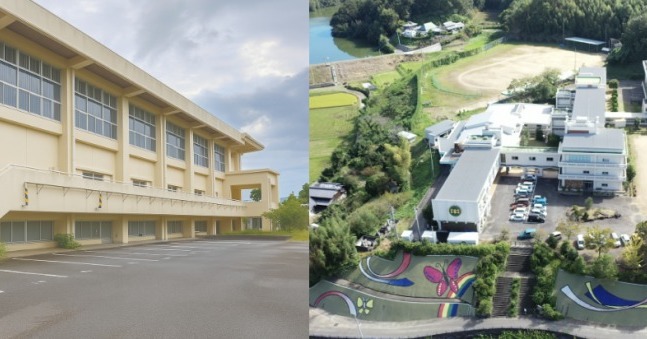
On March 3, a former junior high school in Kagawa Prefecture will reopen—not as a place for students, but as an AI data hub filled with high-performance GPUs.
Tokyo-based GPU cloud company Highreso (ハイレゾ) is launching a new データセンター (deeta sentaa, data center) in Ayauta District, Kagawa. What makes this project remarkable is that the facility was once Ayakami Junior High School, which closed in March 2022. Instead of constructing a brand-new building, the company chose to 転用 (tenyou, repurpose) the former school.
By renovating existing structures, the company aims to reduce construction costs and timelines—〜することで (~suru koto de, by doing ~)—and provide more 低廉 (teiren, low-priced) services through its GPU クラウド (kuraudo, cloud computing) business.
From Closed School to AI Data Center
The project came after Highreso received an official invitation from Kagawa Prefecture—expressed in Japanese news language as 県からの誘致を受け (ken kara no yuuchi o uke, upon receiving an invitation from the prefecture).
The former Ayakami Junior High School closed in March 2022. Now, areas that once served as bicycle parking and club activity practice spaces have been 改装 (kaisou, renovated) to house powerful NVIDIA GPUs, including the A4000 and H100 models.
In Japanese, GPU is written as GPU(ジーピーユー) (jiipii yuu), standing for Graphics Processing Unit. These devices are essential for AI development, machine learning, and high-performance computing.
Interestingly, the main school building itself won’t be filled with servers. Instead, it will be renovated into a community gathering space for local residents, where programming classes and other events are planned.
A Growing Trend: Repurposing Unused Facilities
This is Highreso’s second time converting a closed school into a data center, following a similar project in Genkai Town, Saga Prefecture. It is also the company’s fourth example of utilizing a 遊休施設 (yuukyuu shisetsu, idle facility).
Rather than describing such buildings as abandoned, Japanese media often use the more neutral term 遊休施設, which suggests a facility that is simply not currently in use.
The company says it will continue considering the use of closed schools and other buildings where conversion can reduce construction costs and time.
Correction Notice
The original report initially stated that the GPUs to be installed were “B200” and “H200.” However, due to an error in the provided materials, this was corrected to “A4000” and “H100.” The article was updated accordingly on February 27 at 2:55 p.m.
Correction notices like this are common in Japanese journalism and reflect the industry’s emphasis on transparency and accuracy.
Cultural Context: Why So Many Closed Schools?
Across regional Japan, declining birthrates have led to school closures. When a school closes, local governments must decide how to use the building.
Instead of demolishing these structures, companies and municipalities sometimes collaborate to 転用 (tenyou, repurpose) them. Schools are often structurally sturdy, already connected to utilities, and located within communities—making them suitable for new purposes.
At the same time, turning part of the campus into a community center helps maintain ties with local residents. It’s not just about technology—it’s about regional revitalization.
Learn Japanese from This Article
Key Vocabulary
| Japanese | Romaji | Meaning |
|---|---|---|
| データセンター | deeta sentaa | data center |
| クラウド | kuraudo | cloud (computing) |
| 転用 | tenyou | conversion; repurposing |
| 改装 | kaisou | renovation; remodeling |
| 低廉 | teiren | low-priced; inexpensive (formal) |
| GPU(ジーピーユー) | jiipii yuu | Graphics Processing Unit |
| 遊休施設 | yuukyuu shisetsu | idle facility; unused facility |
| 誘致 | yuuchi | invitation (for business development) |
Notice how many of these tech terms are written in katakana, such as データセンター and クラウド. Japanese constantly adapts global technology vocabulary into its own writing system.
Grammar Spotlight 1: 〜することで (by doing ~)
Structure: Verb (dictionary form) + ことで
This pattern expresses means or method—how something is achieved.
Example from the article:
- 既存施設を改装することで、建設費や工期を抑える。 きぞんしせつをかいそうすることで、けんせつひやこうきをおさえる。 Kizon shisetsu o kaisou suru koto de, kensetsuhi ya kouki o osaeru. By renovating existing facilities, construction costs and timelines are reduced.
More examples:
- 勉強することで、日本語が上達する。 べんきょうすることで、にほんごがじょうたつする。 Benkyou suru koto de, nihongo ga joutatsu suru. By studying, your Japanese improves.
Grammar Spotlight 2: 〜を受け (upon receiving; in response to)
This is a formal expression often used in news writing.
Structure: Noun + を受け (o uke)
Example:
- 県からの誘致を受け、データセンターを設立した。 けんからのゆうちをうけ、データセンターをせつりつした。 Ken kara no yuuchi o uke, deeta sentaa o setsuritsu shita. Upon receiving an invitation from the prefecture, the company established a data center.
You’ll frequently see this structure in headlines and formal reports.
Useful Expression
- 建設費や工期を抑える けんせつひやこうきをおさえる kensetsuhi ya kouki o osaeru to reduce construction costs and timelines
The verb 抑える (osaeru) literally means “to suppress” or “to hold down,” but in business contexts it often means “to keep costs low.”
Continue Learning
Working on your reading skills? Our Katakana Essentials: Adapting Global Words to Japanese lesson is a great next step.
Want to learn more about tech? Check out our lesson on Basic Vocabulary Building: Embracing Words Without Latin Ties.
Want to learn more about tech? Check out our lesson on Reading and Writing in Japanese II: Hiragana and Katakana.
Technology, community, and language all come together in this story. As you read more Japanese news, you’ll start noticing patterns like 〜することで and formal expressions like 〜を受け everywhere.
これからもよろしくお願いします。 Kore kara mo yoroshiku onegaishimasu.