
On February 19, JR East announced that it will launch a new Shinkansen reservation service called “JRE GO” in fall 2026—promising bookings in as little as one minute.
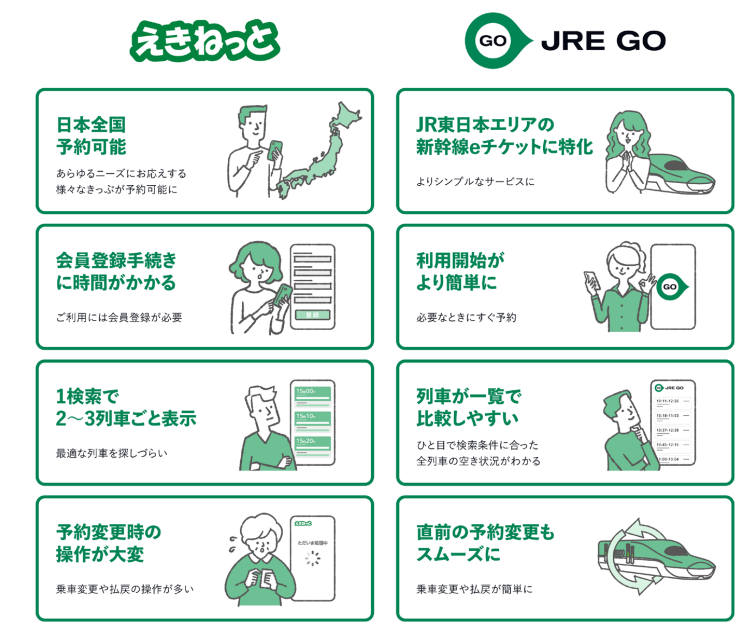
For anyone who has struggled with Japan’s current online train reservation systems, this is big news. The new service is designed to be faster and simpler than the existing 「えきねっと」 (Ekinetto), with fewer steps, a cleaner ユーザーインタフェース (yūzā intafēsu, user interface), and smoother changes and refunds.
Let’s take a closer look at what’s changing—and what you can learn from it.
From 21 Steps to 4: A Faster Way to Book
JR East’s current platform, えきねっと, has been around since 2001. While reliable, it requires 21 steps just to complete the initial registration. On average, booking a Shinkansen ticket can take more than ten minutes.
With JRE GO, that process will be simplified to just four steps. JR East says users will be able to reserve a Shinkansen seat in as little as one minute.
A trial version of the service is scheduled to begin on April 20. Importantly, えきねっと will continue operating as a core service. JR East plans to incorporate user フィードバック (fīdobakku, feedback) from JRE GO and eventually aims to integrate the two systems into one unified platform.
Notice this sentence from the article:
「えきねっと」も基盤サービスとして継続しつつ…
“While continuing Ekinetto as a foundational service…”
We’ll come back to the grammar in that line later.
All Trains at a Glance
One major complaint about えきねっと has been its limited search results. Only three trains appear at a time, meaning that during busy seasons, users must repeatedly go back and forth between screens to find available seats.
JRE GO changes that.
With a single search, users will see all trains for the selected route. Even better, they can check a シートマップ (shīto mappu, seat map) to view:
- Car numbers
- Seat positions
- Information about 併結 (heiketsu, train coupling), such as when the Hayabusa and Komachi Shinkansen are connected together
If you’ve traveled in northern Japan, you may have seen two Shinkansen trains physically joined together and then separated at certain stations. That’s 併結—a uniquely practical feature of Japan’s rail system.
Easier Changes and Refunds
The new ユーザーインタフェース is also designed to improve ticket changes and cancellations.
With JRE GO, you can access your most recent reservation directly from the top screen and complete changes or refunds on the spot. In contrast, older systems often require navigating through multiple menus.
However, there are some limitations:
- Only 「新幹線 eチケット」 (Shinkansen e-tickets) will be available.
- Tickets must be linked to a transportation IC card or モバイルSuica (mobairu Suica), the mobile version of Japan’s Suica transit card.
- Payment is limited to クレジットカード決済 (kurejitto kādo kessai, credit card payment).
- The discount service 「トクだ値」 will not be available.
At launch, the service will cover the Tohoku, Akita, Yamagata, Joetsu, and Hokuriku (Tokyo to Joetsu-Myoko) Shinkansen lines. Users can reserve:
- Ordinary car (non-reserved and reserved seats)
- TRAIN DESK seats
- Green Car
- Gran Class
Future Plans: Points and Seat Access
JR East also announced future goals for JRE GO, including:
- Integration with the モバイルSuica app
- ポイント還元 (pointo kangen, point rewards) for JRE POINT members
- A service allowing passengers to board reserved seats without advance reservations
These features are not yet available but show the company’s broader direction: digital integration and seamless travel.
Cultural Context: Why This Matters in Japan
Rail travel in Japan isn’t just transportation—it’s infrastructure people depend on daily. The Shinkansen connects major cities with extreme punctuality and efficiency.
Because of this, even small improvements in reservation systems can have a big impact. Reducing a process from 21 steps to 4 reflects Japan’s strong focus on usability and operational refinement.
You’ll also notice how many loanwords appear in this tech-related article:
- ユーザーインタフェース
- フィードバック
- シートマップ
- ポイント還元
Modern Japanese—especially in technology—uses katakana extensively for imported concepts. Recognizing these words can dramatically boost your reading speed.
Learn Japanese from This Article
Key Vocabulary
| Japanese | Romaji | Meaning |
|---|---|---|
| ユーザーインタフェース | yūzā intafēsu | user interface (UI) |
| フィードバック | fīdobakku | feedback |
| クレジットカード決済 | kurejitto kādo kessai | credit card payment |
| モバイルSuica | mobairu Suica | mobile Suica transit card |
| シートマップ | shīto mappu | seat map |
| 併結 | heiketsu | coupling (of trains) |
| ポイント還元 | pointo kangen | point rewards / cashback in points |
| 簡便 | kanben | simple; convenient |
| 払い戻し | haraimodoshi | refund |
Grammar Spotlight
1. 〜ようにする
Meaning: to make sure that; to try to make something happen
From the article:
予約や払い戻しがスピーディーにできるようにする。 Yoyaku ya haraimodoshi ga supīdī ni dekiru yō ni suru. “They will make it so that reservations and refunds can be done quickly.”
Pattern: > Verb (dictionary form) + ようにする
Examples:
- 毎日日本語を読むようにしています。 Mainichi nihongo o yomu yō ni shiteimasu. I make sure to read Japanese every day.
- 忘れないようにメモします。 Wasurenai yō ni memo shimasu. I take notes so I won’t forget.
This pattern is extremely common in news and daily conversation.
2. 〜つつ
Meaning: while doing; although doing (formal/written style)
From the article:
「えきねっと」も継続しつつ… “While continuing Ekinetto…”
Pattern: > Verb stem + つつ
Examples:
- 働きつつ日本語を勉強しています。 Hataraki tsutsu nihongo o benkyō shiteimasu. I study Japanese while working.
- 改善しつつサービスを提供する。 Kaizen shi tsutsu sābisu o teikyō suru. Provide services while making improvements.
You’ll often see 〜つつ in formal writing and business announcements.
Useful Expression
最短1分で予約できる Saetan ippun de yoyaku dekiru “Can be reserved in as little as one minute.”
最短 (saetan) means “shortest” or “minimum time required.” It’s commonly used in advertising and tech promotions.
Continue Learning
Working on your reading skills? Our Katakana Essentials: Adapting Global Words to Japanese lesson is a great next step.
Want to learn more about tech? Check out our lesson on Basic Vocabulary Building: Embracing Words Without Latin Ties.
To understand more about tech, explore our Reading and Writing in Japanese II: Hiragana and Katakana lesson.
Digital services like JRE GO show how Japanese language and technology evolve together. By reading real news like this, you’re not just learning vocabulary—you’re seeing how modern Japan communicates change, efficiency, and innovation.
これからもよろしくお願いします。 Kore kara mo yoroshiku onegaishimasu.