
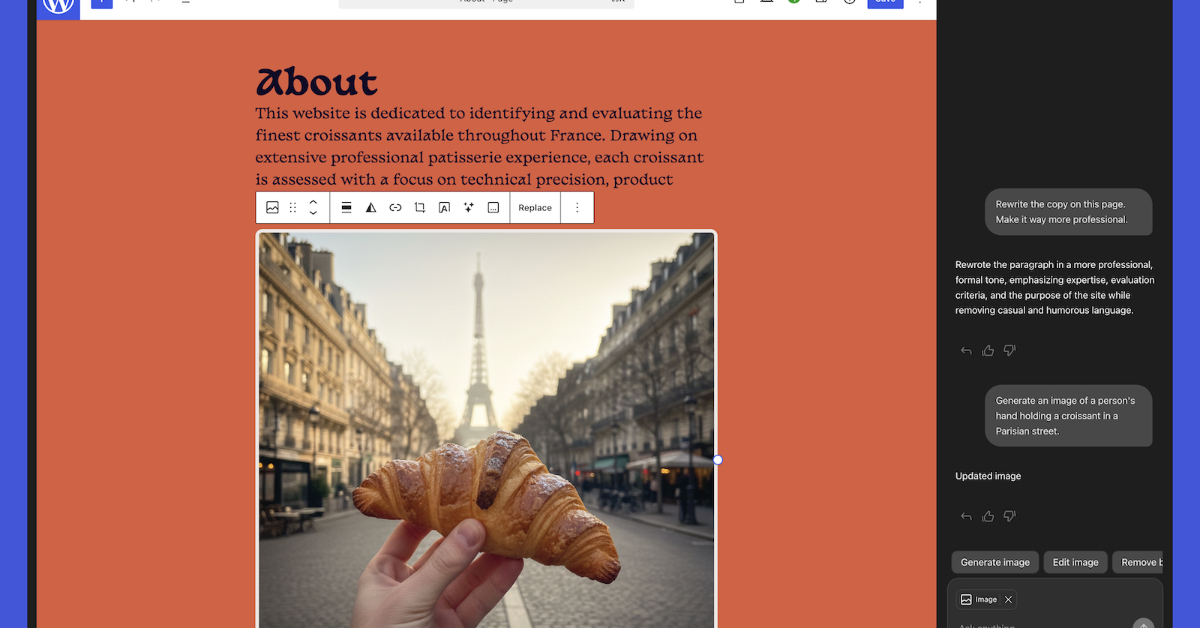
On February 17 (local time), U.S.-based Automattic announced a new feature for WordPress.com: 「WordPress AI Assistant」 (WordPress AI Assistant). The tool allows users to edit website content, adjust design, and even generate or edit images—simply by giving instructions in natural language.
For anyone building a website in Japanese or English, this represents a major shift: instead of navigating complex menus, you can now describe what you want in words.
What Is the WordPress AI Assistant?
WordPress.com is a website プラットフォーム (purattofoomu), meaning a digital platform where users can build and manage sites. It also provides ホスティング (hosutingu), or web hosting services.
The newly announced AI Assistant lets users:
- Rewrite or translate text in posts
- Suggest headlines
- Adjust レイアウト (reiauto) and design
- Generate or edit images
- Make structural changes like adding block patterns or creating a contact page
What makes this tool different from traditional website builders or chatbots is its integration. Instead of working in a separate window, the AI is built directly into the editing screen and メディアライブラリ (media raiburari, media library). According to the announcement, this allows users to use AI without interrupting their workflow.
In Japanese, this idea of “just by doing” something is often expressed with the grammar 〜だけで (~dake de). In this case, you can update your site 自然言語で指示を出すだけで (shizen gengo de shiji o dasu dake de)—“just by giving instructions in natural language.”
Abstract Instructions, Real Design Changes
One especially interesting feature is that users can give abstract instructions such as:
「このセクションをよりモダンな印象に」 Kono sekushon o yori modan na inshō ni “Make this section feel more modern.”
「色合いを明るく」 Iroai o akaruku “Brighten the color tone.”
Even vague design requests can result in changes to layout, fonts, and color schemes. Structural changes—like adding block patterns or generating a contact page—can also be handled through language-based instructions.
For image generation and editing, WordPress.com uses Google’s AI model 「Nano Banana」. It supports specifying アスペクト比 (asupekuto hi, aspect ratio) and visual style, allowing more precise control over images.
How to Enable the Feature
The AI Assistant is provided as an オプトイン (oputo in) feature. That means users must actively choose to enable it.
From the WordPress.com site list, users can simply turn on “AI tools” for each site. However, for sites built with the company’s AI-based website builder, the feature is automatically enabled.
This distinction is important. In Japanese tech writing, オプトイン emphasizes user consent and choice—an increasingly common concept in digital services.
Who Can Use It?
The AI Assistant is available at no additional cost for sites on ビジネスプラン (bijinesu puran, business plan) and commerce plans.
However, there is one limitation: although integration into the editing screen is not available for classic themes, image generation and editing in the media library remain accessible.
This contrast is often expressed in Japanese using the grammar 〜ものの (~mono no), meaning “although” or “even though”:
- クラシックテーマでは編集画面統合が利用できないものの、メディアライブラリでの画像生成・編集は利用できる。 Kurashikku tēma de wa henshū gamen tōgō ga riyō dekinai mono no, media raiburari de no gazō seisei・henshū wa riyō dekiru. “Although editor integration isn’t available for classic themes, image generation and editing in the media library can still be used.”
Cultural Context: Katakana and Tech in Japan
You probably noticed that many key terms—プラットフォーム, ホスティング, レイアウト, オプトイン—are written in katakana.
In modern Japanese, technology vocabulary frequently comes from English and is adapted into katakana. Understanding these loanwords is essential for reading Japanese tech news, product documentation, and even app interfaces.
Rather than translating everything into native Japanese equivalents, Japan often adopts global tech terms and adjusts their pronunciation. This reflects how deeply integrated international tech culture is within Japanese business and media.
Learn Japanese from This Article
Key Vocabulary
| Japanese | Romaji | Meaning |
|---|---|---|
| プラットフォーム | purattofoomu | platform |
| ホスティング | hosutingu | web hosting |
| レイアウト | reiauto | layout |
| メディアライブラリ | media raiburari | media library |
| オプトイン | oputo in | opt-in (user-enabled feature) |
| ビジネスプラン | bijinesu puran | business plan (subscription tier) |
| アスペクト比 | asupekuto hi | aspect ratio |
Grammar Spotlight
1. 〜だけで — “Just by doing…”
Structure: Verb (plain form) + だけで
Example:
自然言語で指示を出すだけで、デザインを変更できる。 Shizen gengo de shiji o dasu dake de, dezain o henkō dekiru. You can change the design just by giving instructions in natural language.
ボタンを押すだけで、有効になる。 Botan o osu dake de, yūkō ni naru. It becomes active just by pressing a button.
This pattern is extremely common in product descriptions and advertisements.
2. 〜ものの — “Although…”
Structure: Verb (plain form) + ものの
Example:
- 便利な機能があるものの、すべてのテーマでは使えない。 Benri na kinō ga aru mono no, subete no tēma de wa tsukaenai. Although it has convenient features, it can’t be used with all themes.
This expression often appears in formal writing, news articles, and business communication.
Useful Expression
- 自然言語で指示を出す Shizen gengo de shiji o dasu “Give instructions in natural language”
You’ll see 自然言語 (shizen gengo) frequently in AI-related Japanese articles.
Continue Learning
Working on your reading skills? Our Katakana Essentials: Adapting Global Words to Japanese lesson is a great next step.
To understand more about tech, explore our Basic Vocabulary Building: Embracing Words Without Latin Ties.
Curious about the Japanese used here? Our Reading and Writing in Japanese II: Hiragana and Katakana lesson covers this in depth.
Technology evolves quickly—but so does your Japanese when you read real-world news like this. Keep noticing the katakana, the grammar patterns, and the way modern Japanese blends global and local language.
これからもよろしくお願いします。 Kore kara mo yoroshiku onegaishimasu.