
On February 13, GungHo Online Entertainment reported a sharp drop in profits for fiscal year 2025. Sales fell 10.0% year-on-year to 93.242 billion yen, operating profit plunged 71.1% to 5.056 billion yen, and net profit dropped 87.4% to 1.407 billion yen.
Best known for the hit 「パズル&ドラゴンズ」 (Pazuru & Doragonzu, Puzzle & Dragons), GungHo has long been a major name in Japan’s スマホゲーム (sumaho geemu, smartphone game) industry. But this latest announcement signals a turning point.
Mobile Game Sales Decline
According to the company, the main reason for the downturn was lower sales from モバイルタイトル (mobairu taitoru, mobile titles), including Puzzle & Dragons.
In the fourth quarter, GungHo also recorded a loss. This was partly due to a reactionary drop in sales from “Ragnarok”-related titles developed by its subsidiary, Gravity. In Japanese business reporting, you’ll often see the term 反動減 (noted in the article) to describe a decline following a previous surge.
In short, the company’s traditional mobile-focused strategy is no longer producing the same results.
A Leadership Change and a New Direction
Just before the earnings announcement, on February 1, former CEO Kazuki Morishita moved into a new role as chairman and chief development officer—without representative authority. The new president and CEO, Kazuya Sakai, is now leading the company.
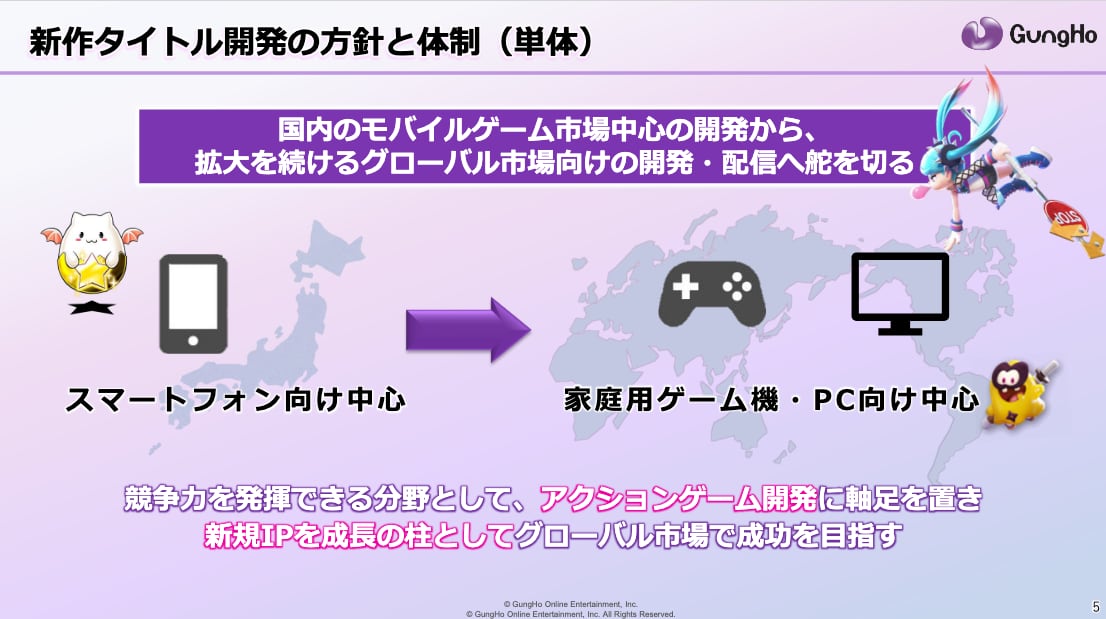
Under Sakai’s leadership, GungHo plans to シフトする (shifuto suru, shift) its development strategy. Until now, the company has focused mainly on Japan’s domestic mobile game market. Going forward, it will target the グローバル市場 (guroobaru shijou, global market*).
This also means a change in プラットフォーム (purattofoomu, platform). Instead of centering on smartphones, GungHo will focus on home video game consoles and *PC(ピーシー) (piishii, personal computers*).
Nine New Titles for the Global Market
GungHo is currently developing nine new game titles. These are being created グローバル配信を前提に (guroobaru haishin o zentei ni)—on the premise of global distribution from the start.
The company aims to strengthen sales mainly in North America and Europe. It also emphasized the importance of new IP(アイピー) (aipii, intellectual property*), such as original characters and franchises, as a key pillar of growth. In the gaming industry, IP refers to the characters, worlds, and brands that can expand into sequels, merchandise, and even anime or films.
The message is clear: GungHo is moving away from a smartphone-centered business model and betting on globally competitive original content.
Cultural Context: From Domestic Hits to Global Competition
For many years, Japan’s mobile game market was one of the most profitable in the world. Titles like Puzzle & Dragons dominated app rankings domestically. However, the global gaming landscape has changed. Console and PC gaming have strong markets in North America and Europe, and competition is intense.
The phrase “脱スマホ” (literally “moving away from smartphones”) in the article’s title captures this strategic pivot. It suggests not just adding new platforms, but fundamentally rethinking the company’s identity.
For Japanese learners, this article is also a great example of how business Japanese blends native words with katakana loanwords like グローバル, プラットフォーム, and IP.
Learn Japanese from This Article
Key Vocabulary
| Japanese | Romaji | Meaning |
|---|---|---|
| スマホゲーム | sumaho geemu | smartphone game |
| モバイルタイトル | mobairu taitoru | mobile game title |
| プラットフォーム | purattofoomu | platform (hardware/service environment) |
| グローバル市場 | guroobaru shijou | global market |
| IP(アイピー) | aipii | intellectual property |
| シフトする | shifuto suru | to shift; to change direction |
| PC(ピーシー) | piishii | personal computer |
Notice how many of these are written in katakana. Japanese business and tech news frequently uses adapted English words.
Grammar Spotlight
1. 〜をはじめとする
Meaning: including…, starting with…
Structure: Noun + をはじめとする + Noun
Example from the article context:
- パズドラをはじめとするモバイルタイトルの売上減 Pazudora o hajime to suru mobairu taitoru no uriage gen A decline in sales of mobile titles, including Puzzle & Dragons.
More examples:
東京をはじめとする大都市 Toukyou o hajime to suru daitoshi Major cities, including Tokyo.
日本企業をはじめとするアジアの会社 Nihon kigyou o hajime to suru Ajia no kaisha Asian companies, starting with Japanese firms.
This pattern is very common in news writing.
2. 〜を前提に
Meaning: on the premise of; assuming that
Structure: Noun + を前提に
Example from the article:
- グローバル配信を前提に新作タイトルを開発中 Guroobaru haishin o zentei ni shinsaku taitoru o kaihatsu-chuu Developing new titles on the premise of global distribution.
More examples:
成功を前提に計画を立てる Seikou o zentei ni keikaku o tateru Make plans assuming success.
海外展開を前提にデザインする Kaigai tenkai o zentei ni dezain suru Design something with overseas expansion in mind.
This phrase is especially useful in business and strategy discussions.
Useful Expressions
大幅な減収減益 Oohaba na genshuu gen’eki A significant decline in revenue and profit.
成長の柱 Seichou no hashira A pillar of growth; a key driver of growth.
These expressions appear often in financial news.
Continue Learning
Working on your reading skills? Our Katakana Essentials: Adapting Global Words to Japanese lesson is a great next step.
To understand more about tech, explore our Reading and Writing in Japanese II: Hiragana and Katakana lesson.
Want to learn more about tech? Check out our lesson on Basic Vocabulary Building: Embracing Words Without Latin Ties.
GungHo’s shift from domestic smartphone hits to globally distributed console and PC titles marks a major strategic change. For learners of Japanese, it’s also a perfect example of how modern business Japanese reflects Japan’s evolving place in the world.
これからもよろしくお願いします。 Kore kara mo yoroshiku onegaishimasu.