
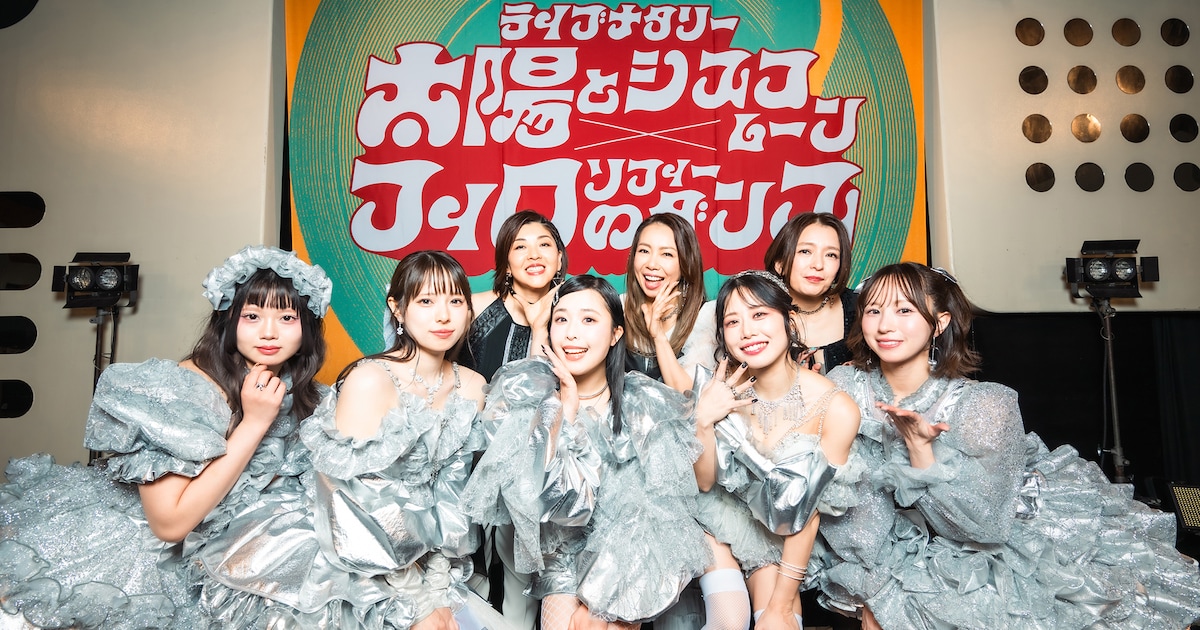
On February 11, Tokyo’s Shibuya duo MUSIC EXCHANGE was packed so tightly that there was “no room to step.” Fans gathered for a rare and emotional event: a ツーマンライブ (tsūman raibu) between Taiyo to Ciscomoon and Filosophy no Dance.
For Taiyo to Ciscomoon, it was their first-ever two-man show in their 26-year career. For Filosophy no Dance, it was a chance to share the stage with the group they lovingly call their musical “ancestors.”
What unfolded was described as an “愛の殴り合い” (ai no naguriai) — a “loving fistfight” of music — filled with mutual respect, explosive vocals, and pure joy.
Two Generations, One Stage
Both groups are known for bringing authentic soul and dance music elements into J-pop. Even before the concert, they had already 意気投合 (iki tōgō) — they instantly clicked in interviews and sensed strong 相性 (aishō), or compatibility.
Filosophy no Dance member Okutsu Mariri even referred to Taiyo to Ciscomoon as their musical “ご先祖様” (gosenzo-sama) — ancestors.
That respect set the tone for the night.
Who Are Taiyo to Ciscomoon?
Taiyo to Ciscomoon was formed in 1999 through an audition project on the TV Tokyo program ASAYAN, the same show that 輩出した (haishutsu shita — produced) stars like Morning Musume and CHEMISTRY.
They debuted in April 1999 with 「月と太陽」 (Tsuki to Taiyō — “Moon and Sun”) and released a rapid string of singles and albums. In March 2000, at the time of their 7th single release, they suddenly changed their name to T&C Bomber.
In October 2000, the group 解散した (kaisan shita — disbanded) following a concert, marking the end of a short but impactful year and a half.
Years later, in January 2009, they reunited (without member RuRu) ベストアルバムの発売を機に (besuto arubamu no hatsubai o kiki ni — taking the opportunity of a best album release). After occasional performances, they fully 再始動した (sai shidō shita — relaunched) in 2024 for their 25th anniversary.
Who Are Filosophy no Dance?
Filosophy no Dance is a five-member idol group formed in 2015 under producer Keitaro Kamo. Their concept combines contemporary funk and R&B with philosophical lyrics.
After member Totoki Otoha graduated in 2021, two new members joined through an audition, creating the current lineup. In March 2024, they released their first full album as a five-member group, 「NEW BERRY」, and they plan to celebrate their 10th anniversary in August 2025 with a special live performance.
They’re known as masters of the 対バン (taiban) — split-bill concerts where artists push each other to new heights.
“踊って踊って、踊りまくるぞ~!”
Before the show began, dance-themed songs filled the venue. The atmosphere built anticipation for what would clearly be a night of movement.
When the lights dimmed, Filosophy no Dance appeared in sparkling silver outfits. They opened with 「ウェイク・アップ・ダンス」 (Wake Up Dance), delivering powerful vocals and tight microphone relays.
Then came the shout from Kayama Nanako:
「踊って踊って、踊りまくるぞ~!」 Odotte odotte, odorimakuru zo! “Dance, dance — we’re going to dance like crazy!”
The crowd responded with roaring cheers. Call-and-response chants of “オーオーオー!” shook the venue. Long sustained notes from members Hyuga Haru and Okutsu Mariri made the entire space vibrate.
This was more than nostalgia. It was synergy.
“YES! しあわせ” — A Message Across Generations
The event wasn’t framed as competition but as celebration. The phrase “愛の殴り合い” captured the spirit perfectly — artists pushing each other passionately, but with love.
Taiyo to Ciscomoon’s long history and Filosophy no Dance’s modern funk identity blended into what fans called “フィロシス” — a combined nickname for the two groups.
The result? A “幸せな時間” (shiawase na jikan) — a happy, unforgettable time.
Cultural Context: Why This Matters
Taiyo to Ciscomoon represents a pivotal era in late-1990s J-pop, when audition programs like ASAYAN reshaped the idol industry. Their sudden name change and eventual disbandment marked a dramatic chapter in idol history.
Meanwhile, Filosophy no Dance reflects a newer wave: idols with strong live vocals and deep musical influences beyond standard pop formulas.
This concert symbolized a musical family tree — proving how one generation’s innovation inspires the next.
Learn Japanese from This Article
Key Vocabulary
| Japanese | Romaji | Meaning |
|---|---|---|
| 意気投合 | iki tōgō | to hit it off; to instantly connect |
| 相性 | aishō | compatibility; chemistry |
| 再始動 | sai shidō | restart; relaunch |
| 輩出する | haishutsu suru | to produce (talent) |
| 解散 | kaisan | disband; break up (a group) |
| ツーマンライブ | tsūman raibu | two-man concert |
| 対バン | taiban | split-bill live show |
| 〜を機に | ~o kiki ni | taking the opportunity of |
| 〜をもって | ~o motte | marking the point of; as of |
Grammar Spotlight
1️⃣ 〜を機に (~o kiki ni)
“Taking the opportunity of…”
Used when one event becomes the turning point for another.
Structure: Noun + を機に
Example from the article: ベストアルバムの発売を機に再集結した。 Besuto arubamu no hatsubai o kiki ni saishūketsu shita. “They reunited on the occasion of releasing a best album.”
Use this in formal speech or writing when describing major life or career changes.
2️⃣ 〜をもって (~o motte)
“Marking the point of…” / “As of…”
Common in news or formal announcements.
Example (based on their history): 10月のコンサートをもって解散した。 Jūgatsu no konsāto o motte kaisan shita. “They disbanded following the October concert.”
You’ll often see this in official statements.
Useful Expression
愛の殴り合い (ai no naguriai) Literally “a fistfight of love.”
It doesn’t mean actual violence — it describes intense but respectful rivalry. You might use it jokingly when competing passionately with a friend.
Continue Learning
Working on your reading skills? Our Katakana Essentials: Adapting Global Words to Japanese lesson is a great next step.
Two generations. One stage. A shared love of groove, soul, and powerful vocals.
Concerts like this show how music history in Japan isn’t just preserved — it’s passed forward.
これからもよろしくお願いします。 Kore kara mo yoroshiku onegaishimasu.