
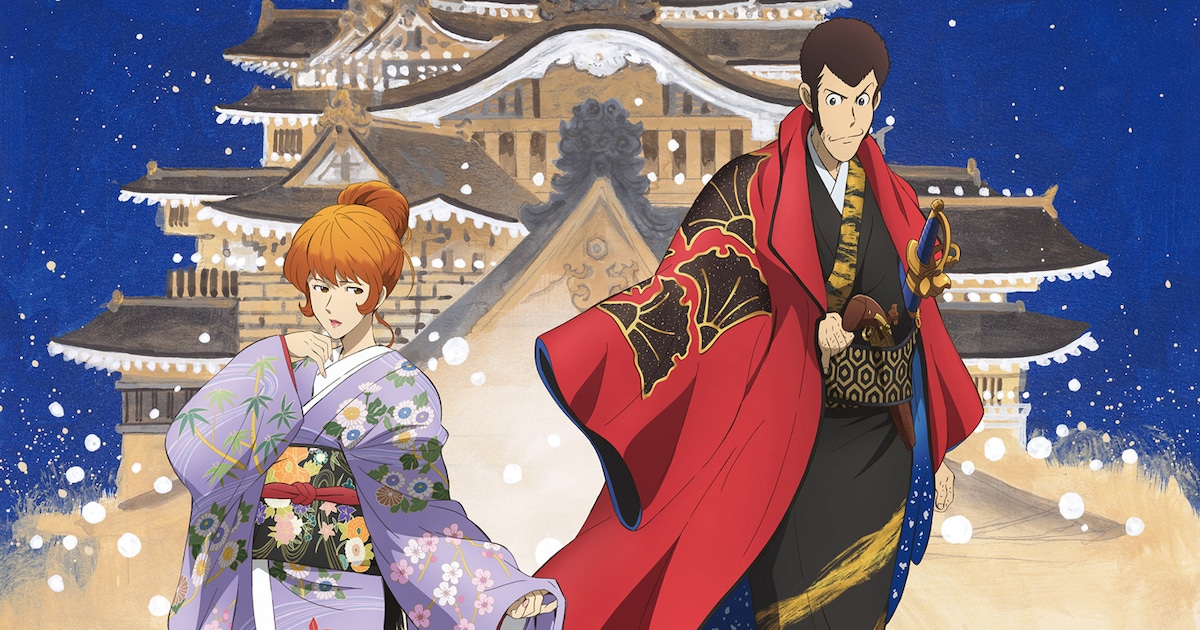
On February 14, 2026, the official illustrated visual for the new kabuki production 「流白浪燦星 碧翠の麗城」 (Nagareboshi no Rupan: Hekisui no Reijō) was 解禁された (kaikin sareta)—officially released. And at the center of the artwork stand Lupin III and Fujiko Mine, dressed in dazzling kimono against the backdrop of a mysterious castle.
This is the second kabuki adaptation of Monkey Punch’s beloved series 「ルパン三世」 (Rupan Sansei, Lupin the Third), and the newly revealed illustration is already building excitement.
A Newly Drawn Visual for a Theatrical Spectacle
The newly revealed image is a 描き下ろし (kakioroshi)—a brand-new illustration created specifically for this production. It was painted by an artist who usually works on large-scale background art for kabuki stage sets.
In the image, Lupin III and Fujiko Mine 佇んでいる (tatazunde iru)—stand quietly and elegantly—in front of a beautifully rendered castle. Both wear kimono, blending the world of classic kabuki with the stylish flair of the Lupin universe.
Lupin wears a red haori coat decorated with the 追いかけ五枚銀杏 crest, a traditional kabuki-style design that has been carefully あしらわれた (ashirawareta, decorated with) to match the stage costume. Fujiko also appears in a stunning kimono, emphasizing elegance and allure.
The visual hints at the story to come: the two are 狙う (nerau)—aiming for—the treasure hidden within an ancient castle. What role will they play in moving the story forward? The illustration raises anticipation for the adventure.
The Story: Romance and Treasure in Feudal Japan
The setting is feudal-era Suwa Province. Princess Seori (瀬織姫 Seori-hime) is forced into an unwanted marriage with the powerful regent Danjō in order to preserve her family’s status.
At this critical moment, Lupin appears—targeting the temple’s treasure where she lives.
The meeting between the freedom-seeking princess and Lupin develops into a faint romance. Their encounter expands into an adventure 〜を巡る (…o meguru, surrounding) the hidden treasure of a “phantom castle.” Lupin and his 一味 (ichimi, gang) join forces with the princess to battle Danjō over the treasure, while Inspector Zenigata pursues them.
It’s classic Lupin—heists, rivalry, romance—but reimagined through the dramatic style of kabuki.
Star-Studded Cast and Double Roles
As in the first installment, Kataoka Ainosuke stars as both Lupin (流白浪燦星) and Ishikawa Goemon, taking on two roles in one production.
Other cast members include:
- Nakamura Yonekichi as Princess Seori
- Ichikawa Emisaburō as Daisuke Jigen
- Ichikawa Emya as Fujiko Mine
- Ichikawa Chūsha as Zenigata
The role of Takitsu Danjō Hisanaga will be performed as a Wキャスト (daburu kyasuto, double cast):
- Nakamura Kinnosuke in Tokyo and Aichi
- Bandō Yajūrō in Kyoto and Fukuoka
In kabuki, star actors and family lineages are central to a production’s appeal. Casting well-known names in multiple cities helps draw audiences across Japan.
Performance Schedule
The play will tour four major theaters:
- Tokyo (Shinbashi Enbujō): March 5–27, 2026
- Aichi (Misonoza): April 3–26, 2026
- Kyoto (Minamiza): September 2–26, 2026
- Fukuoka (Hakataza): February 6–26, 2027
Tokyo tickets are already on sale, and general sales for Aichi begin March 4 at 10:00 a.m.
Cultural Context: Why Turn Lupin into Kabuki?
Kabuki is a traditional Japanese theater form dating back over 400 years. It features elaborate costumes, dramatic makeup, stylized acting, and live music.
Adapting ルパン三世 (Rupan Sansei) into kabuki may seem unexpected, but it reflects a modern trend: blending pop culture with traditional arts to keep them alive and relevant. By placing Lupin in feudal Japan and giving him kabuki-style costumes and stage design, the production bridges past and present.
For learners of Japanese, this is also a chance to see how contemporary stories are reshaped within classical frameworks—something Japan does particularly well.
Learn Japanese from This Article
Key Vocabulary
| Japanese | Romaji | Meaning |
|---|---|---|
| 解禁 | kaikin | official release; lifting a ban |
| 描き下ろし | kakioroshi | newly drawn/created specifically |
| 佇む | tatazumu | to stand quietly; to linger |
| あしらう | ashirau | to decorate; to design with |
| 狙う | nerau | to aim for; to target |
| 一味 | ichimi | a gang; a group with shared purpose |
| Wキャスト | daburu kyasuto | double cast |
Notice how many of these words frequently appear in entertainment news. Learning them helps you read real Japanese articles with confidence.
Grammar Spotlight
1. 〜られた (Passive Form)
Example from the article:
公式イラストビジュアルが解禁された。 Kōshiki irasuto bijuaru ga kaikin sareta. The official illustration was released.
The passive form (〜られた) is commonly used in news writing to sound objective. Instead of saying “They released the illustration,” Japanese often says “The illustration was released.”
Other examples:
- 衣装があしらわれた。 Ishō ga ashirawareta. The costume was decorated.
2. 〜を巡る (…o meguru)
Used to describe something “surrounding” or “concerning” a topic, often conflict or debate.
From the story:
宝を巡る冒険 Takara o meguru bōken An adventure surrounding the treasure
You’ll often see this in news headlines:
- 選挙を巡る議論 Senkyo o meguru giron Debate surrounding the election
Useful Expression
期待をあおる (kitai o aoru) — to heighten anticipation
Entertainment articles often use this phrase to describe visuals or trailers that build excitement.
Continue Learning
Working on your reading skills? Our Introduction to Kanji: Pictorial Foundations of Japanese Script lesson is a great next step.
Ready to dive deeper? Our lesson on Basic Vocabulary Building: Embracing Words Without Latin Ties will help you master these concepts.
Working on your reading skills? Our Katakana Essentials: Adapting Global Words to Japanese lesson is a great next step.
A legendary thief in kabuki costume, a princess seeking freedom, and a treasure hidden in a phantom castle—this production promises spectacle, romance, and tradition all at once. For Japanese learners, it’s also a wonderful reminder: language lives not just in textbooks, but on stage.
これからもよろしくお願いします。 Kore kara mo yoroshiku onegaishimasu.