
Unboxing a Japanese Tea Lucky Bag: A Beginner's Taste Test
If you’ve ever dreamed of sipping your way through Japan’s rich tea culture, imagine stumbling upon a mystery bag packed with premium brews straight from Kagoshima Prefecture. That’s exactly what happened to a curious tea novice browsing Rakuten Market, who decided to dive into a 福袋 (fukubukuro, lucky bag) filled exclusively with 知覧茶 (Chiran-cha), a renowned green tea. What started as a whimsical purchase turned into an eye-opening journey through flavors and aromas, proving that even a beginner can uncover the depth of Japanese tea. Let’s unpack this story and see how it can inspire your own language and cultural exploration!
Discovering the Tea-Filled Lucky Bag
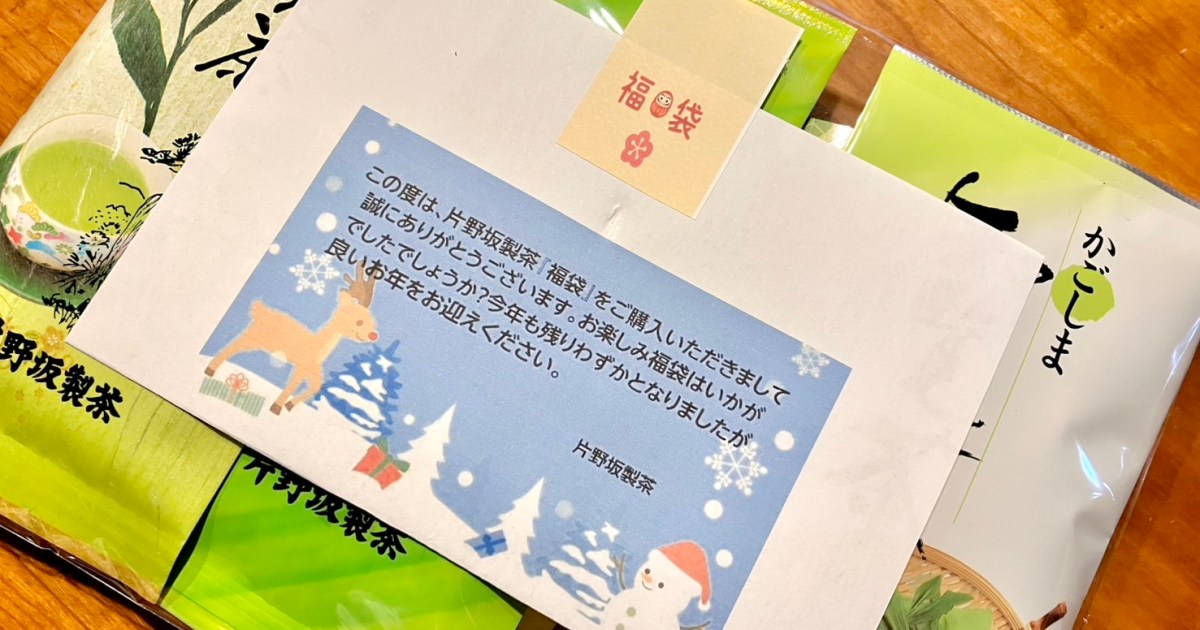
While scrolling through Rakuten Market, Japan’s popular online shopping hub, the writer found something intriguing: a 福袋 (fukubukuro, lucky bag) from 片野坂製茶 (Katanosaka Seicha), a tea producer offering direct sales (直売, chokubai). Unlike the usual New Year’s lucky bags stuffed with random goodies, this one was all about tea. With three tiers named after classic Japanese symbols—松 (matsu, pine), 竹 (take, bamboo), and 梅 (ume, plum)—the writer picked the budget-friendly 梅 set for 2,160 yen. Could someone with little experience in tasting 煎茶 (sencha, steamed green tea) actually notice any differences? They decided to give it a try.
When the package arrived, it was like opening a treasure chest of tea. Inside were seven packs of 知覧茶 (Chiran-cha), including three 100g bags of 煎茶 (sencha), two 40g bags (one 抹茶入りくき茶, matcha-iri kuki-cha, matcha-infused stem tea, and one 粉茶, konacha, powdered tea), and two small tea bag packs with sweet messages like よろしくお願いします (yoroshiku onegaishimasu, nice to meet you). Overwhelmed by the variety, the writer set out to taste-test the teas and discover their unique 風味 (fuumi, flavor or aroma).
A Beginner's Taste Test Adventure
Focusing on the three 100g bags of 煎茶 (sencha), the writer brewed their first cup and was instantly charmed. The tea was smooth and mellow, with a subtle sweetness that made it effortless to sip—no hint of 苦味 (nigami, bitterness) at all. The second bag surprised them even more; its 風味 (fuumi, flavor) was milder, with an aroma that stood out beautifully. It became their favorite for its gentle, approachable taste.
The third bag, though, was a different story. Despite looking similar, its flavor hit with a sharp 苦味 (nigami, bitterness) and a mature, astringent edge. Comparing it to coffee, the writer described the first two teas as creamy lattes and this one as a bold black brew. Who knew that teas under the same 知覧茶 (Chiran-cha) label could have such distinct personalities? This experiment showed that even a novice can appreciate the nuances of Japanese tea with a little curiosity.
Was This Lucky Bag a Good Deal?
Wondering if the 福袋 (fukubukuro) was worth it, the writer crunched the numbers. The three 100g bags of 煎茶 (sencha) alone were valued at 1,953 yen, nearly matching the 2,160 yen price of the entire bag. Since the shop usually sells tea in sets of two or more, buying these individually would likely cost even more. The verdict? A fantastic deal for anyone eager to explore high-quality Japanese tea, especially during the chilly winter months.
Cultural Context: Tea and Tradition in Japan
In Japan, tea isn’t just a beverage—it’s a cultural cornerstone with deep regional roots. 知覧茶 (Chiran-cha) comes from Kagoshima Prefecture in southern Kyushu, a region that recently overtook Shizuoka as Japan’s top tea producer in 2024. Known for its volcanic soil and mild climate, Kagoshima creates teas with a perfect balance of sweetness and umami, making 知覧茶 (Chiran-cha) a standout. Beyond the flavor, drinking tea connects you to everyday Japanese life, where it’s savored in quiet moments or shared with guests as a gesture of hospitality.
Then there’s the 福袋 (fukubukuro), a New Year’s tradition symbolizing luck and renewal. These mystery bags, sold at a discount, are a fun way for stores to celebrate the season, and finding one dedicated to tea shows how even ordinary items carry cultural weight in Japan. Engaging with traditions like this—whether through tea or shopping—offers a window into the Japanese mindset of starting the year with hope and surprise.
Learn Japanese from This Article
Ready to brew up some language skills alongside your tea? This story is packed with useful words and grammar patterns that reflect how Japanese is used in real-life contexts. Let’s break it down the way native speakers learn—through immersion and practical examples.
Key Vocabulary
| Japanese | Romaji | Meaning |
|---|---|---|
| 福袋 | fukubukuro | lucky bag, mystery bag |
| 煎茶 | sencha | steamed green tea |
| 知覧茶 | Chiran-cha | Chiran tea (from Kagoshima) |
| 抹茶 | matcha | powdered green tea |
| 苦味 | nigami | bitterness |
| 風味 | fuumi | flavor, aroma |
| 直売 | chokubai | direct sale |
Grammar Spotlight: 〜てみる (Try Doing Something)
One useful pattern from this story is 〜てみる (~te miru), which means “to try doing something.” It’s a great way to express experimentation or curiosity, just like the writer tried tasting different teas. You take the て-form of a verb and add みる (to see/look).
飲んでみる (nonde miru) - Try drinking
- お茶を飲んでみる。 (Ocha o nonde miru.) - I’ll try drinking tea.
- 新しい味を飲んでみる。 (Atarashii aji o nonde miru.) - I’ll try drinking a new flavor.
買ってみる (katte miru) - Try buying
- 福袋を買ってみる。 (Fukubukuro o katte miru.) - I’ll try buying a lucky bag.
Use this pattern when you’re stepping out of your comfort zone or testing something new. It’s casual yet polite enough for everyday conversations, especially in the ます-form like 飲んでみます (nonde mimasu).
Grammar Spotlight: 〜たところ (When/As a Result)
Another handy structure is 〜たところ (~ta tokoro), often used to describe a result or realization after doing something. It’s like saying, “When I did this, I found that…”—perfect for reflecting on experiences like a taste test.
- 飲んだところ、甘かった。 (Nonda tokoro, amakatta.) - When I drank it, it was sweet.
- 開けたところ、たくさん入っていた。 (Aketa tokoro, takusan haitte ita.) - When I opened it, there was a lot inside.
- 試したところ、違いが分かった。 (Tameshita tokoro, chigai ga wakatta.) - When I tried it, I understood the difference.
This pattern works well for storytelling, helping you share what happened after taking action. It’s a natural way to describe discoveries, much like the writer’s tea journey.
Useful Expression
A phrase you’ll see on one of the tea bags is よろしくお願いします (yoroshiku onegaishimasu), which translates to “nice to meet you” or “please take care of me.” It’s a versatile expression used in greetings, requests, or even small gifts, reflecting Japanese politeness and humility.
Continue Learning
Want to dive deeper into the language used in this story? Check out these lessons to build your skills:
- Masu Form: Mastering Polite Everyday Speech: Want to understand the verb forms used here? Check out Masu Form: Mastering Polite Everyday Speech.
- Wa vs. Ga: Emphasizing Importance in Sentences: To understand more about は, explore our Wa vs. Ga: Emphasizing Importance in Sentences lesson.
- Ni, De, and E: Mapping Directions and Locations: Curious about the Japanese used here? Our Ni, De, and E: Mapping Directions and Locations lesson covers this in depth.
これからもよろしくお願いします。 Kore kara mo yoroshiku onegaishimasu.