
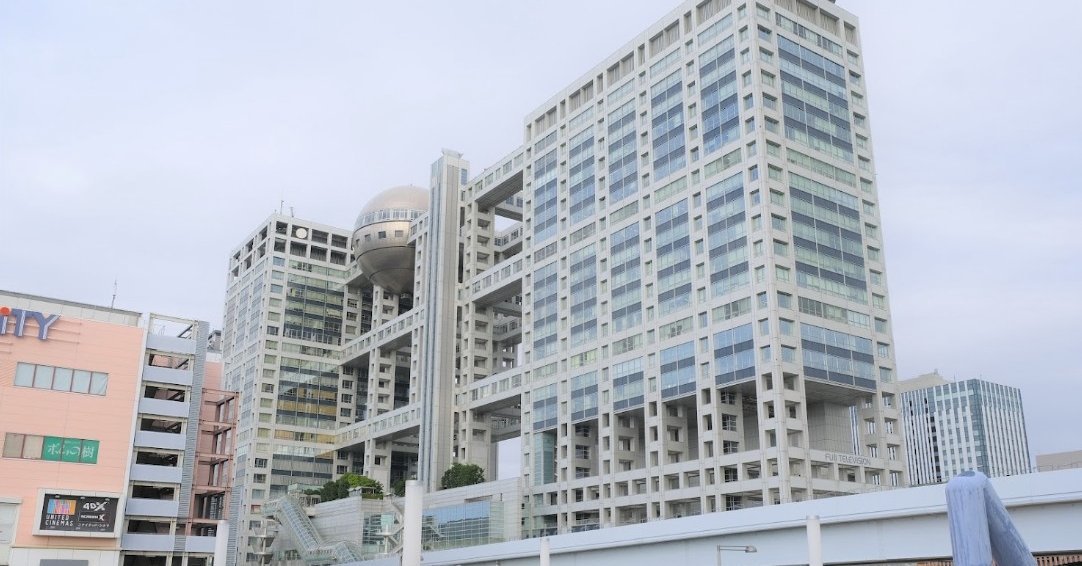
Fuji Television said on November 5 that it plans to build a system so every drama it produces can use 生成AI (seisei ai), or generative AI, by October 2027. Starting with the October 2026 season, the company will designate at least one drama each quarter as an “AI-enhanced” production slot. In some parts of video production, it says the amount of work required, or 工数 (kousuu), has already been cut by as much as 70 to 80 percent.
According to ITmedia, Fuji Television will build on testing done at “AI Sandbox,” an experimental 拠点 (kyoten), or base, opened at its Wangan Studio. The facility began operating in September under the company’s AI Center, an internal organization launched in July to promote AI use across the company. Drama production teams, technical staff, and the AI-related company ANDENT in Shibuya, Tokyo, are working together there to test how generative AI can be used in actual drama production.
How Fuji TV is using AI in drama production
Fuji Television says it is already using generative AI in several works, including the currently airing drama 救命病棟24時 (kyuumei byoutou nijuu yoji), “Emergency Ward 24 Hours.” In that production, generative AI is used before filming to turn the director’s mental image into something visible, a process called 可視化 (kashika). That helps staff share a clear image of what the finished scene should look like.
The company also says AI is being used for detailed image processing in medical scenes and for accident scenes that would be difficult to reproduce through live-action filming alone. In the explosion accident scene in episode 1, for example, the team created a fictional aerial-view-style landscape with generative AI and then added smoke through 合成 (gousei), or compositing.
Fuji says this has improved efficiency in some production steps. Compared with older methods, the company says it reduced 工数 (kousuu) by as much as 70 to 80 percent in certain parts of video production. It also added an important limit: that figure comes from testing in specific processes, and it does not show a reduction rate for the total production cost or labor of an entire drama.
AI will be combined with existing methods
Shinya Masaki, who oversees technology for AI Sandbox, said the company is not making all video with AI. Instead, it combines AI with conventional VFX (buiefuekkusu), or visual effects, and chooses the method that best suits each work.
Daisuke Nagashima, general manager of the Drama and Film Production Center, said generative AI can also help with scenes that are hard to film because of location limits, weather, legal issues, or safety-related 制約 (seiyaku), meaning constraints. He said he expects this to broaden the choices available for visual expression.
Fuji Television plans to expand these efforts to other video-related companies within its group. By fiscal 2029, it aims for the entire group to have AI utilization capability.
Learn Japanese from This Article
Vocabulary
| Japanese | Romaji | Meaning |
|---|---|---|
| 生成AI | seisei ai | generative AI |
| 活用 | katsuyou | practical use; utilization |
| 工数 | kousuu | man-hours; amount of work required |
| 拠点 | kyoten | base; hub |
| 可視化 | kashika | visualization; making something visible |
| 合成 | gousei | compositing; synthesis |
| 制約 | seiyaku | constraints; limitations |
| VFX | buiefuekkusu | visual effects |
Grammar Spotlight
〜ではなく: not ..., but ...; rather than ...
Pattern:
- Aではなく、B
- “Not A, but B” / “Rather than A, B”
From the article:
- 全ての映像をAIで制作するのではなく、従来のVFX(視覚効果)などと組み合わせ、作品に適した手法を選んでいる。 Subete no eizou o AI de seisaku suru no de wa naku, juurai no buiefuekkusu (shikaku kouka) nado to kumiawase, sakuhin ni tekishita shuhou o erande iru. They are not producing all video with AI, but combining it with conventional VFX and choosing the method that suits the work.
Example:
- 東京ではなく、大阪で会議をします。 Toukyou de wa naku, Oosaka de kaigi o shimasu. We’ll have the meeting not in Tokyo, but in Osaka.
Example:
- 一人でやるのではなく、チームで進めます。 Hitori de yaru no de wa naku, chiimu de susumemasu. We won’t do it alone; we’ll move forward as a team.
〜ことを目指す: to aim to do; to aim for something
Pattern:
- dictionary form + ことを目指す
- “Aim to do ...”
From the article:
- 29年度にはグループ全体でAI活用能力を持つことを目指す。 Nijuu kyuu nendo ni wa guruupu zentai de AI katsuyou nouryoku o motsu koto o mezasu. By fiscal 2029, the group aims to have AI utilization capability across the whole organization.
Example:
- 来年までに日本語で新聞を読めるようになることを目指しています。 Rainen made ni nihongo de shinbun o yomeru you ni naru koto o mezashite imasu. I’m aiming to be able to read newspapers in Japanese by next year.
Example:
- 会社は作業時間を減らすことを目指しています。 Kaisha wa sagyou jikan o herasu koto o mezashite imasu. The company is aiming to reduce work time.
Useful Expressions
- AI強化枠 (AI kyouka waku) — an “AI-enhanced” production slot
- 完成イメージを共有する (kansei imeeji o kyouyuu suru) — to share a vision of the finished product
- 選択肢が広がる (sentakushi ga hirogaru) — options expand
- 運用を開始する (unyou o kaishi suru) — to begin operations
Continue Learning
- Te Form: Linking Actions Seamlessly: Want to use 〜なく from this article yourself? Our Te Form: Linking Actions Seamlessly lesson covers it.
- Conjugation in Japanese: It Doesn't Exist: Want to use 活用 from this article yourself? Our Conjugation in Japanese: It Doesn't Exist lesson covers it.
これからもよろしくお願いします。 Kore kara mo yoroshiku onegaishimasu.