
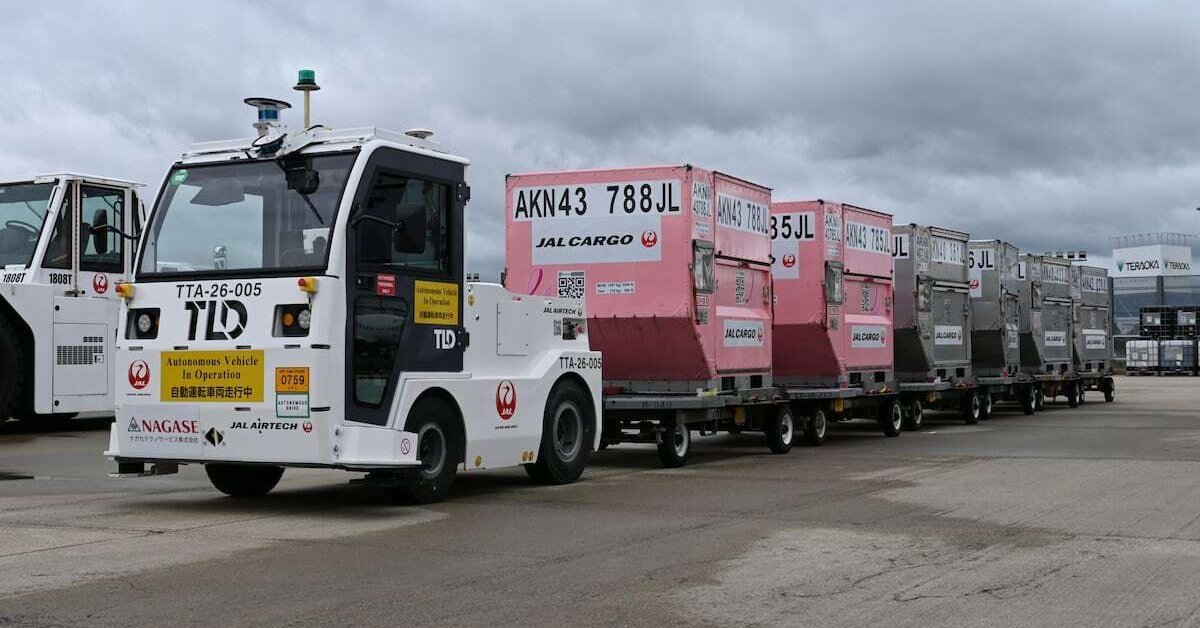
On October 26, Japan Airlines and Fukuoka International Airport began Level 4 自動運転 (jidou unten) for towing tractors that carry cargo containers at Fukuoka Airport. Under Level 4, the system operates the unmanned vehicle under specific conditions. According to ITmedia, this is the third location in Japan to put Level 4 運用 (unyou) of this type of vehicle into service, after Narita Airport and Haneda Airport.
How the system will operate at Fukuoka Airport
The route runs from Fukuoka Airport’s air cargo collection area to aircraft parked in the domestic terminal area. Of the roughly 2.5-kilometer route, 1.7 kilometers will be handled by autonomous driving.
The towing vehicle pulls six connected carts and follows a pre-set route. Right now, there is one operating vehicle, and the airport aims for the 導入 (dounyuu) of a total of four by the end of this fiscal year.
Why Japan Airlines and the airport are introducing it
Japan Airlines said that, through the 導入 (dounyuu) of autonomous driving, there are benefits such as being able to shift employees from long outdoor work to indoor duties through 配置転換 (haichitenkan). Miho Saruwatari, head of the Kyushu branch, said that with labor shortages continuing, supporting workloads through automation and improving staff placement 最適化 (saitekika) while reducing the burden on frontline workplaces is an urgent task.
Etsuya Uchiyama, head of airport operations at Fukuoka International Airport, said the system will improve work efficiency and also reduce ヒューマンエラー (hyuuman eraa) associated with human driving, helping airport safety.
Learn Japanese from This Article
Vocabulary
| Japanese | Romaji | Meaning |
|---|---|---|
| 自動運転 | jidou unten | autonomous driving; self-driving operation |
| 運用 | unyou | operation; practical use |
| 導入 | dounyuu | introduction; implementation |
| 配置転換 | haichitenkan | reassignment of personnel |
| 最適化 | saitekika | optimization |
| ヒューマンエラー | hyuuman eraa | human error |
Grammar Spotlight
〜により — due to; by means of; as a result of
Pattern: 名詞 + により
From the article: 日本航空によると、自動運転の導入により、屋外での長時間業務から、室内業務に社員を配置転換できるなどのメリットがあり、九州支社の猿渡美穂支社長は「労働力が不足する中、自動化で業務量を支え、人員配置の最適化や現場の負担軽減をしていくことは喫緊の課題だ」と語った。 Nihon Koukuu ni yoru to, jidou unten no dounyuu ni yori, okugai de no choujikan gyoumu kara, shinai gyoumu ni shain o haichitenkan dekiru nado no meritto ga ari, Kyushu shisha no Saruwatari Miho shishachou wa "roudouryoku ga fusoku suru naka, jidouka de gyoumuryou o sasae, jinnin haichi no saitekika ya genba no futan keigen o shite iku koto wa kinnikyuu no kadai da" to kattatta. According to Japan Airlines, the introduction of autonomous driving brings benefits such as being able to reassign employees from long hours of outdoor work to indoor work, and Kyushu branch chief Miho Saruwatari said that, amid labor shortages, supporting workloads through automation and optimizing staff placement while reducing burdens on the worksite is an urgent issue.
Example: 新しいシステムにより、作業時間が短くなりました。 Atarashii shisutemu ni yori, sagyou jikan ga mijikaku narimashita. The new system reduced work time.
Example: 自動化により、安全性が高まりました。 Jidouka ni yori, anzensei ga takamarimashita. Automation increased safety.
Use 〜により in formal writing and news language to show cause, means, or result.
〜を目指す — to aim for; to seek to achieve
Pattern: 名詞 + を目指す
From the article: 運用車両は現在は1台で、今年度末までに計4台の導入を目指す。 Unyou sharyou wa genzai wa ichidai de, konnendo matsu made ni kei yondai no dounyuu o mezasu. There is currently one operating vehicle, and they aim to introduce a total of four by the end of this fiscal year.
Example: 会社は来年までに新しい設備の導入を目指しています。 Kaisha wa rainen made ni atarashii setsubi no dounyuu o mezashite imasu. The company aims to introduce new equipment by next year.
Example: 空港は業務の効率化を目指しています。 Koukuu wa gyoumu no kouritsuka o mezashite imasu. The airport is aiming for greater work efficiency.
Use 〜を目指す when talking about official goals, plans, and targets.
Useful Expressions
Here are a few natural expressions from this news:
- 労働力が不足する中 (roudouryoku ga fusoku suru naka) — while labor is in short supply
- 現場の負担軽減 (genba no futan keigen) — reducing the burden on frontline worksites
- 空港の安全に寄与する (kuukou no anzen ni kiyo suru) — contribute to airport safety
Continue Learning
- Advanced Particles: Kara, Made, Yori Depth: Want to use 〜より from this article yourself? Our Advanced Particles: Kara, Made, Yori Depth lesson covers it.
- Time and Dates: Tense-Free Expressions: Ready to dive deeper? Our lesson on Time and Dates: Tense-Free Expressions will help you master these concepts.
これからもよろしくお願いします。 Kore kara mo yoroshiku onegaishimasu.