
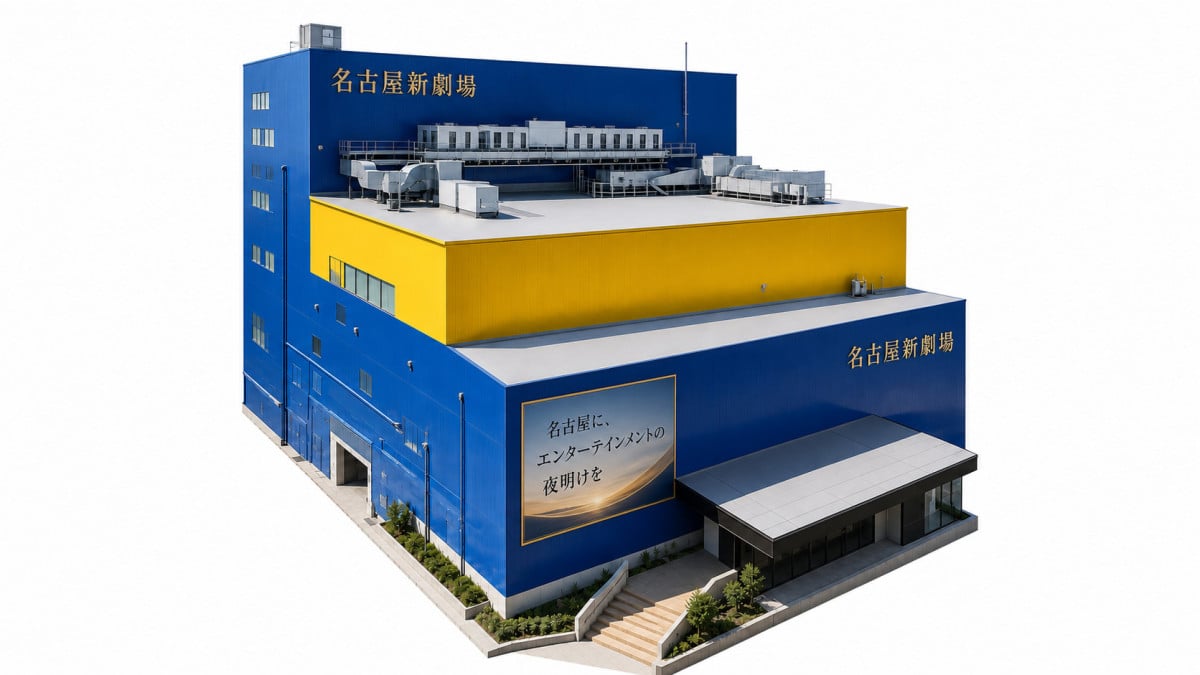
On July 31, Sunrise Promotion announced that it had acquired the former Nagoya Shiki Theatre building and signed a 定期借地契約 (teiki shakuchi keiyaku, fixed-term land lease contract) with the landowner, NTT Urban Development. The company plans to renovate the space and reopen it as a new theater in July 2027.
The goal? To correct the long-discussed issue of 名古屋飛ばし (nagoya tobashi, “skipping Nagoya”) in national entertainment tours.
From Dedicated Theater to Multi-Genre Stage
The former 名古屋四季劇場 (Nagoya Shiki Gekijō) opened in 2016 as a dedicated venue for the famous theater company Shiki Theatre Company. Since then, it has delivered high-quality stage productions to local audiences.
The building was originally scheduled for demolition 再開発に伴い (saikaihatsu ni tomonai, due to redevelopment of the site). However, after plans changed, it was decided that the structure could continue to be used as a theater instead.
Now, Sunrise Promotion will lead its 再生 (saisei, revival/regeneration*), transforming it into a venue that can host a wide range of performances.
A Theater for Musicals, Concerts, and Traditional Arts
The new venue—tentatively named 名古屋新劇場 (Nagoya Shin Gekijō, “Nagoya New Theater”)—will be jointly operated by Sunrise Promotion and Sunday Folk Promotion, a company with strong experience in the Tokai region.
The theater will host:
- Musicals
- Plays
- Music concerts
- Traditional performing arts
With approximately 1,200 seats planned, the facility aims to address Nagoya’s shortage of theaters and contribute to the 活性化 (kasseika, revitalization) of the entertainment market in central Japan.
To support productions of many different genres, about 500 million yen will be invested in renovations. The upgrades will allow different productions to bring in their own equipment by improving core infrastructure and technical systems.
The theater is scheduled to operate for 10 years starting in July 2027. The official name will be announced later, as the company plans to seek a naming rights partner.
What Is “Nagoya Tobashi”?
You may hear the term 名古屋飛ばし (nagoya tobashi) in entertainment news. Literally, it means “skipping Nagoya.”
In Japan, major national tours often focus on three large metropolitan areas: Tokyo, Osaka, and sometimes Fukuoka. Nagoya, despite being one of Japan’s largest cities, has sometimes been left off tour schedules—especially for stage productions.
Sunrise Promotion’s president, Takahashi Kazuhito, explained that the shortage of theaters in Nagoya is not just a local issue. It affects how national tours are formed and how works circulate across Japan. Through this theater’s revival, the company hopes to achieve the 是正 (zesei, correction/rectification) of “Nagoya tobashi” and establish a stable Tokyo–Nagoya–Osaka three-city model for stage productions.
He also expressed gratitude to Shiki Theatre Company for deciding to preserve the theater to help address Nagoya’s venue shortage. The company intends to 引き継ぐ (hikitsugu, carry on/inherit*) this important space into the next era as a place where diverse entertainment gathers and creates moving experiences.
Meanwhile, Sunday Folk Promotion’s president, Ikami Satoru, said he feels a strong 違和感 (iwakan, sense of discomfort*) toward the phrase “Nagoya skip” when it comes to live music events. At least in music, he does not believe the expression truly applies. However, he acknowledged that for plays and stage works, limited privately operated theaters and the closure of public halls have made performances in Nagoya difficult in some cases.
Through this project, both companies aim to improve that situation.
Cultural Context: Why Theaters Matter in Japan
In Japan, dedicated theaters are extremely important for long-running productions. Companies like Shiki Theatre Company often perform the same musical for months or even years in a single location. This requires specialized stage equipment and stable facilities.
Unlike flexible concert halls, many theaters are designed for specific uses. That’s why upgrading infrastructure to handle different types of performances is such a major investment.
The phrase 〜を通じて (〜o tsūjite, through/by means of*) appears in Takahashi’s comment:
本劇場の再生を通じて、「名古屋飛ばし」を是正し… Hon gekijō no saisei o tsūjite, “Nagoya tobashi” o zesei shi… “Through the revival of this theater, we aim to correct ‘Nagoya skip’…”
This kind of formal expression is common in business announcements and official statements.
Learn Japanese from This Article
Key Vocabulary
| Japanese | Romaji | Meaning |
|---|---|---|
| 再生 | saisei | revival; regeneration |
| 定期借地契約 | teiki shakuchi keiyaku | fixed-term land lease contract |
| 名古屋飛ばし | nagoya tobashi | skipping Nagoya on a tour |
| 是正 | zesei | correction; rectification |
| 活性化 | kasseika | revitalization |
| 違和感 | iwakan | sense of discomfort |
| 引き継ぐ | hikitsugu | to inherit; to carry on |
Notice how many of these words are common in business and news contexts. Learning them helps you read formal Japanese more smoothly.
Grammar Spotlight
1. 〜に伴い (ni tomonai) — “due to; accompanied by”
Used in formal writing to show that one event happens as a result of another.
Structure: Noun + に伴い
Example from the article:
再開発に伴い取り壊される予定だった。 Saikaihatsu ni tomonai torikowasareru yotei datta. “It was scheduled to be demolished due to redevelopment.”
You’ll often see this in news reports and official statements.
2. 〜を通じて (o tsūjite) — “through; by means of”
Used to explain the method or means by which something happens.
Structure: Noun + を通じて
Example:
本劇場の再生を通じて… Hon gekijō no saisei o tsūjite… “Through the revival of this theater…”
This expression adds a formal, strategic tone—very common in corporate speeches.
Useful Expression
心より感謝申し上げます。 Kokoro yori kansha mōshiagemasu. “We sincerely express our gratitude.”
This is a highly polite business phrase. You’ll see it in press releases and formal speeches.
Continue Learning
Working on your reading skills? Our Introduction to Kanji: Pictorial Foundations of Japanese Script lesson is a great next step.
Ready to dive deeper? Our lesson on Basic Vocabulary Building: Embracing Words Without Latin Ties will help you master these concepts.
Working on your reading skills? Our Katakana Essentials: Adapting Global Words to Japanese lesson is a great next step.
Nagoya’s new theater is more than just a building renovation—it’s an effort to reshape how entertainment tours move across Japan. By understanding the language behind the announcement, you’re also learning how business, culture, and regional identity connect in Japanese society.
これからもよろしくお願いします。 Kore kara mo yoroshiku onegaishimasu.