
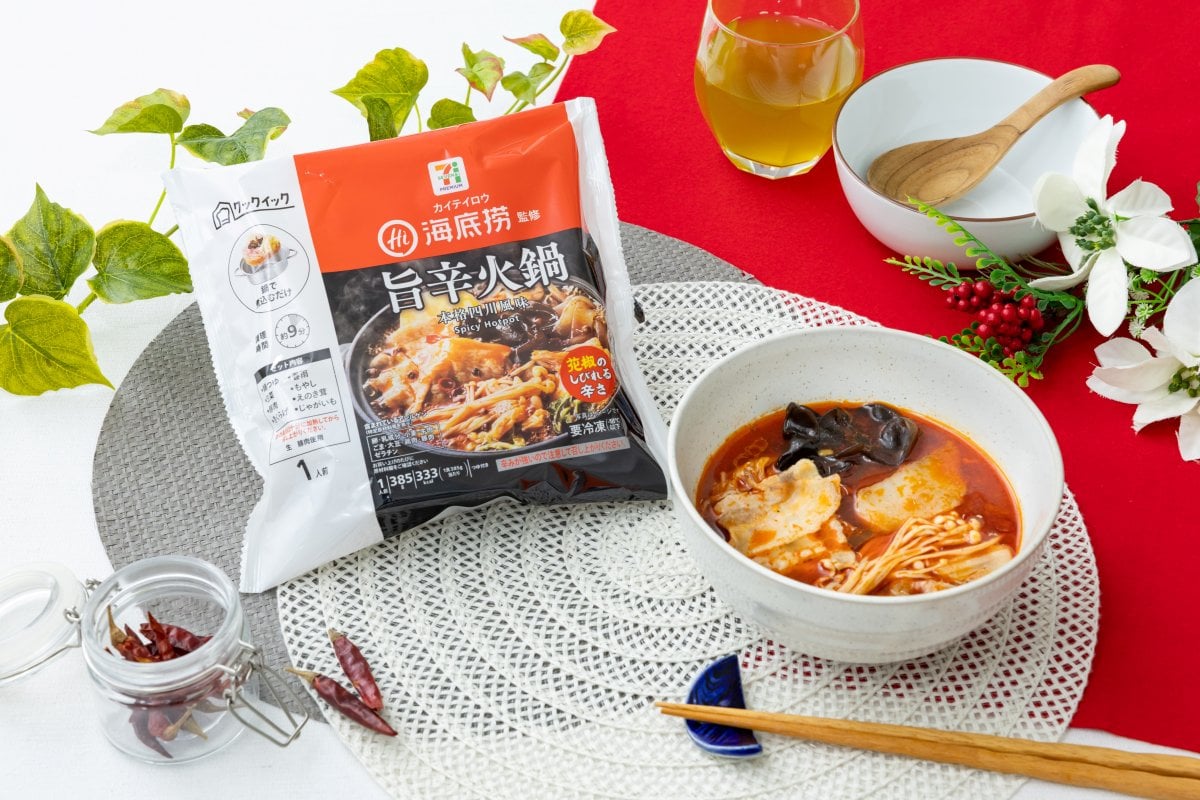
On July 21, Seven-Eleven Japan began a 順次発売 (junji hatsubai, rolling release) of its first frozen product supervised by the globally popular hot pot brand Haidilao. The new item, セブンプレミアム 海底撈監修 旨辛火鍋 (Sebun Puremiamu Kaitairō kanshū umakara hinabe), is priced at 699.84 yen (tax included) and is available at Seven-Eleven stores across Japan.
With more than 1,500 locations in 18 countries and regions, Haidilao is one of the most recognized hot pot brands in the world. Now, Japanese customers can enjoy its flavor at home—no restaurant reservation required.
An Authentic Hot Pot Experience at Home
The product is released under Seven-Eleven’s frozen food series designed to deliver restaurant-quality meals at home. This hot pot is produced under the 監修 (kanshū, supervision) of Haidilao, meaning the brand directly oversaw the flavor development.
The result is a 本格的 (honkakuteki, authentic) hot pot experience.
The soup is made with a rich beef-bone base combined with a house-made chili oil containing nine different spices. Each bite delivers a fragrant aroma, a pleasant 痺れ (shibire, numbing sensation), and deep umami from the beef broth. The spicy yet savory flavor—called 旨辛(うまから) (umakara) in Japanese—is designed to 食欲をかき立てる (shokuyoku o kakitateru, stimulate your appetite), even during the hot summer months.
Interestingly, the article notes that hot pot has recently been gaining popularity especially among young people and women in Japan. Spicy food in summer? In Japan, that combination is increasingly trendy.
All-in-One Convenience
One of the biggest selling points is convenience.
The frozen package includes all the essential ingredients:
- Glass noodles
- Pork
- Chinese cabbage
- Bean sprouts
- Enoki mushrooms
- Potatoes
Everything comes pre-set in the container. You simply heat it in a pot for about eight minutes—冷凍のまま鍋で8分加熱するだけで完成 (reitō no mama nabe de hachifun kanetsu suru dake de kansei)—and it’s ready to eat.
The grammar point 〜するだけで (~suru dake de) means “just by doing.” So here, it means “just by heating it for 8 minutes.” No complicated preparation needed.
You can also add your own favorite ingredients to customize it, making it easy to recreate a restaurant-style hot pot experience at home.
A Meal to Care for Yourself
According to the product representative, the item was developed with the idea that people could enjoy popular hot pot flavors even during busy daily routines. The goal was to create a meal that allows you to 自分を労わる (jibun o itawaru), meaning “to take care of yourself” or “treat yourself kindly.”
In Japanese culture, this idea of small daily self-care—especially through food—is deeply valued. A warm, comforting dish after a long day can be a way to relax and refresh both body and mind.
The company expressed hope that this hot pot would provide a moment to take a breath and feel refreshed.
Cultural Context: Why Is Hot Pot So Popular?
Hot pot, known as 火鍋 (hinabe), originates from China and is especially famous for its spicy Sichuan-style broth. In recent years, it has become popular in Japan, particularly among younger generations.
The appeal?
- Customizable ingredients
- Bold, spicy flavors
- A social, shareable dining experience
Now, with this frozen version, that experience becomes accessible even when you’re busy or dining alone.
Learn Japanese from This Article
Key Vocabulary
| Japanese | Romaji | Meaning |
|---|---|---|
| 監修 | kanshū | supervision; produced under supervision |
| 順次発売 | junji hatsubai | rolling release |
| 本格的 | honkakuteki | authentic; full-scale |
| 旨辛(うまから) | umakara | tasty and spicy |
| 痺れ | shibire | numbing sensation |
| 食欲をかき立てる | shokuyoku o kakitateru | to stimulate appetite |
| 自分を労わる | jibun o itawaru | to take care of oneself |
Grammar Spotlight
1️⃣ 〜中(ちゅう) — “in the middle of; during”
Example from the article’s context:
- 忙しい日々の中でも楽しめる Isogashii hibi no naka demo tanoshimeru “You can enjoy it even during busy days.”
〜中 shows something happening within a period or situation.
Other examples:
会議中です。 Kaigi-chū desu. “I’m in a meeting.”
仕事中に電話がありました。 Shigoto-chū ni denwa ga arimashita. “I got a call during work.”
2️⃣ 〜するだけで — “just by doing”
Structure: Verb (dictionary form) + だけで
Example:
- 8分加熱するだけで完成します。 Hachifun kanetsu suru dake de kansei shimasu. “It’s finished just by heating it for 8 minutes.”
More examples:
読むだけでわかります。 Yomu dake de wakarimasu. “You’ll understand just by reading.”
押すだけで始まります。 Osu dake de hajimarimasu. “It starts just by pressing (a button).”
This structure is extremely common in advertisements in Japan because it highlights convenience.
Useful Expression
- ほっと一息つく Hotto hitoiki tsuku “To take a breather” / “To relax for a moment”
You’ll often see this phrase in food and lifestyle marketing.
Continue Learning
📚 Working on your reading skills? Our Katakana Essentials: Adapting Global Words to Japanese lesson is a great next step.
📚 Working on your reading skills? Our Introduction to Kanji: Pictorial Foundations of Japanese Script lesson is a great next step.
Introduction to Kanji: Pictorial Foundations of Japanese Script
📚 Ready to dive deeper? Our lesson on Basic Vocabulary Building: Embracing Words Without Latin Ties will help you master these concepts.
Basic Vocabulary Building: Embracing Words Without Latin Ties
これからもよろしくお願いします。 Kore kara mo yoroshiku onegaishimasu.