
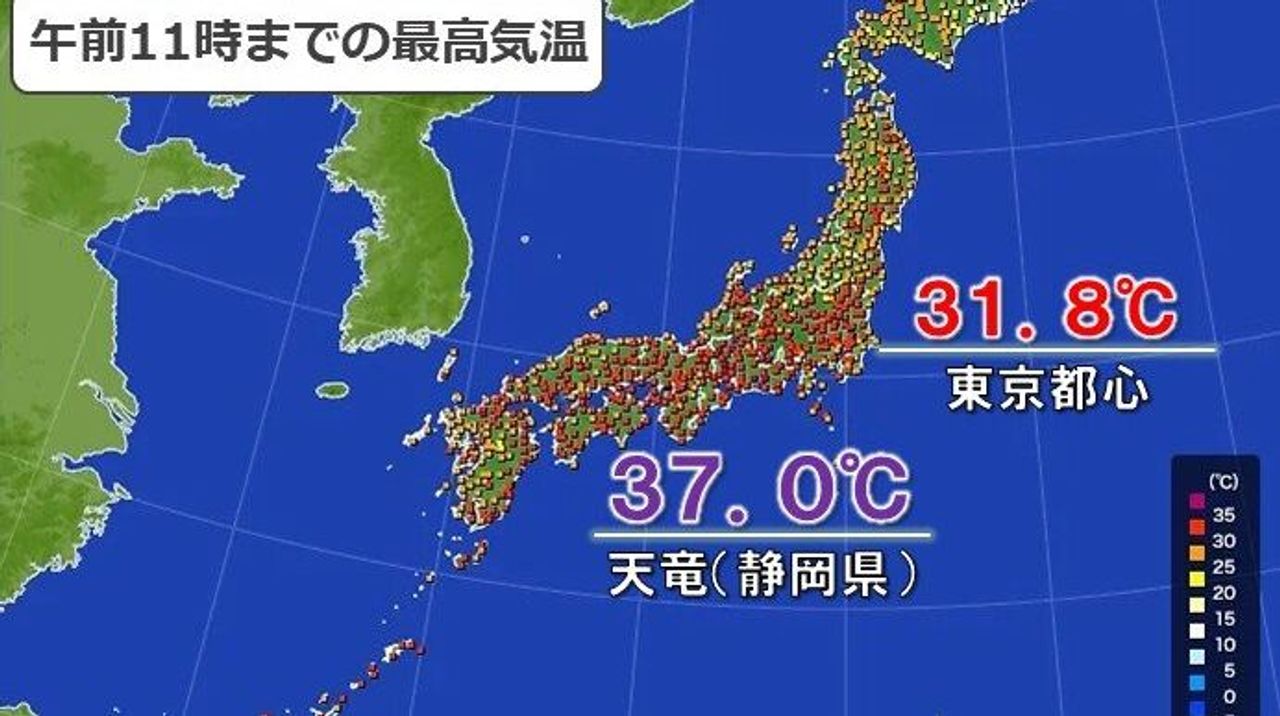
On July 16, temperatures in Tenryū, Shizuoka Prefecture reached a scorching 37.0°C by 11 a.m., according to official reports. Across Japan, 猛烈(もうれつ)な暑さ (mōretsu na atsusa) — fierce, intense heat — has taken hold.
In central Tokyo, this marked the third straight day of 真夏日(まなつび) (manatsubi), and there is a real possibility that the capital could experience its first 猛暑日(もうしょび) (mōshobi) of the year.
What’s Happening Across Japan
The Japan Meteorological Agency reported that Tenryū 観測(かんそく) (kansoku) — recorded — a high of 37.0°C before noon. That temperature already exceeds the threshold for a 猛暑日(もうしょび) (mōshobi), which refers to a day when the high reaches 35°C or more.
Meanwhile, central Tokyo has experienced 3日連続(みっかれんぞく) (mikka renzoku) of 真夏日(まなつび) (manatsubi), meaning daily highs of at least 30°C for three consecutive days. Forecasters warn that July 16 could become Tokyo’s first 猛暑日(もうしょび) of the year.
Looking ahead, the three-day holiday beginning on July 18 may also bring extreme heat to some areas. Officials are urging people to 厳重(げんじゅう)に警戒(けいかい) (genjū ni keikai) — exercise strict caution — against 熱中症(ねっちゅうしょう) (necchūshō), or heatstroke.
Why These Terms Matter in Japan
Japan has very specific weather vocabulary. Rather than simply saying “hot day,” meteorologists use precise temperature categories:
- 真夏日(まなつび) (manatsubi): High of 30°C or more
- 猛暑日(もうしょび) (mōshobi): High of 35°C or more
You’ll hear these words frequently in summer news reports. They’re not casual expressions — they’re official classifications used nationwide. This precision reflects how seriously Japan monitors seasonal weather patterns.
The repeated warnings about 熱中症(ねっちゅうしょう) (necchūshō) also show how dangerous summer heat can be. News programs often emphasize prevention, especially during long holidays when people may spend extended time outdoors.
Learn Japanese from This Article
Let’s break down the key vocabulary and grammar used in the report.
Key Vocabulary
| Japanese | Romaji | Meaning |
|---|---|---|
| 猛烈 | mōretsu | fierce, intense |
| 観測 | kansoku | observation (meteorological) |
| 真夏日 | manatsubi | day with a high of 30°C or more |
| 猛暑日 | mōshobi | day with a high of 35°C or more |
| 3日連続 | mikka renzoku | three consecutive days |
| 厳重に警戒 | genjū ni keikai | to exercise strict caution |
| 熱中症 | necchūshō | heatstroke |
Notice how many of these are compound kanji words. Learning to recognize patterns like 連続 (renzoku, continuation) or 警戒 (keikai, caution) will greatly improve your news-reading ability.
Grammar Spotlight
1. 〜となっている
Meaning: “has become” / “is in the state of” (formal, often used in news)
Example from the article context:
- 東京都心では3日連続の真夏日となっている。 Tōkyō toshin de wa mikka renzoku no manatsubi to natte iru. “In central Tokyo, it has become three consecutive days of manatsubi.”
This pattern is common in news reports because it sounds objective and formal. Instead of simply saying “is,” reporters use 〜となっている to describe an ongoing state.
2. 〜となる可能性がある
Meaning: “There is a possibility that ~ will become”
- 今日16日は今年初の猛暑日となる可能性がある。 Kyō jūroku-nichi wa kotoshi hatsu no mōshobi to naru kanōsei ga aru. “There is a possibility that today, the 16th, will become the first mōshobi of the year.”
You’ll often see 可能性(かのうせい) (kanōsei, possibility) in forecasts and predictions.
Useful Expression
- 熱中症に厳重に警戒が必要です。 Necchūshō ni genjū ni keikai ga hitsuyō desu. “Strict caution against heatstroke is necessary.”
This phrasing is very typical in public safety announcements.
Continue Learning
Weather reports are full of useful kanji and formal expressions. Strengthen your reading skills with these lessons:
- Reading and Writing in Japanese II: Hiragana and Katakana: Ready to dive deeper? Our lesson on Reading and Writing in Japanese II: Hiragana and Katakana will help you master these concepts.
- Introduction to Kanji: Pictorial Foundations of Japanese Script: Working on your reading skills? Our Introduction to Kanji: Pictorial Foundations of Japanese Script lesson is a great next step.
- Basic Vocabulary Building: Embracing Words Without Latin Ties: Want to learn more about general? Check out our lesson on Basic Vocabulary Building: Embracing Words Without Latin Ties.
Summer in Japan isn’t just hot — it’s precisely measured, carefully reported, and taken very seriously. Mastering this weather vocabulary brings you one step closer to understanding Japanese news the way people in Japan do.
これからもよろしくお願いします。 Kore kara mo yoroshiku onegaishimasu.