
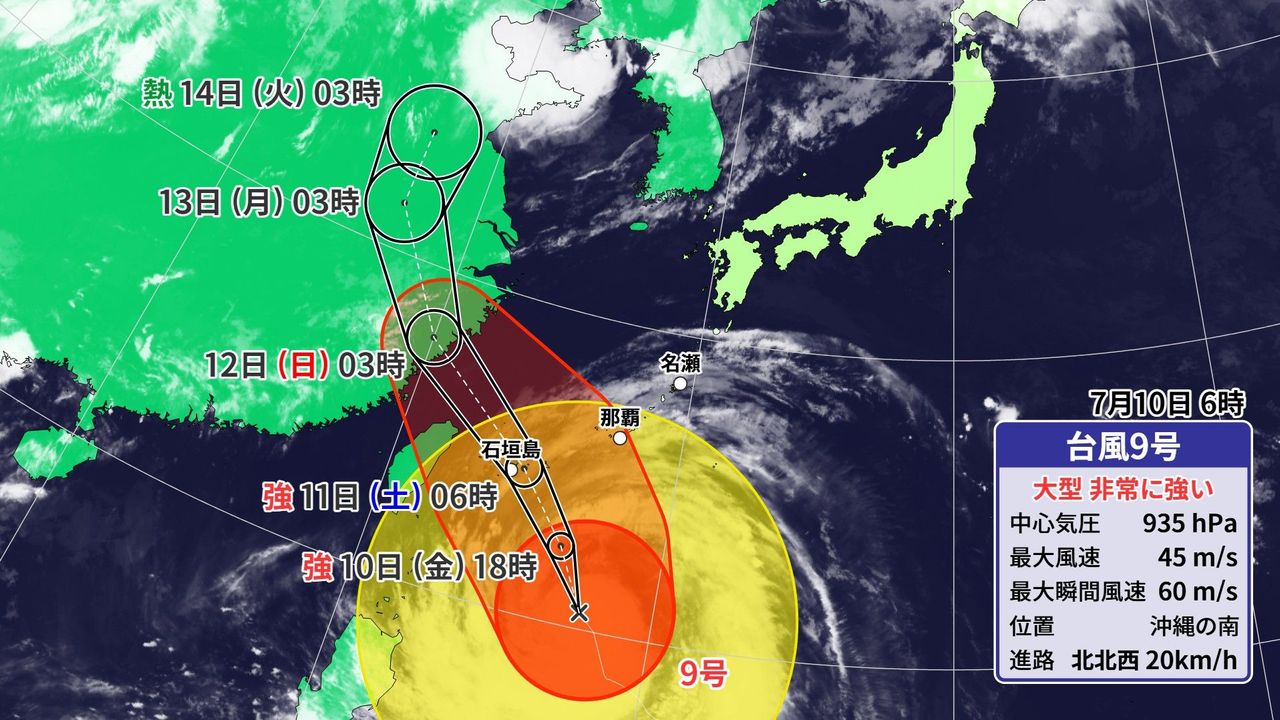
Typhoon No. 9 is approaching Okinawa, and forecasters warn that violent winds could last for many hours. At the same time, other parts of Japan are bracing for extreme heat, with temperatures expected to reach as high as 37°C in some cities.
Typhoon No. 9 Approaches Okinawa
In Okinawa, particularly around the Sakishima Islands, 台風9号 (taifū kyū-gō, Typhoon No. 9) is making its 接近 (sekkin, approach). Starting today (Friday), rain and wind are expected to grow stronger, leading to stormy weather conditions.
Forecasters say there is a risk that 暴風 (bōfū, violent winds) could continue for a long period. Because of this, residents are urged to exercise 警戒 (keikai, caution or alertness).
The phrase used in the report is:
- 暴風が長い時間続くおそれがある
- bōfū ga nagai jikan tsuzuku osore ga aru
- “There is a risk that violent winds will continue for a long time.”
We’ll look more closely at this grammar pattern below.
Extreme Heat Across the Country
While Okinawa prepares for stormy weather, much of the rest of Japan is experiencing clear skies and intense heat.
Temperatures of 35°C or higher—known in Japanese as 猛暑日 (mōshobi, an extremely hot day)—are expected to occur one after another. The report uses the word 続出 (zokushutsu), meaning “to occur in succession” or “to appear one after another.”
In Saga and Kumamoto, temperatures are forecast to rise as high as 37°C, creating what the report calls “dangerous heat.”
Authorities are warning people to be careful about 熱中症 (necchūshō, heatstroke).
The forecast says:
- 猛暑日になる所が続出となるでしょう
- mōshobi ni naru tokoro ga zokushutsu to naru deshō
- “Places becoming extremely hot days (35°C+) are likely to appear one after another.”
Cultural Context: Typhoons and Heat in Japan
Typhoons are a regular part of summer and early autumn in Japan. They are numbered in order—台風9号 simply means “Typhoon No. 9” of the season. Okinawa, located in the far south, often experiences typhoons before the rest of the country due to its geographic position.
At the same time, mainland Japan can experience severe heat waves. The term 猛暑日 is officially defined as a day when temperatures reach 35°C or higher. You’ll frequently hear this word in summer weather reports.
Heatstroke, or 熱中症, is taken very seriously in Japan. Public announcements, school guidelines, and workplace policies often stress prevention during periods of extreme heat.
Understanding these weather terms is essential if you follow Japanese news—or if you plan to spend a summer in Japan.
Learn Japanese from This Article
Key Vocabulary
| Japanese | Romaji | Meaning |
|---|---|---|
| 接近 | sekkin | approach |
| 暴風 | bōfū | violent wind, gale |
| 警戒 | keikai | alert, caution |
| 猛暑日 | mōshobi | extremely hot day (35°C or higher) |
| 続出 | zokushutsu | to occur one after another |
| 熱中症 | necchūshō | heatstroke |
Try reading the original sentence again and see how many of these words you can now recognize.
Grammar Spotlight ①: 〜おそれがある
Meaning: “There is a risk that…” / “There is a possibility that…”
Structure: Verb (dictionary form) + おそれがある
Example from the article:
- 暴風が長い時間続くおそれがある。 Bōfū ga nagai jikan tsuzuku osore ga aru. There is a risk that violent winds will continue for a long time.
More examples:
台風が接近するおそれがある。 Taifū ga sekkin suru osore ga aru. There is a risk that a typhoon will approach.
気温が40℃まで上がるおそれがある。 Kion ga yonjū-do made agaru osore ga aru. There is a possibility that temperatures will rise to 40°C.
This expression is common in news reports and formal warnings.
Grammar Spotlight ②: 〜となりそうです/〜になりそうです
Meaning: “It is likely to become…” / “It seems it will…”
Structure:
- Noun + になりそうです
- Noun + となりそうです (more formal, often in news)
Example from the article:
荒れた天気となりそうです。 Areta tenki to nari sō desu. It is likely to become stormy weather.
危険な暑さになりそうです。 Kiken na atsusa ni nari sō desu. It is likely to become dangerously hot.
You’ll hear this pattern constantly in weather forecasts.
Useful Expressions
警戒が必要です。 Keikai ga hitsuyō desu. Caution is necessary.
熱中症に注意が必要です。 Necchūshō ni chūi ga hitsuyō desu. Caution against heatstroke is necessary.
Both are standard phrases in Japanese public announcements.
Continue Learning
Ready to strengthen your reading skills?
- Reading and Writing in Japanese II: Hiragana and Katakana: Ready to dive deeper? Our lesson on Reading and Writing in Japanese II: Hiragana and Katakana will help you master these concepts.
- Introduction to Kanji: Pictorial Foundations of Japanese Script: Working on your reading skills? Our Introduction to Kanji: Pictorial Foundations of Japanese Script lesson is a great next step.
- Basic Vocabulary Building: Embracing Words Without Latin Ties: To understand more about general, explore our Basic Vocabulary Building: Embracing Words Without Latin Ties lesson.
Weather reports are one of the best ways to build practical Japanese. They’re repetitive, vocabulary-rich, and deeply connected to everyday life.
これからもよろしくお願いします。 Kore kara mo yoroshiku onegaishimasu.